

Machining a plastic part is often the fastest way to get a hundred units that behave like the final product. It is also, above a certain quantity, an expensive way to avoid a tool. The comparison between machining and low volume molding is one of the most useful exercises in a product program, because it shows exactly where the tooling investment starts to pay, and because both routes can produce saleable parts in the production resin. This guide covers how the two cost structures behave, where each route’s geometry limits lie, and how to plan the migration from one to the other.
Should a plastic part be machined or molded?
Machine the first units, mold once the tool pays back.
Machining has no tooling cost and is economical at low quantities, while molding has a fixed tool cost and a much lower cost per part, so the choice follows the quantity and the geometry.
Machining’s advantage is that it requires nothing but a program and a block of plastic. Parts can be produced in days, dimensions can be held tightly, and a design change means a new program rather than a tool modification. For an initial batch of tens or low hundreds of units, that combination is hard to beat.
Molding’s advantage is repeatability at volume. Once a tool exists, parts are produced in a single cycle with no per-part machining time, and the cost per part falls accordingly. The tool is a fixed cost, and the question is simply whether the quantity expected justifies it.
The geometry then constrains the answer. Machining is limited by tool access: sharp internal corners always carry the cutter’s radius, deep narrow pockets are difficult, and features that require reaching inside a closed shape are impossible in one piece. Molding handles those features naturally, because the geometry is formed rather than cut, provided the part can be ejected from the tool.
How do the cost curves behave at 100, 1,000 and 10,000 units?
Machining is flat; molding falls steeply.
Machined parts carry a roughly constant cost per part, while molded parts carry a fixed tool cost and then a much lower unit cost, so the two cross at a quantity that depends on the part.
At one hundred units, machining usually wins. The cost per part is set by machine time and material, and there is no tool to amortise. Molding at that quantity carries the entire tool cost across a hundred units, which makes the unit price high even though the running cost is low.
At one thousand units, the position depends on the part. A small, simple component may already be cheaper molded; a large part with several machining operations may still favour machining, particularly where the tool would need side actions. This is the range where getting the answer wrong is most expensive, because the tool decision is close enough to be justified either way.
At ten thousand units, molding usually wins decisively for parts within its design rules. The tool cost is spread across enough units to be minor, and the low running cost takes over. Where the part has features that a tool cannot produce, machining or a hybrid route remains the answer regardless of volume.
| Factor | CNC machining | Low volume molding |
|---|---|---|
| Tooling | None | Fixed tool cost |
| Cost per part | Roughly constant | Falls with quantity |
| Sharp internal corners | Limited by cutter radius | Formed by the tool |
| Deep narrow features | Difficult; tool deflection | Possible with the right tool design |
| Design change | Reprogram | Modify the tool |
| Typical use | First units, complex one-offs, prototypes | Repeat production in the production resin |
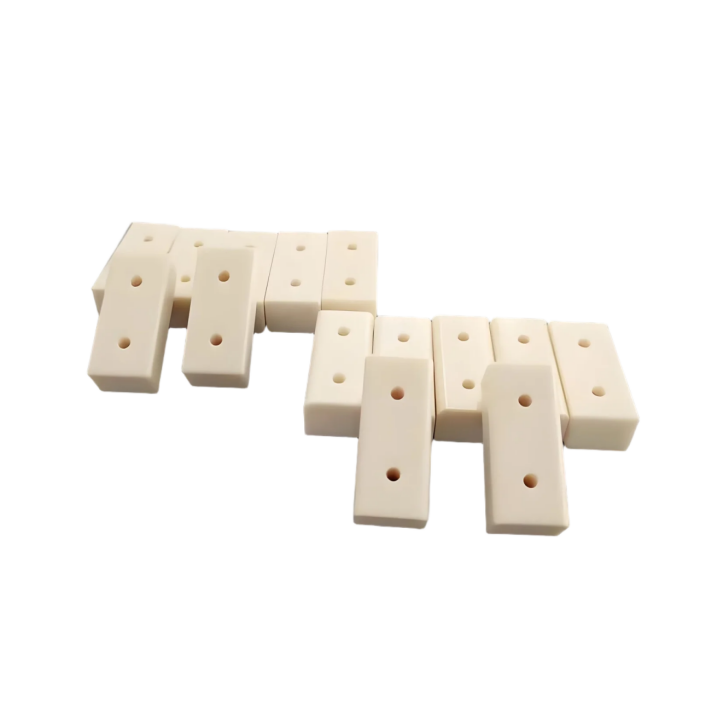
What are the geometry limits of machining plastic?
Tool access, and the material’s own behaviour.
Machining cannot produce sharp internal corners, struggles with deep narrow pockets, and can distort thin plastic sections through clamping and cutting forces.
The first limit is geometric. A rotating cutter leaves its radius in every internal corner, so a design that requires a sharp 90-degree internal corner cannot be machined as drawn. Deep pockets with narrow openings become harder as the depth-to-width ratio rises, because a slender cutter deflects and chatters. And features that require reaching inside a closed shape simply cannot be produced in one piece.
The second limit is material behaviour. Plastics machine differently from metals: they conduct heat poorly, so the cutter tends to rub, and they are elastic, so they spring away from the tool and then relax after the cut, which makes holding a tolerance harder than it is in aluminium. Clamping forces can also distort thin walls, particularly on parts that were designed with molded wall thicknesses in mind.
Those limits are not defects of the route, but they determine when it is the right answer. Where the part’s value lies in its geometry rather than in its quantity, machining remains competitive at high volumes simply because molding cannot produce the shape. Where the geometry is moldable, the cost comparison applies.
How do material behaviour and anisotropy differ?
Machined parts are isotropic; molded parts have flow.
Machining cuts a solid block whose properties are uniform, while molding introduces flow orientation that gives the part directional properties and a skin.
The difference matters for structural parts. A machined component has the properties of the stock material in every direction, which makes its behaviour easier to predict. A molded component has molecules oriented by flow, a distinct skin, and weld lines where flow fronts met, so its strength depends on gate position and part geometry.
That does not make the molded part weaker in service; it makes its behaviour more dependent on the design. Where a part carries a load, the gate location and the position of weld lines become design decisions, and the molded prototype is the way to validate them. A machined part sidesteps the question entirely, which is why machining is often used to validate a design before the flow behaviour is introduced.
Dimensionally, machining generally holds tighter tolerances on individual features, because the cut is controlled directly. Molding holds dimensions through the tool, with variation coming from shrinkage and process conditions. A machined prototype can therefore be dimensionally accurate while a molded production part needs its own sampling to establish the same dimensions. The test methods used to compare the two are defined by ASTM committee E28.
How does lead time compare?
Machining is faster to first part; molding to volume.
Machining requires only programming and a setup, while molding waits for a tool to be designed, machined and sampled before the first parts exist.
The machined route front-loads very little. A model and a drawing become a program, and the first parts arrive quickly. That makes machining the practical choice whenever parts are needed for a review, a customer sample or a first production batch before the tool is ready.
The molded route front-loads the tool. Design, machining and sampling take time before any parts are produced, so the first molded parts arrive later than the first machined parts. After that point, production rate is limited by machine capacity rather than by per-part cut time, and the schedule becomes much faster per unit.
The practical planning conclusion is that the two routes can run in sequence: machine the parts needed for the early stage while the tool is being prepared, then switch to molded parts once sampling is approved. That sequence uses each route where it is strongest, and it avoids the situation where a program waits for a tool it did not need yet. The plastic machining route that supports the first stage is described in the 6CProto article on plastic CNC services.
When does machining cover the bridge period?
When the tool is being built and parts are still needed.
Machining covers the interval between design freeze and the first approved molded parts, and it does so without adding a second tooling investment.
The bridge period is a genuine gap in most programs. The design is settled, so the parts have to be representative; the tool is not ready, so they cannot be molded. Machining fills that gap with parts in the production resin, produced to the same design, which keeps the launch or the customer shipment moving.
Two conditions make it work. The material should be the same grade the molding will use, so the parts are comparable, and the dimensional requirements should be ones machining can meet, which for plastic parts usually means avoiding very thin sections and features that distort under clamping. Where the geometry is not machinable in one piece, the alternative is to accept a printed part for the bridge period and to treat its material difference as a known limitation.
The cost of the bridge matters less than the schedule it protects, which is why the decision is usually straightforward. Where a program needs a few hundred parts before the tool is approved, machining them is generally cheaper than delaying the launch.
How does a program migrate from machining to molding?
With a documented handover, not a restart.
The machined parts establish the dimensions, the material and the acceptance criteria; the molded tool is then built and sampled against that reference.
The machined batch is more useful than its quantity suggests, because it establishes what an acceptable part is. Dimensional results from the machined parts, the resin grade used and the acceptance method form the reference that the molded tool’s sampling is measured against. Without them, the molded program starts by renegotiating what the part should be.
The tool design then benefits from what the machined parts revealed. Features that were difficult to cut, sections that distorted under clamping, and interfaces that needed adjustment are all known before the tool is designed, which is precisely the information a tooling review would otherwise have to assume.
The migration is complete when the molded parts are approved against the same criteria. At that point the machined route has served its purpose, and any remaining demand is met by molding. Where the program runs for a long period, the machined parts remain the reference for the tool, and the documented results are what make a second tool possible without repeating the process. The low-volume molding route that follows is described on the low volume injection molding page, and the material specifications behind both routes are published by ASTM committee D20.
Getting the comparison right
The comparison between machining and molding is a question about quantity, geometry and change tolerance rather than a preference between processes. Machining wins at low volume, on complex one-off geometry and wherever the design is still moving. Molding wins once the quantity justifies a tool, the geometry suits a cavity, and the design is settled enough that a tool modification is unlikely. The resin behaviour that decides many of those cases is documented by ASTM committee D20 and by materials bodies such as ASM International.
The useful practice is to price both routes at the quantity in question, with the same material and the same finishing scope, and to include the cost of a design change under each. Where the answer remains close, the deciding factor is usually which route protects the schedule. The broader low-volume production context is described on the low volume manufacturing page, and the quality practices that support both routes are published by NIST MEP.
FAQ
Is injection molding the same as CNC machining?
No. Machining removes material from a solid block using a cutting tool, which allows tight tolerances and fast first parts but limits geometry to what the tool can reach. Injection molding injects molten resin into a cavity, which requires a tool but produces parts at a low cost per unit and creates geometry that machining cannot reach, such as sharp internal corners and deep narrow features.
What are the downsides of machining plastic parts?
Three are common. Sharp internal corners cannot be produced because every cutter leaves a radius. Deep, narrow features are difficult because slender tools deflect. And plastic is elastic and conducts heat poorly, so it tends to spring away from the cutter and hold tolerances less predictably than metal. Thin sections also distort under clamping. None of these is a defect, but each affects what should be machined.
At what quantity does molding become cheaper than machining?
It depends on the part, the tool and the cycle time rather than on a standard number. The crossover is the quantity where the tool cost divided by the run, plus the molded cost per part, falls below the machined cost per part. Pricing both routes at the volume in question is the only reliable way to find it, and the answer frequently falls in the hundreds rather than the thousands for small parts.
Can machined parts and molded parts be mixed in one product?
Yes, and it is common during a transition. Early units may use machined components while later ones use molded components, provided the interfaces and material match and the design is identical between the two. The risk is dimensional drift between the routes, which is why the machined batch should be measured and documented so that the molded parts can be compared against it rather than against an assumption. The test methods referenced in this article are published by ASTM committee B08.
If a part is being produced by machining now and molded later, send the model with the quantity and the interfaces that must match. 6CProto runs CNC machining and low volume injection molding in the same facility, so both routes can be quoted from one manufacturing review and the transition planned in sequence. Upload the file at the 6CProto quote page or send it to projects@6cproto.com.