

Why Plastic CNC Earns Its Place Between Printing and Molding
Plastic CNC machining sits in a useful gap in the manufacturing lineup. It is faster than injection molding because no steel tool exists, and it is stronger and more accurate than 3D printing because the part starts as solid, isotropic stock rather than fused layers. That makes it the default for engineering teams that need functional parts in days, in real engineering-grade polymers, without the tooling cost of a mold. The trade is that machining removes material, so it cannot reproduce the internal draft, knit lines, or deep undercuts that molding creates for free.
Companies across aerospace, defense, automotive, medical devices, and consumer electronics rely on plastic CNC for prototypes, low-volume runs, and custom parts that never justify a mold. The rest of this guide covers the processes, the materials, and the sourcing decisions that keep those parts on tolerance. The right rule of thumb: plastic CNC is the answer when the part is solid, when tolerance and strength matter, and when volume does not justify tooling.
The Core Machining Capabilities
Plastic CNC is a subtractive process: computer-controlled cutting tools remove material from a solid block or sheet of polymer stock. Polymers differ from metals in three ways that drive the process: higher thermal expansion, lower stiffness, and low melting points. Achieving tight tolerances requires chip control, correct feed rates, and thermal management to prevent warping, cracking, or surface melting.
- CNC milling (3-axis and 5-axis). Rotating multi-point cutters remove material across multiple axes, producing complex 3D geometries, undercuts, enclosures, and internal features. Multi-axis setups reach industrial tolerances around plus or minus 0.025 mm, with specialized precision setups going further for critical aerospace and medical features.
- CNC turning and lathe work. The workpiece rotates against sharp cutting tools at high speed, producing roundness, surface finish, and dimensional control for cylindrical parts. This is the primary route for bushings, bearings, rollers, shafts, and fluid-handling fittings.
- Precision routing and laser cutting. Routing profiles large sheet plastics at speed, while CO2 laser cutting delivers edges that are clean and often optically clear on transparent materials without manual post-processing. Laser works well for 2D profiles and engraving; it cannot cut blind cavities or thick walls the way a mill can.
 `n
`n
The process choice follows the geometry, not the machine: rotationally symmetric parts go to the lathe, enclosures and features go to the mill, and flat profiles go to routing or the laser. Teams that skip that matching step pay for it in setups and scrap.
The Engineering Plastics That Actually Get Machined
The polymer determines the mechanical threshold and the regulatory compliance of the part. These are the materials that dominate plastic CNC work, and each earns its place through a specific combination of properties:
- Acetal (POM, Delrin). Excellent machinability, stiffness, low friction, high wear resistance, and low moisture absorption make it the default for precision gears, bearings, bushings, fuel-system components, and sliders.
- PEEK. Extreme thermal stability, chemical inertness, and a high strength-to-weight ratio put it in aerospace, medical, and high-temperature roles where performance matters more than cost.
- Acrylic (PMMA). Optical clarity, weatherability, and easy polishing suit lenses, protective covers, and transparent enclosures.
- Nylon (polyamide). Toughness, wear resistance, and self-lubricating behavior are the reasons it appears in gears, wear pads, and mechanical parts, though machining nylon demands attention to moisture conditioning and chip control.
- PTFE. Chemical inertness and the lowest friction of the group make it the answer for seals, bearings, and chemical handling components. Its softness rewards sharp tools and stable fixturing.
- UHMW-PE. Self-lubricating, impact-resistant, and wear-resistant, it appears in heavy wear pads, chutes, and fluid-handling parts.
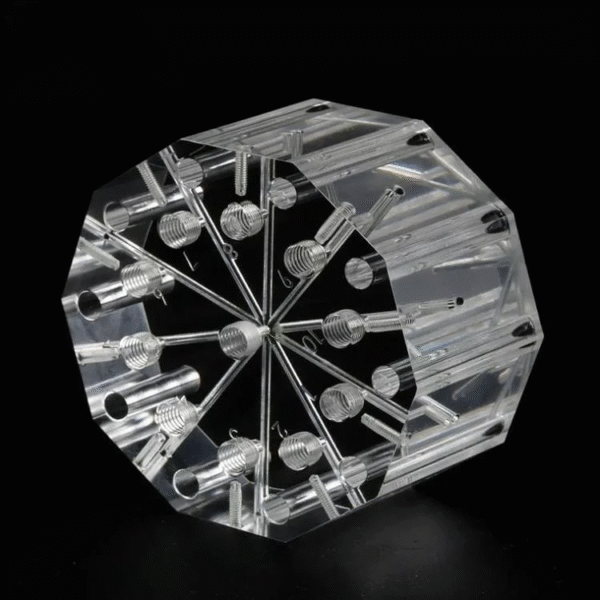
Selection is a test against the environment, not a preference for a marketable name. A gear that carries load and runs dry wants acetal; a bearing in a chemical washdown area wants PTFE; a window that must stay clear wants acrylic; a structural part near a hot motor wants PEEK. When a requirement is not met by one grade, the answer is usually a different family, not a higher-priced version of the same one.
Why Plastic Machining Temps and Tolerances Are Tricky
Plastic CNC is not just machining a softer metal. The material’s thermal expansion means a part can grow during cutting and shrink as it cools, so every tolerance must be set against a defined measurement temperature. Thin walls deflect under tool pressure. Deep pockets need longer tools that flex at the tip. And hygroscopic materials like nylon absorb moisture, shifting dimensions over time.
The practical response is process discipline. Sharp, positive-rake tool geometries minimize friction and cutting force, and high-volume chip extraction with cooling fluids or air blasts removes heat before it softens the part. Light, consistent finishing passes take the tolerance-critical surfaces to final size while the part is at a stable temperature. A shop that treats plastic as a scaled-down metal job produces melting, warpage, and scrap; a shop that manages the thermal story holds tolerances that surprise buyers in a good way.
Supply Chain Realities: Grades, Certification, and Dedicated Lines
The machining is only part of the story. A “PEEK” or “nylon” quote is only as good as the grade certificate behind it, and the raw stock condition changes the result. Material certification matters for every serious application but is non-negotiable for medical and food-contact parts, where the raw stock must be sourced from certified grades and the machining line may need to be dedicated to non-metallic work to avoid metallic contamination.
When comparing plastic CNC suppliers, check which grades are actually stocked rather than merely listed, ask what machine precision is demonstrated rather than advertised, look for inspection depth such as CMM and first-article reports, and confirm regulatory readiness including ISO 9001 quality systems, RoHS compliance, and medical-grade sourcing. Ask for a sample inspection report before committing a critical part. A supplier that answers with documents rather than promises is one whose line discipline will carry through to your parts.
Surface Finish and Secondary Operations
Raw machined plastic is often not the finished product. Functional parts may be vibratory finished, media blasted, or polished to spec; optical parts go through progressively finer polishing to remove tool marks; and cosmetic parts are brushed or textured to a defined finish class. The finish sequence belongs on the drawing, because the roughness on a sealing face and the appearance on a visible face are different specifications and different inspection criteria.
Specify which surfaces are functional and which are cosmetic, and what roughness value applies to each. Machined acrylic can be returned to near-optical clarity by polishing, but the polish budget and the tolerance interplay: polishing removes material, so critical dimensions should either be cut to final size after polishing or measured with the finish applied. Define the final surface and let the process sequence follow.
Applications Across Industries
Plastic CNC appears wherever a functional prototype or a low-volume production part is needed faster than a mold can be cut. In aerospace and critical systems, PEEK and acetal parts carry load and survive temperature where printed parts cannot be trusted. In medical devices, certified-grade PEEK, PTFE, and acetal parts run on dedicated non-metallic lines with material traceability and full inspection documentation. Fluid handling and industrial equipment use PTFE seals, UHMW-PE wear pads, and acetal fittings for low friction, chemical resistance, and stable dimensions in continuous service. Consumer electronics teams test drop tolerance and snap-fit assemblies with fast-turn thin-walled prototypes in production plastics before committing to steel injection molds.
The common thread is that each application picks the polymer for the environment, then picks the process for the geometry and the volume. 6CProto’s CNC machining materials page lists the stocked plastic grades so the material question is settled before the quote, and the CNC machining services include plastic milling and turning in-house. For parts that graduate to higher volume, injection molding converts a machined pilot into a molded production part, and surface finishing covers the polishing, blasting, and texturing steps. The tolerance discussion in the article “CNC Machining Tolerances: A Practical Guide” explains how plastic CNC tolerance claims should be evaluated.
Plastic grade names and machining terminology in this guide follow the conventions used by the standards bodies that publish polymer and machining specifications, such as ASTM (ASTM standards). Naming the standards family on the drawing, not just the grade, closes the last ambiguity in the specification.
`n
FAQ
Why is CNC plastic stronger than a 3D printed plastic part?
Machined parts start from solid, extruded, or molded stock with isotropic properties, so strength is consistent in every direction. 3D printing builds in layers, and layer adhesion creates an anisotropic weakness, particularly across the build direction, and uses modified resin formulations that differ from the bulk material.
Can plastic CNC meet medical and food-contact requirements?
Yes, when certified medical-grade or food-safe raw stock is sourced and parts are machined on dedicated non-metallic lines under a documented quality system, with material traceability, RoHS compliance, and first-article documentation. The certification belongs to the raw material and the process line, not to the machine alone.
What files are required for a plastic CNC quote?
A complete 3D CAD model in a standard exchange format such as STEP or IGES, plus a 2D engineering drawing in PDF when assembly-critical tolerances, finishes, or inspection setups need to be stated. The drawing is what turns a good model into an unambiguous contract.