

Overmolding exists because a single material rarely does everything a part needs. A structural core carries the load while a soft outer layer provides grip, sealing or appearance, and the two are joined in the mold rather than assembled afterwards.
How overmolding is done
There are two common routes. In insert overmolding, a pre-formed substrate — usually a molded or machined rigid part — is placed into a second mold and the soft material is injected around it, bonding mechanically, chemically or both. In two-shot molding, both materials are injected in the same machine in sequence, which removes the handling step and produces a more consistent bond, at the cost of a more complex mold and a machine able to run two injection units.
| Route | How it works | Where it fits |
|---|---|---|
| Insert overmolding | Place a substrate, inject the second material around it | Lower volume, substrates that are machined or pre-molded |
| Two-shot molding | Both materials injected in one machine, in sequence | Higher volume with a consistent bond requirement |
| Silicone overmolding | Liquid silicone rubber injected onto a rigid substrate | Sealing, medical and high-temperature applications |
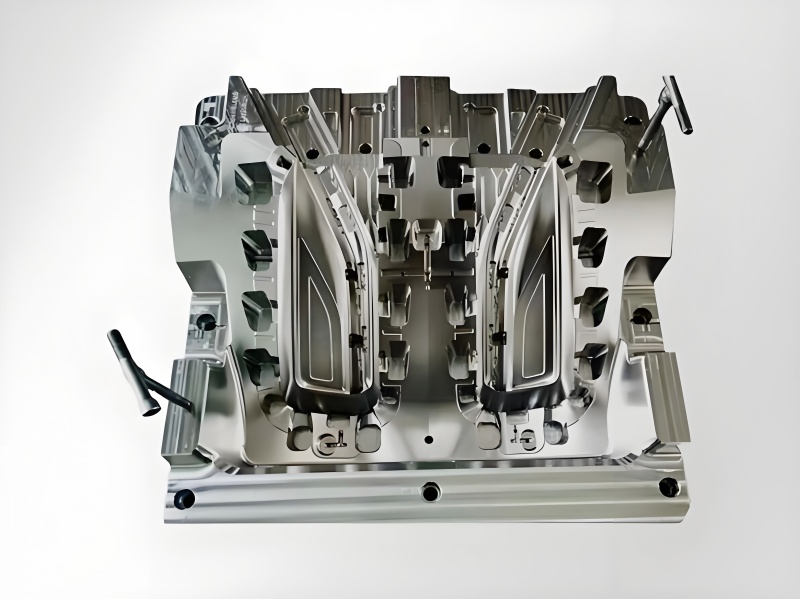
Is overmolding expensive?
The part is not, but the tooling usually is.
Overmolding adds a tooling set and a second molding operation, so the upfront cost is higher than for a single-material part. What it removes is the assembly step, the adhesive and the risk of a bond failing in the field, which is why the comparison should be against an assembled part rather than a plain molded one. At sufficient volume, the per-part cost of overmolding is often lower than the assembled alternative.
The variables that move the price are the number of shots, the mold complexity needed to hold the substrate, and the cycle time of the second material. Silicone overmolding adds its own considerations, because the material behaves differently in the barrel and needs its own tooling tolerances and temperature control.
Which substrates can be overmolded
The bond depends on the material pair as much as on the process. Thermoplastic substrates bond well with a compatible overmold material, because the two can fuse at the interface. Dissimilar pairs rely on mechanical interlocking instead, which is why the substrate design usually includes undercuts, holes or a textured surface for the second material to grip. Metal inserts can be overmolded, but they depend entirely on mechanical retention and on thermal expansion being accounted for during cooling.
Two design habits make the bond more reliable. Keep the substrate surface free of mold release and contamination, since a release agent left in place is a deliberate barrier to adhesion, and provide features that lock the overmold mechanically rather than relying on chemical bonding alone. Where the part must seal, the overmold geometry should be designed around the sealing function rather than added as a surface covering.
Design rules that prevent defects
Overmolded parts fail in predictable ways. Warp appears when the two materials shrink differently and the part is constrained; flash appears where the substrate does not seal against the mold, which is why substrate tolerances matter as much as the overmold geometry; bond failure appears where the interface is too smooth or contaminated; and short shots appear when the second material cannot flow into thin sections before it cools.
The design response is consistent. Keep the overmold wall thick enough to flow, avoid sharp transitions between materials, and give the substrate a positive mechanical feature at the interface. Where the substrate is itself molded, its shrinkage has to be accounted for in the mold that will receive it. Process and material references are published by ASM International, and the single-material cases are covered under plastic injection molding and liquid silicone rubber molding.
How to brief an overmolding project
The brief needs three things beyond the drawing: the substrate material and how it will be produced, the overmold material with its hardness or grade, and the function of each region of the part. Saying which areas must grip, seal or simply look uniform lets the supplier choose wall thickness and gate positions that serve the function rather than only fill the cavity.
Volume enters early, because the two-shot route only becomes economical at quantities that justify the tooling. For a prototype or a pilot batch, insert overmolding onto a machined or printed substrate usually gives a representative part without committing to a two-shot mold. Drawing conventions follow ASME standards, dimensional verification is described by the NIST Manufacturing Extension Partnership, additive routes for a prototype substrate are covered on the 3D printing pages, and material handling obligations are set out by the US EPA.
Prototyping a two-material part before tooling
Committing to overmolding tooling before the geometry has been validated is expensive, and there are two ways to defer it. The first is to machine the substrate and hand-place it in a simpler mold for a pilot run, which produces representative parts without a two-shot tool. The second is to print or machine the rigid substrate and cast the soft layer in a silicone tool, which reproduces the geometry and the material pair closely enough to test grip, appearance and assembly.
What neither route replaces is the bonding behaviour of the production process, which depends on melt temperature and interface design. For a part where the bond carries load, the validation has to happen on production tooling. Where the soft layer is cosmetic or provides grip, a prototype is usually enough to settle the design. Process-safety obligations for molding and cleaning operations are published by the US EPA, and material compatibility data by ASM International.
Send the two-material model with the function of each region marked, and request an overmolding quote with the tooling route stated.
FAQ
Is overmolding expensive?
The tooling is, because overmolding adds a second molding operation, but the part often costs less than an assembled alternative once adhesive, handling and bond failure are counted. The comparison should be against the assembly it replaces.
What substrates can be overmolded?
Thermoplastics bond chemically when the two materials are compatible, while dissimilar pairs and metal inserts rely on mechanical retention through undercuts, holes or texture. Surface contamination and mold release prevent bonding and must be avoided.
How do you prevent flash and warp on an overmolded part?
Control the substrate tolerances so it seals against the mold, keep the overmold wall thick enough to flow, avoid sharp transitions, and account for the different shrinkage of the two materials rather than assuming they behave alike.