

A machined valve body needs nickel plating inside a 40 mm deep bore, and the first plating quote says “electrolytic only” while the second says “electroless, no problem.” The two quotes are not competing on price; they are describing different processes with different coverage behavior. Electrolytic nickel uses an electric current and deposits where current flows, so deep recesses plate thinly. Electroless nickel is a chemical process that deposits uniformly wherever the solution can reach. For a part with internal geometry, that one difference decides which process is physically capable — and for simple external shapes, it decides which process is cheaper. Choosing correctly starts with reading the geometry, not the datasheet.
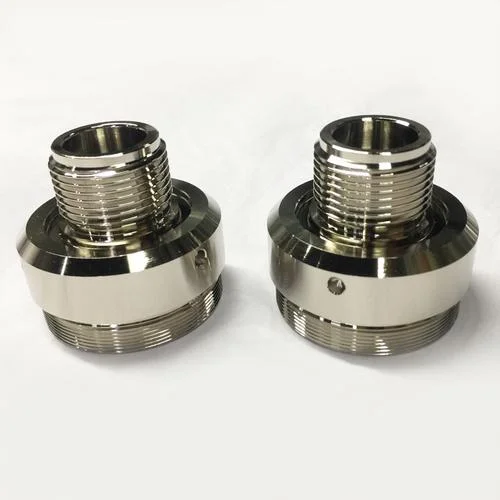
Electroless nickel deposits evenly; electrolytic follows the current
Electrolytic plating works like a battery: the part is the cathode, and nickel ions deposit where the electric field reaches. Current density is higher on edges and outer surfaces, so corners build thicker deposits while deep recesses and blind holes may plate thinly or not at all. Electroless nickel uses a chemical reducing agent in the bath, so the deposit forms evenly over every wetted surface, including internal bores and complex geometry, as long as the solution can be refreshed inside the feature.
The practical difference is not quality but coverage control. A bright electrolytic nickel finish on a simple shaft is excellent; the same process inside a blind bore leaves an unpredictable thickness. Engineers who specify “nickel plate” without saying where the functional surface is force the plater to guess, and the guess usually optimizes the visible surface, not the internal one.
Geometry decides which process can coat the functional surface
Use electroless nickel when the part has internal bores, blind holes, or complex geometry that must be coated uniformly, or when a predictable thickness is needed on close-tolerance features. Use electrolytic nickel when the part is simple and external, when a bright decorative deposit is required, or when the process cost difference matters at volume. Many parts plate best with a hybrid: an electrolytic decorative finish on visible faces and electroless where coverage matters — though that adds process steps and masking complexity.
| Decision factor | Electroless nickel | Electrolytic nickel |
|---|---|---|
| Coverage in bores and recesses | Uniform where solution reaches | Thin or missing where current is weak |
| Thickness predictability | Uniform across complex geometry | Thicker at edges and corners |
| Appearance | Matte to semi-bright, process-dependent | Can be bright and decorative |
| Typical cost driver | Chemical bath and process control | Current density and racking |
The table points to the first question in any nickel RFQ: where is the functional plated surface? If the answer is “everywhere,” electroless is usually the answer; if it is “the outside,” electrolytic may win on cost and appearance.
Hardness, corrosion, and solderability vary with phosphorus class
The two deposits differ in properties as well as coverage. Electroless nickel, especially in high-phosphorus grades, offers strong corrosion resistance and consistent hardness, and responds to heat treatment for higher wear resistance; low-phosphorus grades favor wear, while mid- and high-phosphorus grades favor corrosion and solderability. Electrolytic nickel can be bright and ductile, with hardness depending on the bath, and is often used where buildup or decorative brightness matters. State the required property — hardness, corrosion test, solderability — rather than writing “nickel,” because the phosphorus class changes all of them.
Heat treatment changes the deposit too. Baking after plating is required on hardened steels for hydrogen embrittlement relief, and higher-temperature heat treatment can increase hardness at the cost of corrosion resistance. The heat-treat cycle must be part of the specification, because it affects both the coating and the substrate.
Plating nickel onto aluminum starts with the oxide, not the bath
Aluminum oxidizes instantly in air, and nickel will not adhere to the oxide. The part must be cleaned, deoxidized, and given a zincate or equivalent strike before nickel plating, and that pretreatment chain is where most adhesion failures start. Adhesion should be verified with a bend or thermal-cycle test on samples, not assumed from the process name, especially when the part will see temperature changes or mechanical load.
If the substrate is an aluminum alloy with high silicon or copper content, the pretreatment may need adjustment, and the plater should know the exact alloy. A drawing that says “aluminum, nickel plate” without the alloy and the adhesion test leaves the risk invisible until the first field failure.
A nickel spec needs thickness, class, and a measurement method
A useful specification states the deposit thickness range, the phosphorus class for electroless nickel, the required property or test, and any post-plate treatment. Dimension close-fitting features “before plating” or “after plating” explicitly, because a coating thickness of 25 µm changes a bore diameter by twice that before allowance. Ask where and how thickness will be measured, since the measurement location decides whether the spec is met on the functional surface or only on an easy one.
The electroplating services page covers the process options available on custom parts, and the finish callouts guide on this site explains how to dimension coated threads and bores. Sending the drawing with the functional surface marked is what turns a generic nickel quote into a comparable one.
Nickel plating interacts with the rest of the part in ways that show up at assembly. Threaded features need the coating allowance planned before tapping or cutting, because a nickel deposit of tens of micrometers changes a pitch-diameter fit; press-fit diameters and sealing surfaces need the same treatment, and the drawing should state whether the dimension is measured before or after plating. Plating also changes the surface behavior of moving parts: a nickel deposit alters friction and wear against the mating surface, and electroless nickel with its uniform thickness behaves differently from the edge-heavy electrolytic deposit on a sliding feature. If the part will be assembled with adhesives or seals, confirm compatibility, because plating can change the surface energy that adhesives rely on. The plater should know the full function of the part, not just the coating thickness, so it can flag interactions such as hydrogen embrittlement risk on hardened fasteners or masking requirements on functional bores. A coating specified in isolation is a recipe for an assembly-level surprise; a coating specified with the assembly notes is a controlled process step.
Coating thickness verification is the part of the specification that most buyers leave vague, and it is where platers and buyers disagree. Magnetic and eddy-current gauges measure the deposit on the part, but the reading depends on the substrate, the part geometry, and the gauge calibration; on curved or small features the reading can be off by more than the tolerance band. X-ray fluorescence (XRF) measures thickness on specific spots and is common for verification on functional surfaces, while the plater’s own process control may use a different method. The specification should state the acceptance method and the measurement location, and the two sides should agree on them before plating, not at the receiving inspection. For electroless nickel, thickness on a complex bore is best verified by sectioning or by a coupon placed in the same bath position during production; the coupon method is practical when the part cannot be sectioned. If the coating thickness matters for a fit or a wear surface, the drawing should name the feature and the method, because a thickness measured on the outside face does not prove the inside bore is coated to spec.
Frequently asked questions
Is electroless nickel always more expensive than electrolytic?
Not always. Electroless nickel chemistry costs more per unit of deposit, but on complex geometry it can be cheaper than electrolytic because it avoids rework, special racking, or additional anodes for coverage. Compare quoted cost on your actual part geometry rather than assuming one process is cheaper in general.
Can nickel plating be stripped and reapplied?
Yes, nickel deposits can be stripped chemically or electrolytically and reapplied, but stripping risks the substrate, especially on aluminum and hardened steels, and it changes dimensions slightly. Stripping is practical for rework on valuable parts; for a production defect, understand the root cause first, because replating a part that was rejected for adhesion will fail again unless the pretreatment changes.
Does nickel plating affect electrical conductivity?
Nickel is a reasonable conductor but not as conductive as copper or silver, so a nickel-plated contact surface has higher resistance than bare copper. Use nickel when corrosion or wear matters more than resistance, add a gold or silver top layer where contact resistance is critical, and specify the resistance or contact test rather than assuming the coating is electrically transparent.
Conclusion
Choose the nickel process by reading the geometry first: electroless deposits uniformly where the solution reaches, and electrolytic deposits where the current flows. Then specify thickness, phosphorus class, heat treatment, and adhesion testing so the coating meets the function, not just the name. The extra lines on the drawing are cheap; the failed bore coating is not.
If you are specifying nickel plating on a part with internal features or tight dimensions, send the drawing with the functional surface marked to the 6CProto surface finishing team. The process recommendation should follow the geometry, and the quote should state where thickness will be measured.