

Both coatings are used to make a metal surface harder and more corrosion resistant, both build thickness on the part, and both are commonly specified on hydraulic rods, molds, wear plates and precision shafts. The differences that decide between them appear under load and in the geometry: one deposits by electrical current and therefore builds unevenly on complex shapes, and the other deposits chemically with near-uniform coverage. This comparison covers wear, corrosion, dimensional build-up, coverage, cost and how to specify each on a drawing.
Hard chrome or electroless nickel: which one fits?
Chrome for sliding wear, nickel for complex geometry.
Hard chrome gives the harder, lower-friction surface; electroless nickel deposits uniformly where coverage inside bores matters more.
The distinction comes from how each coating is deposited. Hard chrome is applied electrolytically, so the deposit follows the current density, which is higher on edges and lower inside recesses. That produces a very hard, low-friction surface on exposed geometry but makes uniform coverage difficult inside a bore or a complex internal feature. Electroless nickel deposits by chemical reduction, so it builds at a similar rate on every wetted surface regardless of geometry, which is its defining advantage.
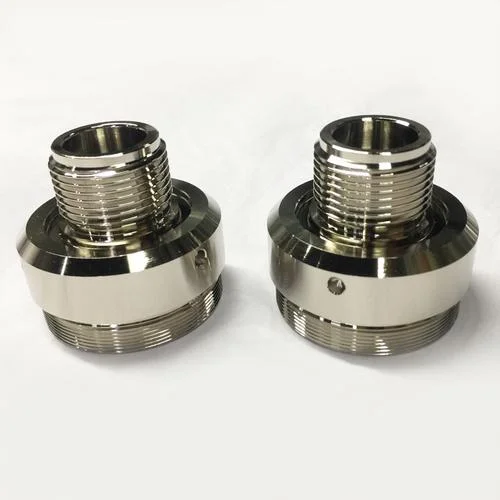
Wear behaviour follows the same split. Hard chrome resists abrasion and sliding wear and holds a low friction coefficient, which is why it is specified on hydraulic rods and on mold surfaces that see sliding contact. Electroless nickel produces a hard, wear-resistant surface that also resists corrosion well, and in its higher-phosphorus forms it is used where chemical resistance matters alongside hardness.
The choice usually resolves on geometry first and wear second. A simple cylindrical surface that must slide is chrome work. A part with internal bores, blind holes or complex shapes that must be uniformly protected is electroless nickel work. Where both requirements apply, a combination is often used, with the wear surface in chrome and the corrosion barrier in nickel.
How do wear and hardness compare?
Chrome is harder; nickel is more consistent.
Hard chrome produces the higher surface hardness and the lower friction coefficient, while electroless nickel provides good wear resistance with more uniform properties across the part.
The hardness of a hard chrome deposit depends on the chemistry and the process, and it is typically the highest available from a commercial plating system, which is why the coating appears on sliding wear surfaces. Its low friction coefficient is equally important in service: a hydraulic rod that slides through a seal thousands of times benefits as much from low friction as from hardness.
Electroless nickel’s wear performance depends on its phosphorus content and on any subsequent heat treatment, which can raise its hardness substantially. It is used on valves, pump components, molds and precision parts where a hard, corrosion-resistant surface is needed across a complex geometry. Its uniformity means the wear properties are consistent on every surface rather than only where the current density was favourable.
Neither coating is a substitute for a bearing surface in high-load contact. Both are thin relative to the part, and both depend on the substrate for load support. Where a part needs a hardened wear surface under heavy load, a hardened steel base with a coating for corrosion and friction is the usual arrangement, rather than relying on the coating alone.
How does corrosion performance compare?
Nickel is the better barrier; chrome needs a base layer.
Electroless nickel forms a continuous barrier layer that resists a wide range of chemicals, while chrome protects best when applied over a nickel or copper underlayer.
Corrosion protection from plating works by barrier action rather than by sacrificial protection, which is the mechanism zinc uses on steel. That means the coating must be continuous and free of pores to protect the substrate. Electroless nickel’s uniform deposition helps here, because it covers complex geometry without thin spots, and its chemical resistance is the reason it appears on valve components and process equipment.
Hard chrome on its own is porous and, at the thicknesses used for wear surfaces, can allow corrosion to reach the substrate through the crack network. That is why decorative chrome is applied over nickel: the nickel provides the corrosion barrier and the level surface, while the chrome provides the appearance and wear resistance. Where a hard chrome surface must also resist corrosion, a nickel underlayer is a common answer.
Salt spray performance is the usual way to compare coatings for outdoor or marine service, and it is measured under a defined test method rather than asserted. Because the result depends on the total coating system, the thickness of each layer and the substrate, the practical approach is to specify the requirement and let the coating stack be designed around it, rather than comparing single-layer figures. The test methods themselves are published by ASTM committee B08.
How much build-up does each coating create?
Both add thickness, and both need dimensional planning.
Each coating builds on the surface rather than into it, so an external diameter grows by the deposit thickness and a bore closes by twice that, and thick deposits often require grinding back to tolerance.
The magnitude differs with the application. Hard chrome for wear surfaces is often applied thick enough to provide a genuine wear layer, which means the dimensional change is significant and post-plate grinding is part of the process rather than an exception. Electroless nickel is often applied in thinner deposits for corrosion protection, though the same grinding consideration applies when thickness is used to salvage an undersized part.
The practical consequence for a drawing is that the coating thickness belongs in the dimensional plan. A shaft that must fit a seal grows and may need to be ground to its final dimension after plating; a bore that must accept a pin closes and may need masking or post-plate honing. Where a part is being repaired rather than made, plating can be used to build up a worn surface and then ground back, which is a legitimate use of the process but requires enough substrate to work with.
Masking belongs in the same plan. Threads, press fits and any surface that must remain conductive are usually protected, and each masked area is hand work. The dimensional framework behind those decisions is set out on 6CProto’s standards and tolerances page.
| Factor | Hard chrome | Electroless nickel |
|---|---|---|
| Deposition method | Electrolytic; follows current density | Chemical; uniform on all wetted surfaces |
| Surface hardness | Highest of the common plating systems | Good; can be increased by heat treatment |
| Friction | Low; suited to sliding contact | Moderate |
| Coverage inside bores | Uneven; difficult on complex geometry | Uniform; the main reason to choose it |
| Corrosion behaviour | Porous alone; usually applied over nickel | Continuous barrier; good chemical resistance |
| Post-plate machining | Commonly ground to final size | Ground when used for build-up |
| Typical parts | Hydraulic rods, molds, wear faces | Valves, pump parts, precision components |
How do cost and lead time compare?
Both are process-heavy, and chrome adds grinding.
Electroless nickel avoids the current-density problem but requires careful bath control, while hard chrome usually carries an additional grinding operation to bring the part back to tolerance.
The cost of each route is dominated by the process steps surrounding the coating rather than by the deposit itself. Both require a pretreatment sequence, both require racking or fixturing, and both require a masking plan if any feature must stay bare. Hard chrome adds a grinding operation where the coated surface must hold a tolerance, which is common on wear surfaces and on any part where the deposit is thick.
Electroless nickel’s cost sits in bath maintenance. The chemistry has to be controlled closely and replenished as it is consumed, which affects both the price and the consistency of the deposit across a batch. It is also less tolerant of certain contaminants, which means the pretreatment has to be thorough.
Lead time follows the process route: pretreatment, plating, any post-plate machining and inspection. Where a part requires both a nickel underlayer and a chrome top layer, both operations are sequential and the schedule reflects them. Where a program has a fixed date, the useful question is which operations can be planned in parallel, and usually none can, since each depends on the previous one.
How should thickness and class be specified?
By the coating system and its thickness, not by the metal.
A drawing should state each layer in the stack, the thickness or class for each, the areas that must stay bare and the acceptance test for the finished surface.
Specifying the stack rather than the top layer is what makes the result predictable. A part that says “chrome plate” leaves the underlayer, the thickness and the surface finish open; a part that names the nickel underlayer, the chrome thickness and the resulting appearance requirement is a specification a shop can meet and an inspector can verify.
Thickness classes are defined in the coatings standards, which also provide the test methods used to verify them. Referring to those standards rather than describing the result in words makes quoting and inspection consistent across suppliers, and it allows a thickness measurement to be compared with a requirement rather than with an impression.
Where the coating exists to restore a dimension, the drawing should say so, since the requirement is then a finished size rather than a coating thickness. Plating for build-up followed by grinding is a standard repair route, and specifying it as a dimensional requirement rather than a coating requirement is clearer for everyone involved. The relevant test methods are published by ASTM committee B08, with adhesion assessed by methods such as ASTM D3359, and materials behaviour documented by ASM International.
What about repair and stripping?
Both coatings can be removed, and both can be reapplied.
Stripping returns the part to its substrate so a new coating can be applied, which is common on worn or damaged parts provided the substrate has enough material left.
Hard chrome is frequently stripped and reapplied on hydraulic components and molds, because the substrate is valuable and the wear is confined to the coating. The stripping chemistry attacks the coating rather than the steel, so the part can be recoated and reground. The limit is dimensional: each cycle removes some substrate, and eventually the part no longer has enough material to rebuild to its nominal size.
Electroless nickel is also strippable, though the chemistry has to be matched to the substrate, because some stripping solutions attack aluminium and other metals aggressively. On aluminium parts the risk is significant enough that stripping is treated as a decision rather than a routine operation.
Repair planning belongs in the original specification where a part is expensive or long-lived. Knowing that a coating can be stripped without damaging the substrate, and that enough material will remain, turns a worn part into a rebuild instead of a replacement. That is a design decision, and it is cheapest to make when the part is first specified.
Choosing between chrome and nickel
The decision usually resolves in three steps. Identify whether the requirement is sliding wear, corrosion resistance, or both. Then look at the geometry: a simple external surface can be chrome plated; a complex shape with internal features is better served by electroless nickel. Finally, plan the dimensions, because both coatings build and thick deposits usually need grinding.
Where both requirements are genuine, the answer is often a stack: a nickel underlayer for corrosion protection with a chrome top layer for wear and appearance, each specified with its own thickness. That arrangement costs more than either coating alone, but it satisfies both requirements, which a single layer rarely does. The coatings available alongside plating are described in the surface finish guides, and the substrate grades on the steel material page. Where a coating is stripped and reapplied, the resulting chemical waste is handled under the framework published by the US Environmental Protection Agency.
FAQ
What is hard chromium plating?
It is an electrolytic chrome deposit applied relatively thick to provide a hard, low-friction wear surface, and it is distinct from decorative chrome, which is a thin cosmetic layer usually applied over nickel. Hard chrome appears on hydraulic rods, molds and wear plates. It is porous on its own, so where corrosion protection is also required it is normally applied over a nickel or copper underlayer.
Is hard chrome plating expensive?
It is a process with several steps, so the cost reflects preparation, plating, masking where needed, and the grinding operation that commonly follows to bring the surface back to tolerance. Compared with a simple corrosion coating, that makes it more expensive per part; compared with replacing a worn hydraulic component, it is usually far cheaper. The comparison that matters is against the alternative for the specific part.
Can electroless nickel be used as a wear coating?
It can, and its wear resistance improves with phosphorus content and with a heat treatment after plating. It is chosen over chrome where uniform coverage on complex geometry matters, and where corrosion resistance is as important as wear. Where the requirement is a low-friction sliding surface under load, hard chrome remains the common choice, particularly on cylindrical parts with a seal running against them.
Do both coatings need post-plate machining?
Chrome usually does when it is applied thickly for wear, because the deposit has to be ground back to the required diameter. Electroless nickel needs machining only when the deposit is being used to build up a dimension or when the surface finish matters. In both cases, the allowance for that operation belongs on the machined part rather than being added after plating. The test methods referenced in this article are published by ASTM committee D20.
If a part needs either a wear surface or uniform corrosion protection, send the model with the geometry, the service environment and the dimensions that must hold after coating. 6CProto reviews the part together with the finishing route and returns a DFM report with the quote. Upload the file at the 6CProto quote page or send it to projects@6cproto.com.