

Most molded products do not start at a hundred thousand units. They start at a few hundred, produced to prove a market, satisfy a first customer or bridge a launch, and the tooling decision made for that quantity determines whether the second order is profitable or painful. Low volume injection molding covers that range: roughly one hundred to ten thousand parts, produced in a tool built for the run rather than for the product’s life. This guide covers what makes the category different, how tooling routes compare across that range, what sets the cost per part, and how to plan batches so repeat orders stay consistent.
What does low volume injection molding actually mean?
Molded parts in the hundreds to thousands.
It describes production runs where the quantity justifies a mold but not the construction of a long-life production tool, so the tool is matched to the expected output.
The category exists because tooling and production economics point in different directions. A production tool is expensive because it is built to run for years, with optimised cooling, hardened steels and a cavity count that matches high volume. At a few hundred parts, that investment cannot be recovered, and the parts still need to be molded rather than printed or cast, because the material, the surface and the assembly behaviour have to be those of the final product.
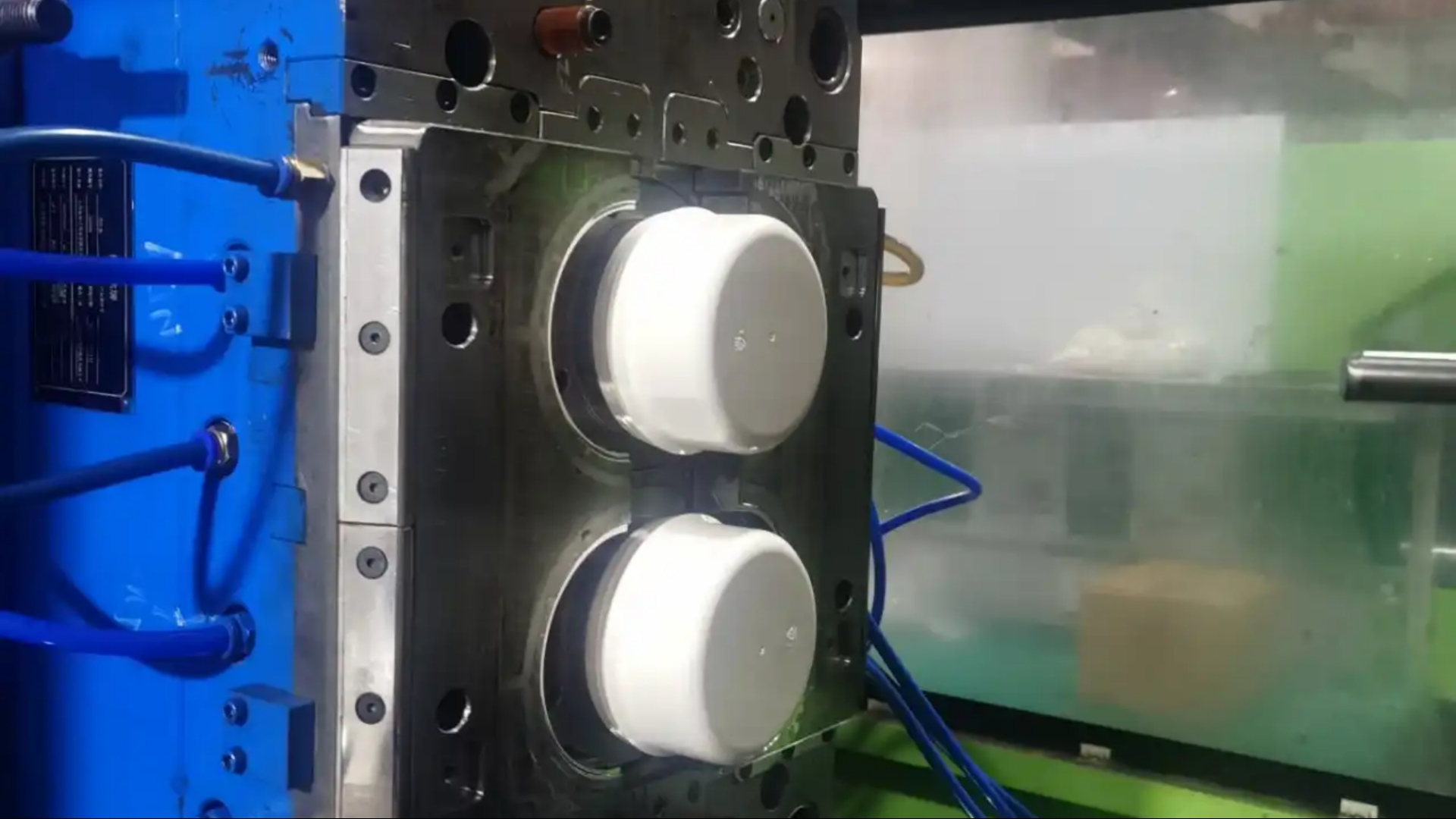
A low volume tool resolves that tension. It is built from materials that machine quickly, usually with a single cavity and a simpler cooling layout, and it is designed to produce a defined quantity and then either be retired or extended. The parts that come off it are molded in the production resin, which is what makes them usable as saleable units rather than samples.
The boundary between low volume and mass production is not a fixed number. It depends on the part: a small component produced several per cycle may be economic at volumes where a large one with a long cycle time is not.
Which tooling route fits which quantity?
Match the tool to the run, not to the eventual size.
Aluminium tools suit hundreds to a few thousand parts, bridge tools with steel inserts extend the range, and full production tools take over when the volume justifies their construction.
Aluminium is the standard choice for the lower end of the range. It machines quickly, transfers heat well and can be modified cheaply, which matters when the design may still change after the first batch. Its limits are wear at the gate and on shut-offs, and slightly less dimensional stability under sustained clamping pressure.
Where the quantity is larger, or the resin is abrasive, steel inserts at the wear points extend the tool’s useful life without the cost of building the whole tool in steel. This hybrid construction is often the most economical answer for the middle of the range: a few thousand to a few tens of thousands of parts, in a resin that wears an aluminium gate faster than the rest of the tool.
A full production tool becomes the right answer when the volume justifies it and the design is settled. The decision point is not the total quantity alone but the combination of quantity, resin and how likely the design is to change. Where any of those is uncertain, the lower-cost tool that can still supply saleable parts is usually the better first investment. The tooling routes themselves are described on the rapid tooling page. Where a part is subsequently coated, adhesion and preparation follow documented test methods such as ASTM D3359.
What sets the cost per part?
Tool amortisation, cycle time and secondary operations.
Cost per part is the tool cost divided by the quantity, plus the running cost of each cycle, plus any finishing or assembly the part requires.
The amortised tool cost dominates at low quantities. A tool that costs a certain amount spread across two hundred parts contributes far more per part than the same tool spread across five thousand, which is why the first batch is always the most expensive and why increasing the initial order quantity is often the single largest available saving.
The running cost then depends on cycle time and cavity count. A single-cavity tool produces one part per cycle, so the machine time per part is the cycle time. Increasing the cavity count reduces that time per part but raises the tool cost, and the trade is worth examining where the quantity is large enough to amortise the difference.
Secondary operations are frequently underestimated. Dyeing, coating, machining a critical feature, inserting hardware or assembling sub-components each adds labour and a separate step. On a short run those steps can contribute as much per part as the molding itself, which is why specifying them in the request is important for a meaningful quote.
| Quantity band | Typical construction | Why it fits |
|---|---|---|
| 100 to 1,000 parts | Single cavity, aluminium | Lowest tool cost; fast delivery; easy to modify |
| 1,000 to 5,000 parts | Aluminium with steel gate insert | Extends life at the wear point cheaply |
| 5,000 to 20,000 parts | Hybrid tool, aluminium frame with steel inserts | Wear resistance where it is needed |
| 20,000 and above | Steel tool, cavity count matched to volume | Lower cost per part at sustained volume |
How should MOQ and batch planning work?
Plan by tool life and storage, not by a fixed minimum.
The minimum order quantity for a low volume run is usually set by what the tool can produce economically, and it is worth ordering enough to cover the next few months rather than the next few weeks.
Two forces set the practical minimum. The first is tool amortisation: the more parts each batch carries, the lower the tool cost per part, so a very small order spreads a fixed cost across too few units. The second is tool life: an aluminium tool has a finite number of cycles, and ordering beyond that limit means either a replacement or a switch to a more durable construction.
Batch planning then becomes a storage and cash question. Producing a larger batch lowers the cost per part but ties up inventory, and molded parts occupy space. Where the design is likely to change, a smaller first batch in a tool that can be modified is worth more than a larger batch at a better unit price, because the modification will invalidate the stock.
The useful approach is to ask for the cost per part at several quantities and look at where the curve flattens. The point at which additional quantity stops materially reducing the unit cost is the point beyond which carrying more inventory is not buying anything.
Which materials suit short runs?
The production resins, with attention to wear.
Low volume runs use the same resin families as production molding, and the main consideration is how abrasive the grade is to the tool.
The common engineering resins, including the styrenics, polycarbonate blends, nylons and polypropylenes, all run in low volume tools, and choosing among them follows the application: stiffness, impact, heat resistance, chemical exposure and appearance. That decision should not be compromised for tooling reasons, because the part has to behave like the product.
What does affect the tooling decision is filler content. Glass-filled and mineral-filled grades are abrasive, and they wear gates and shut-offs faster than unfilled resins. On a short run that difference may not matter; on a run in the thousands, it is the reason to specify a steel gate insert or to select a hybrid tool. The material options available for molding, with their properties, are listed on the injection molding materials page.
Two secondary considerations belong in the same conversation. Some resins require specific drying and temperature profiles, which affects processing time. And some produce parts that need annealing or a specific cooling practice to reach their properties, which adds a step to the production plan.
How do repeat batches stay consistent?
Record the parameters and keep the tool.
Consistency across repeat batches depends on keeping the same tool, the same resin grade and the same process settings, and on documenting them against the part number.
Where a tool is retained between runs, consistency is largely a question of process discipline. Recording the settings used for the approved batch, including temperatures, injection profile and cooling time, means the next run starts from a known position rather than from an operator’s memory. Storing the tool properly between runs also protects the cavity and core from corrosion and damage.
Where the tool has reached its wear limit, the replacement becomes the new reference. At that point the dimensional report from the approved batch is what the new tool is measured against, and the report is more reliable than a physical part that may itself have been damaged in storage.
Resin consistency matters as much as the tool. The same grade from the same supplier behaves consistently; a substitute grade with similar nominal properties may shrink differently. Where a substitution is unavoidable, it should be treated as a change to the part and validated rather than assumed equivalent. The specifications behind those grades are published by ASTM committee D20, the test methods by ASTM committee E28, and the manufacturing quality practices that support repeatability by NIST MEP, with the materials engineering context from ASM International.
What to put in an RFQ for a low volume run
Quantity, resin, tolerances and finishing.
A quote is only comparable when it states the quantity, the grade, the tolerances that matter and the finishing steps included, because each of those changes the tool and the price.
The quantity should cover the first order and the expected total, since the tool construction depends on both. The resin should be named with its grade and filler content, because that determines the wear the tool will see. The tolerances should identify the features that matter rather than applying a blanket requirement, which allows the tool to be designed around them. And the finishing steps, including any secondary operations, should be listed so they can be priced rather than discovered.
Adding the date the parts are needed allows the tooling route to be chosen against the schedule as well as the cost, which is often the practical constraint on a launch. Requests submitted through the quote flow receive a manufacturability review before production, so draft, wall thickness and gate questions are raised before the tool is cut rather than after sampling.
Planning the first low volume batch
Low volume injection molding works best when the tool is matched to the run and the run is planned around the tool’s life. An aluminium single-cavity tool is the economical answer for a few hundred parts; steel inserts extend that range cheaply; and a production tool is justified only when the volume and the design both support it.
Three habits make the first batch go well. Ask for pricing at several quantities to see where the cost curve flattens. State the resin grade and its filler content, because it determines how long the tool will last. And record the settings and the dimensional results from the approved batch, so the second order starts where the first one finished. The low volume manufacturing route that often accompanies these programs is described on the low volume manufacturing page.
FAQ
What is considered low volume in injection molding?
Broadly, runs in the hundreds to a few thousand parts, sometimes up to tens of thousands, where the tool is built for the quantity rather than for the product’s life. The boundary is not fixed, because a small part produced several per cycle can be economical at volumes where a large part with a long cycle is not. The practical definition is that the tool construction is chosen around a defined run.
What is the minimum order quantity for molded parts?
The practical minimum is set by tool amortisation rather than by a policy figure. A very small order spreads a fixed tool cost across too few parts, which pushes the unit price up sharply. Asking for pricing at several quantities shows where that effect fades, and that point is usually a better guide than any published minimum. Carrying inventory has its own cost, so the ideal batch is often the smallest one that amortises the tool sensibly.
Can a low volume tool be extended into production?
It can supply more parts than originally planned, within limits that depend on the construction, the resin and the geometry. An aluminium tool wears at gates and shut-offs, and abrasive filled resins accelerate that wear. Where an extension is likely, specifying steel inserts at the wear points from the start is an inexpensive way to keep the option open. Beyond that limit, a replacement tool is the honest answer.
How do repeat orders stay consistent with a low volume tool?
By keeping the tool, the resin grade and the process settings together and recording them against the part number. Consistency across runs is mostly a documentation question: the approved batch establishes the settings and the dimensional results, and the next run starts from those rather than from memory. Where the tool is replaced because of wear, the earlier report becomes the reference for the new tool.
If a product needs molded parts in the hundreds or thousands, send the model with the quantity you expect and the resin you intend to use. 6CProto reviews the design before tooling, proposes a construction matched to the run, and returns a DFM report with the quote. Upload the file at the 6CProto quote page or send it to projects@6cproto.com.