

A material change on a powder-bed part is not a swap of equivalent options. Moving from PA12 to PA11 changes how the part behaves in a drop test; moving to an elastomeric powder changes how thick the walls need to be; and dyeing a batch produces a colour that depends on the powder beneath it. Programmes that treat material and finish as separate line items usually discover this after the first reorder. This guide covers the grades used in multi jet fusion production, what each one changes, and how finishing decisions interact with dimensions, colour and cost.
Which materials run in MJF production?
A short list, each with a distinct job.
Unfilled PA12 covers most functional parts, PA11 and elastomeric grades add impact tolerance and flexibility, and filled grades raise stiffness where a part holds a sustained load.
The powder family for jetting platforms is smaller than the material catalogue for machining, and that is an advantage: the choice is quick to narrow once the load case is written down. PA12 is the default engineering nylon, used for brackets, housings, covers and fixtures where stiffness and predictable dimensions matter more than elongation. PA11 moves the balance toward impact absorption and repeated flexing. Elastomeric powders, including TPU-style grades, produce parts that compress and return, which suits gaskets, grips and damping elements. Glass-filled grades raise stiffness and slow creep.
Colour is not part of the material selection. Parts arrive in the powder’s natural shade, which is usually grey, and colour is applied afterwards by dyeing. That means a program can change colour without changing the grade, which is useful when a product line uses one part in several variants.
Published properties for these grades, including the specifications gathered in the Formlabs material library, the material documentation published for HP Multi Jet Fusion, and the powder data published by EOS, give a comparable starting point before the conversation moves to the specific geometry. The measurement methods behind those published values are described in the NIST additive manufacturing program, and the terminology used across powder-bed processes follows ASTM committee F42.
How do PA12 and PA11 differ in a finished part?
PA12 is the stiffer default; PA11 takes impact.
The two are visually similar after blasting, and the difference appears when a part is dropped, flexed repeatedly, or loaded against a hard stop.
PA12 behaves like an engineering nylon: stiff enough for structural brackets, predictable in thin sections, and well documented as a finishing substrate, which means blasting, dyeing and machining all behave the way a shop expects. It is the grade that most production nylon parts are made from.
PA11 shifts behaviour toward elongation. A clip made from it survives more flexing before cracking, a cover tolerates being pressed and released, and a part that occasionally takes a hit is less likely to fail at a layer boundary. The trade is a slightly softer feel and a different response to blasting, which matters where a program is matching a surface finish across two grades.
The practical test is the failure mode. If a part is cracking in service, elongation is the property to examine and PA11 is the direction to explore. If a part is deflecting too far or creeping under a constant load, a filled grade addresses that better than a tougher one.
| Grade family | Property that drives the choice | Typical parts |
|---|---|---|
| PA12 (unfilled) | Stiffness, dimensional predictability, finishing behaviour | Brackets, housings, covers, fixtures |
| PA11 (unfilled) | Elongation and impact absorption | Clips, snap features, parts exposed to drops |
| Glass-filled nylon | Stiffness and creep resistance | Load-bearing brackets, stiffening structures |
| Elastomeric / TPU powders | Compression and return, damping | Gaskets, grips, vibration isolation |
| Flame-retardant grades | Compliance-driven behaviour | Housings with a flammability requirement |
When does an elastomeric powder make sense?
When the part must deform and recover.
Elastomeric MJF parts absorb mismatch between rigid components and damp vibration, which suits seals, grips and soft interfaces rather than structural brackets.
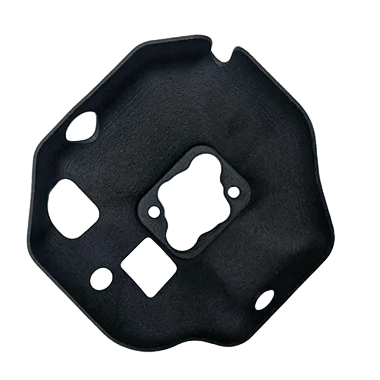
Flexible powder-bed parts occupy their own design space. They are used where two rigid components need an interface that compresses, where a surface needs grip without a separate rubber part, or where vibration has to be damped rather than transmitted. A printed gasket, a soft-touch pad and a machine foot are typical applications, and each would fail in a stiff nylon.
Design rules change accordingly. Walls are usually thicker, because thin sections lose the compression behaviour that makes the material useful. Ribs and gussets serve less purpose, since the part is meant to move. Threads should be avoided entirely in favour of metal inserts or captive hardware, because a thread cut into an elastomeric part will not carry load. And acceptance criteria should be written around function rather than around a cosmetic reference photographed from a rigid part, because the same finishing step produces a different surface on a flexible substrate.
Cost behaviour is different as well. Elastomeric parts are harder to hold to a dimensional tolerance, so a drawing that depends on tight fits in a flexible material is a design problem rather than a manufacturing one.
What does the as-built surface look like, and what changes it?
Uniform matte grain, then blasting, then dye.
Parts leave the build with a consistent fine texture across every face, blasting cleans and evens it, and dyeing adds colour into the surface layer rather than coating it.
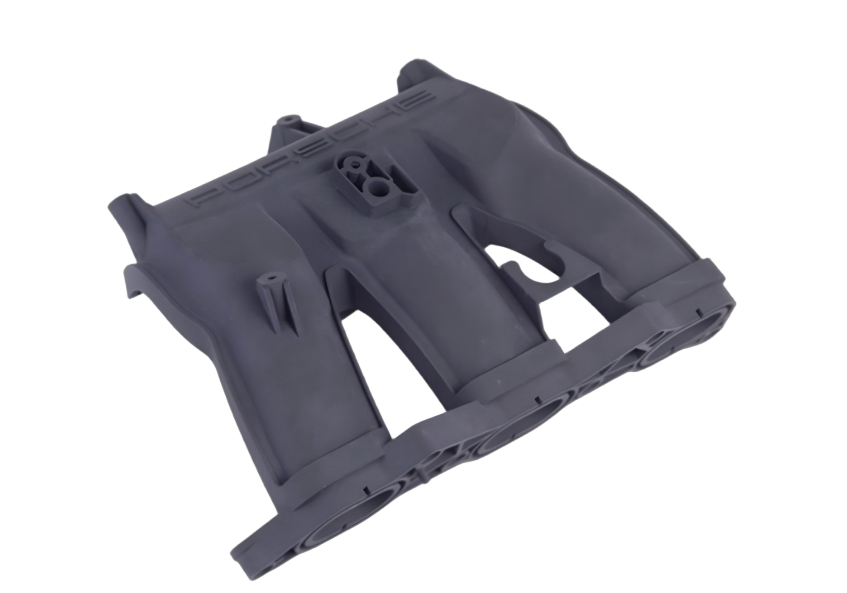
Because jetting platforms distribute material uniformly, the as-built texture is consistent across a bed, which is one of the practical advantages of the process for appearance parts. Blasting removes caked powder and evens the grain further. Neither step makes the surface smooth; a glossy finish on nylon requires machining or a coating, and powder-bed parts are normally specified matte. The surface finish guides explain how the blasting and sealing routes are normally called out on a drawing.
Dyeing is the step that surprises buyers most. Dye penetrates the surface layer of the nylon, so the colour is part of the material and does not chip. The final shade depends on the base shade of the powder, on part thickness, and on how the part was blasted beforehand. Thin sections can take colour differently from thick ones, and a batch dyed after a longer blast will read slightly darker or lighter than a previous batch.
The practical response is to agree a reference part from an approved batch and treat colour as a documented acceptance criterion, with a defined viewing condition. That is a more reliable arrangement than a colour number, because the number cannot represent how the surface scatters light.
How do sealing, tapping and inserts fit into the process?
They are secondary operations, and they change the surface.
Sealing closes porosity where a part carries fluid, tapping or inserts provide a load-bearing thread, and both are best specified on the drawing rather than added after the fact.
Sealing addresses the porosity inherent to powder-bed fusion. Any part that holds fluid, sees pressure or must be cleaned repeatedly benefits from it, and sealing is usually applied before final inspection because it changes the surface condition of the treated faces. A part that will be sealed should say so at the quoting stage, since sealing after a colour match has been agreed can change the appearance slightly.
Threads follow the same logic. Printing a pilot hole and tapping afterwards gives a thread with a predictable pitch and flank, and the wall behind that thread has to be thick enough to carry the load. Where a joint will be assembled repeatedly, a metal insert is more durable still. Both options require clearance and wall thickness on the model, which makes them a design decision rather than a finishing preference.
Machined interfaces belong in the same conversation. A bearing bore, a sealing land or a gasket face is usually machined after printing, and 6CProto runs MJF production alongside machining and finishing, so those operations stay within one order.
How does finishing affect dimensions?
Blasting is negligible; machining and sealing are not.
Media blasting rounds edges slightly without changing overall size, while a machined face removes material deliberately and a sealing treatment can add a thin film on treated surfaces.
The dimensions that matter on a nylon part are usually the interfaces: a bore, a face that seats against another component, or a gasket land. Each of those is better served by specifying the operation that produces it than by hoping the as-built surface will do. A sealing face that is simply printed is porous and uneven at the micro scale, which is why it is normally machined flat after printing.
Colour and sealing also interact with measurement. A dyed part and an undyed one from the same build will measure the same, but a sealed part may differ slightly on treated faces, and a part that was blasted for longer will have more edge rounding. Where a callout sits close to an edge, that rounding is worth raising during the DFM review rather than discovering it at inspection.
The reference framework for those callouts is set out on the standards and tolerances page, and the terminology used across additive processes follows the vocabulary maintained in ASTM F2792.
What does finishing add to part cost?
Labour, and it is priced per surface.
Blasting is a batch operation with modest cost, dyeing adds a second batch step, sealing adds another, and every machined interface adds a setup to the order.
Because the build cycle is shared across the parts in a chamber, finishing is where the price differences between two similar quotes usually originate. A quote that assumes blasting only is not comparable with one that includes dyeing and a machined bore, and comparing them without that detail produces a decision that has to be revisited.
The cost-effective approach is to specify finish per surface rather than per part. Hidden faces usually need blasting only, cosmetic faces need a consistent blast and possibly dye, and functional faces need the operation that makes them work. That allocation keeps labour where it adds value and removes it where it does not.
Quantity also matters, because blasting and dyeing are batch operations and their cost per part falls with volume, while a machined interface costs the same per part regardless of batch size. On small orders, that difference can be the largest single line in the quote.
Choosing material and finish together
Material and finishing decisions are coupled, and treating them separately is what produces a part that meets the drawing and still disappoints. The grade sets the behaviour: stiffness, impact tolerance, creep resistance and whether the part can be machined afterwards. The finishing route sets the surface, the colour and the dimensional state of any treated face. Choosing one without the other leaves the result to chance.
Two habits keep the pair aligned. Write the load case and the environment down before comparing grades, so the choice has a criterion. Then specify the finish per surface on the same drawing, so the shop knows which faces are cosmetic, which are functional and which may be left as-built. Where colour matters across a program, agree a reference part rather than a colour number, and record the finishing route against the part number so the next batch can repeat it. Powder variation behind those batches is discussed for both powder-bed processes in this 6CProto article on nylon PA properties, finishes and applications.
FAQ
Can MJF parts be tapped and threaded?
They can, and it is normal practice on functional nylon parts. The thread is usually produced by printing a pilot hole and tapping afterwards, which gives a predictable pitch and flank. The wall behind the thread has to carry the load, because a thread cut into a thin nylon section strips easily. Where the joint will be opened and closed repeatedly, a metal insert or captive hardware is the more durable choice.
How consistent is colour between MJF batches?
Dyeing penetrates the nylon surface, so the colour does not chip, but the final shade depends on the base powder, part thickness and how the parts were blasted. Batches usually match closely when the grade and the finishing route are identical, and can differ by a visible shade when either changes. Agreeing a reference part from an approved batch is more reliable than specifying a colour number, because the surface scatters light in ways a number cannot capture.
Do MJF parts need sealing?
Only when the application requires it. Powder-bed parts have a small amount of surface porosity, which is irrelevant for a bracket or a cover but matters for anything that holds fluid, sees pressure or must be cleaned repeatedly. Sealing closes that porosity, and it is applied before final inspection because it changes the surface condition of the treated faces. A part that will be sealed should say so when it is quoted.
Which grade should be used for a part that must not crack?
Start with the failure mode rather than the grade name. If the part cracks under impact or repeated flexing, elongation is the relevant property and an unfilled PA11 or an elastomeric powder is the direction to examine. If the part instead deflects or creeps under a constant load, a stiffer filled grade addresses the cause. In both cases, build orientation matters, because layer bonding is weaker than the material inside a layer.
If the grade and the finish are still open, send the model with the load case and the surfaces that matter. 6CProto reviews manufacturability before production, runs MJF alongside machining and finishing, and returns a DFM report with the quote so the material, the finish and the interfaces are settled together. Upload the file at the 6CProto quote page or write to projects@6cproto.com.