

Consider two hypothetical black MJF presentation housings: one has a visibly granular surface, while the other feels smoother and reflects light differently. Both could satisfy an instruction to dye the part black. A buyer preparing a customer demonstration needs a more specific checklist that connects the required look and feel to the finishing route and final fit.
As-printed vs dyed surfaces
Specify MJF dye and vapor smoothing through the actual material, cleaning and finishing sequence, approved appearance reference, cosmetic zones, final dimensions, and inspection conditions. Dyeing and smoothing address different characteristics. Approve a representative sample and document color, texture, defects, and fit separately before ordering customer-facing prototypes or treating two black finishes as equivalent.
Start by asking what “as printed” includes. Powder removal and other cleaning may already have occurred; the label should not hide an unspecified preparation step. Record the starting condition for a meaningful comparison with dyed or smoothed parts.
DyeMansion’s DM60 guidance ties coloring to specific material and finish combinations. This supports specifying the actual combination rather than expecting a color reference to look identical on every polymer and texture. Ask for the proposed route and a physical example when appearance is important.
Vapor smooth dimensional change
Identify fits, thin edges, small markings, clips, bores, and mating surfaces before approving smoothing. Avoid specifying a universal dimensional allowance from the process name. Measure representative features before and after the proposed treatment, and inspect final dimensions against the drawing.
AMT describes controlled solvent-vapor finishing and states that results depend on the material and finishing agent. Its published results are evidence about those tested conditions, not a tolerance guarantee for another supplier’s part. Do not assume the same dimensional change for external walls, internal passages, and every geometry.
For a hypothetical clearance check, suppose a finished opening measures 20.04 mm and its mating feature measures 20.00 mm. Their measured diametral clearance is 0.04 mm. If a trial finishing route instead leaves that opening at 19.98 mm, the calculated clearance becomes −0.02 mm: interference. These invented measurements illustrate the calculation only; they do not predict a smoothing allowance or acceptable fit.
Define the required clearance range, measurement condition, and mating-part variation. A good appearance cannot compensate for an assembly that no longer works. Decide which surfaces must remain protected and whether an alternative finishing or machining route is necessary.
Acceptance photos
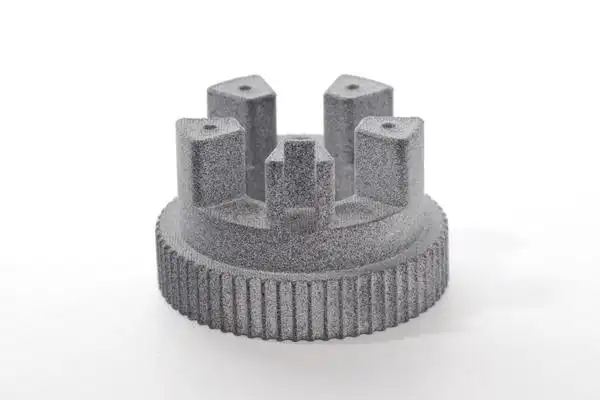
Use an acceptance photo set with a part identifier, revision, finish state, scale where useful, and marked viewing zones. Include an overall view and close-ups of agreed problem areas such as recesses, edges, lettering, and visible contact points. Keep the lighting and viewing arrangement consistent between samples.
ASTM D1729’s public scope addresses controlled visual color appraisal of diffusely illuminated opaque materials. It provides a relevant reference for agreeing a visual method; the public summary alone does not establish that a particular inspection complies with the full practice.
A photograph is a record of a scene and imaging chain. Use an approved physical master when critical color decisions require direct comparison. Describe whether an image documents a defect location, texture, or color. Avoid using an edited marketing picture as the sole acceptance reference for a production batch.
Table: cosmetic grades
The following cosmetic grades are proposed project categories, not an industry standard or a 6CProto capability promise. Assign them on a marked drawing and agree the actual defect limits, viewing conditions, and reference sample before purchase.
| Zone | Typical exposure | What to specify | Acceptance record |
|---|---|---|---|
| A: presentation | Customer-visible exterior | Color reference, texture, allowable marks and viewing conditions | Approved master and controlled views |
| B: handled | Touch points and assembly access | Feel, edge condition, color continuity and local marks | Visual and handling checks |
| C: concealed | Internal surfaces after assembly | Cleanliness, clearance and prohibited functional defects | Drawing checks and relevant photographs |
If gloss is a decision criterion, agree a suitable method and instrument geometry rather than writing “satin” alone. ISO 2813’s published scope concerns gloss measurement of coatings. Check applicability to the actual uncoated dyed polymer, its texture and geometry before adopting it; a citation does not make every curved printed surface a suitable test specimen.
FAQ
These questions address specification details that should be settled before sample approval.
Does black dye automatically make an MJF surface smooth?
No. Color and texture are separate acceptance characteristics. Define the cleaning, surfacing, and coloring route, then approve the resulting material and finish combination. A dark photograph alone cannot establish tactile smoothness or a numerical roughness requirement.
Can a successful vapor-smoothed sample remove the need for dimensional inspection?
No. Measure the critical features in their final delivered condition using the agreed method. Approval should cover representative geometry and processing. A supplier demonstration or a published process result cannot replace the dimensional requirements of your component.
Related process selection notes
Keep aesthetic, dimensional, and functional decisions connected but separately documented. HP’s public MJF handbook overview identifies aesthetics, accuracy, mechanical properties, and post-processing as distinct topics. It is a useful map for the review, rather than evidence that an unspecified finishing recipe meets every requirement.
Compare the whole delivered route: cleaning, surface preparation, coloring, smoothing where selected, final conditioning, inspection, and packaging. Confirm the intended sequence with the provider. Request a representative sample with difficult details rather than approving a simple flat coupon for a complex customer-facing housing.
Record any change in material, finish sequence, or approved reference that requires reapproval. Evaluate repeat orders against the retained master and current drawing, including damage during handling. Distinguish color variation from dirt, residue, texture changes, and scratches so that corrective action targets the actual problem.
Internal links and next steps
Send the model, drawing, quantity, visible-surface map, color reference, texture expectations, final fit requirements, and photo protocol. State whether the prototype is for a display, handling demonstration, assembly trial, or another defined purpose. Include any separate leakage, cleaning, or environmental requirements.
Use the MJF service discussion to confirm the material and geometry, then review the proposed route through surface finishing. Compare other options through the 3D-printing overview if the required finish conflicts with fit or feature detail.
Request a quote with the cosmetic zones, approved reference, and final-dimensional checks attached. Confirm availability of the specific dye and smoothing combination, sample approval, and inspection records before committing the order.
FAQ
These questions address specification details that should be settled before sample approval.
Are photographs sufficient to approve a critical color match?
Usually they need supporting controls. Agree the lighting, camera handling, views, and reference, and use a physical master where the decision requires it. Screens and image processing can alter appearance. State whether photographs document defects or constitute the contractual color acceptance method.
Does an attractive smoothed surface prove the part is waterproof?
No. Appearance approval does not establish leakage resistance, long-term durability, or other functional requirements. Specify and validate those separately for the actual material, geometry, finish, and application. Confirm any relevant testing and acceptance evidence before making a performance claim.