

Choosing a powder by name is how projects end up with a part that is stiff where it needed to bend, or brittle where it needed to hold a thread. Selective laser sintering materials are a small family with large behavioural differences, and the choice changes the design rules, the finishing steps, and the price of the part. This guide compares the powders used in production nylon printing, explains what each one changes in service, and sets out the verification steps that tell a buyer whether a grade and a batch will behave the way the data sheet suggests.
Which SLS powder fits your part?
Match the powder to the failure the part must avoid.
Start from the property that cannot be compromised: stiffness for a bracket, elongation for a clip, heat resistance near electronics, or hardness for a sliding surface.
The powder choice is a decision about behaviour under load, not about appearance. Two parts with identical geometry, one in unfilled PA12 and one in glass-filled nylon, will feel different in the hand, fail at different loads, and machine differently if either needs a secondary operation. That is why the useful first step is to write down what the part must survive, then read the material options against that single requirement.
Published property data from powder and platform suppliers, including the material documentation from EOS and 3D Systems, gives comparable values for the grades they supply. Those data sheets describe properties measured on specimens built under defined conditions, which is a different thing from the strength of a specific part built in a specific orientation, and the distinction matters when a customer asks for evidence.
How do PA12 and PA11 differ in service?
PA12 is stiffer; PA11 bends further before failing.
Both are unfilled nylons with similar appearance, and the difference shows up under impact and repeated flexing rather than in a static load test.
PA12 is the workhorse powder for functional parts: brackets, housings, enclosures, and fixtures where stiffness and dimensional predictability matter more than elongation. Its behaviour is well documented, it finishes predictably, and it accepts dyeing and sealing without much drama. For most engineering prototypes and low-volume production parts, it is the default choice.
PA11 shifts the balance toward toughness. Parts made from it tolerate impact and repeated flexing better, which is what a clip, a cover, or a living feature needs. The trade is usually a slightly softer feel and a different surface response after blasting, and it is worth confirming that the application is genuinely impact-driven before paying for a tougher grade that adds nothing to a static bracket. Both grades are covered on the nylon material page alongside the other polymers available for printing and machining.
The practical test is to describe the failure mode. If the part cracks in service, elongation matters and PA11 is the direction to explore. If it deflects too far or creeps under a sustained load, stiffness matters and the discussion belongs with a filled grade instead.
| Powder | Stiffness | Impact and elongation | Typical parts |
|---|---|---|---|
| PA12 (unfilled) | Good | Moderate | Brackets, housings, fixtures, general functional parts |
| PA11 (unfilled) | Moderate | High | Clips, covers, parts exposed to drops |
| Glass-filled nylon | High | Lower | Load-bearing brackets, creep-resistant structures |
| TPU / elastomeric powders | Low | Very high, elastic | Gaskets, grips, damping elements |
| Flame-retardant grades | Application dependent | Application dependent | Housings with a flammability requirement |
What does glass-filled nylon buy you, and what does it cost?
Stiffness and creep resistance, paid for in elongation.
Adding glass raises the modulus and reduces how much a part moves under a sustained load, while lowering the strain the material tolerates before it cracks.
Creep is the reason most buyers move to a filled grade. A nylon bracket holding a constant load can continue to deflect for weeks, and if the geometry has no margin the deflection eventually breaks a fit or a seal. Glass filling raises stiffness and slows that movement, which is what makes filled nylon common in load-bearing brackets and structural parts.
The cost is not only financial. Filled nylon elongates less, so it behaves more like a stiff plastic and less like a forgiving one: a part that would bend in unfilled nylon may crack instead. Glass also makes secondary operations harder and leaves a rougher surface after blasting, so a filled part that must also look clean is a more expensive proposition than an unfilled one. Where the application needs stiffness and a smooth finish, the usual answer is a machined interface on an unfilled body rather than a fully filled part.
Because part properties depend on how specimens were built and tested, values quoted from different sources are only comparable when the test method matches. Tensile properties of plastics are measured under defined specimen and conditioning conditions, and the standards that describe those methods are maintained by bodies such as ASTM committee F42 for additive manufacturing.
When is TPU the right powder?
When the part must deform and return.
Elastomeric powders produce parts that bend, compress, and damp vibration, which suits seals, grips, and soft interfaces rather than structural brackets.
Flexible powder-bed parts occupy a different design space from the rigid nylons. They are used where the part has to absorb a mismatch between two rigid components, protect a surface, or provide grip without a separate rubber component. A printed gasket, a soft-touch pad, or a damping foot are typical applications, and each of them would fail if made in a stiff nylon.
The design rules differ accordingly. Walls are usually thicker because thin sections lose the compression behaviour that makes the material useful, supported overhangs are less of a concern because the part flexes rather than fractures, and any feature that must hold a fastener needs a rigid insert or a metal component, since a thread cut into an elastomeric part will not carry load.
Finishing also changes. Dyeing behaves differently on an elastomeric part, and blasting has less effect on appearance, so the acceptance criteria should be based on function rather than on a cosmetic reference photographed from a rigid nylon part.
How does material choice change design rules?
The powder sets the wall thickness and the thread strategy.
Stiffer grades tolerate thinner walls and finer features, elastomeric grades need thicker sections, and any grade that must hold a thread needs wall thickness behind it or a metal insert.
Design rules follow from the material’s behaviour rather than from the process alone, and treating one set of rules as universal is how a nylon design ends up over-built in one place and fragile in another. The geometry rules that apply across powder-bed printing, from minimum wall sections to powder escape paths, are collected in the 3D printing design tips library.
| Design decision | Unfilled nylon | Glass-filled nylon | Elastomeric powder |
|---|---|---|---|
| Wall thickness | Moderate; stiffness comes from geometry | Can be thinner for the same stiffness | Thicker sections needed for compression behaviour |
| Ribs and gussets | Effective; add stiffness cheaply | Very effective, but risk of stress concentration | Rarely useful; the part is meant to flex |
| Threaded features | Workable with adequate wall behind the thread | Workable; less forgiving of thin walls | Use metal inserts or captive hardware |
| Living features | Possible with careful orientation | Not recommended; low elongation | Natural fit |
| Secondary machining | Straightforward | More abrasive; tooling wear to plan for | Difficult to hold tolerance |
What are the real disadvantages of SLS materials?
Texture, porosity, anisotropy, and dimensional spread.
Nylon parts are strong but not smooth, slightly porous unless sealed, weaker across layer boundaries, and less dimensionally uniform than a machined part across a long dimension.
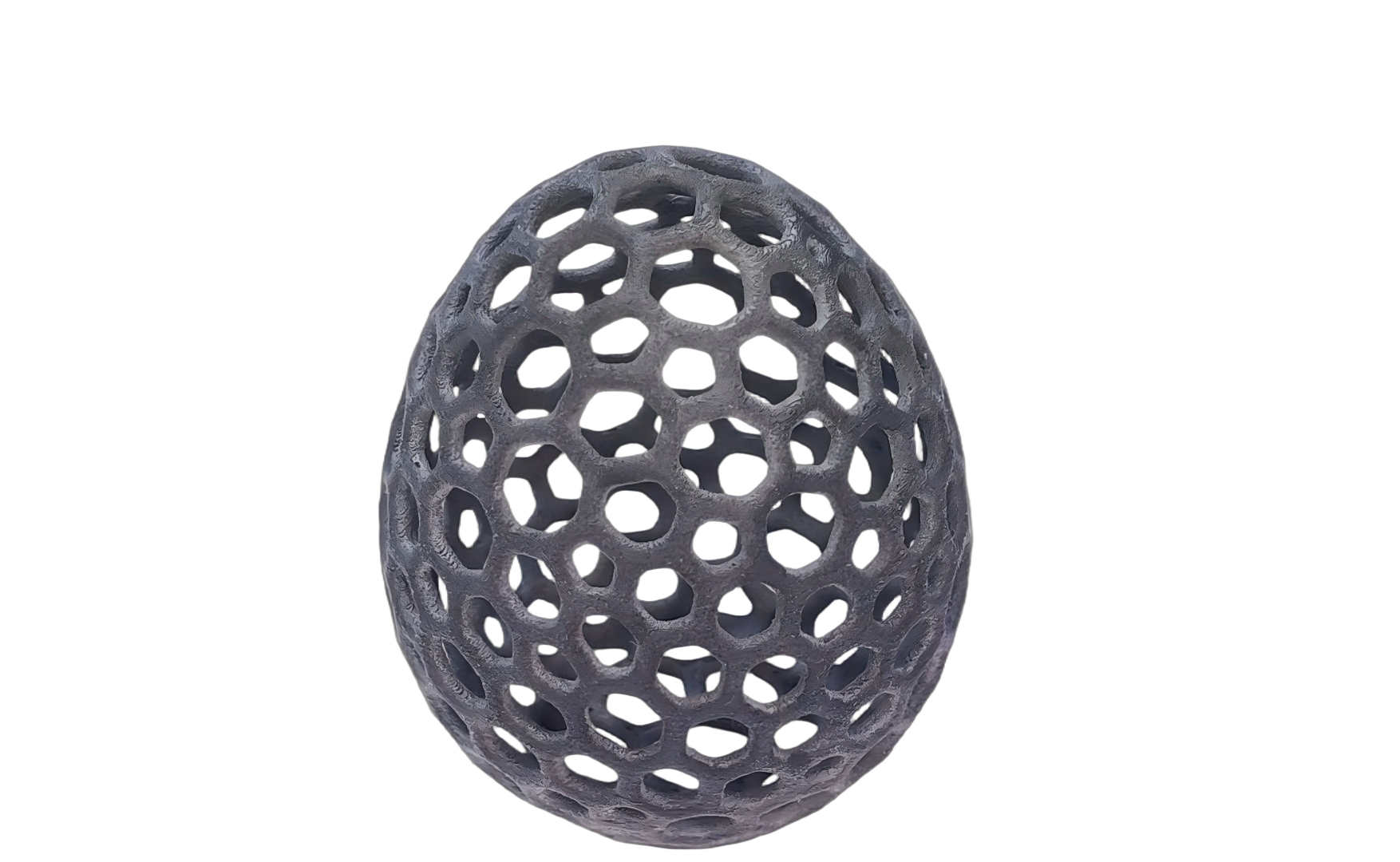
Four limitations appear repeatedly in practice. The surface arrives matte and slightly granular, which is an advantage for grip and a problem for appearance. Internal porosity is normal in powder-bed parts, so a part that must hold fluid or gas is usually sealed or machined on the sealing face. Layer bonding is weaker than the material inside a layer, so strength depends on orientation. And dimensional variation grows with part size, because cooling history differs across the build chamber.
None of these is a defect, but each changes what the part can be used for. A nylon part is an excellent functional component and a poor substitute for a machined sealing surface. Where a program needs both, the standard approach is to print the nylon body and machine the interface, which is common practice on manifolds, valve bodies, and parts with a gasket face.
Material safety is the other limitation that is rarely written down. Powder handling generates dust, and resin and powder handling in additive manufacturing is treated as an occupational exposure question rather than a housekeeping detail, which is why containment and extraction matter in a production environment.
How do you verify a powder and a part batch?
Verify the grade, the build record, and the part.
A material certificate identifies the grade, the build record shows what was actually built, and the part inspection shows whether the result meets the interfaces that matter.
Three levels of evidence are worth asking for on a functional program. At material level, the grade and its supplier documentation confirm what went into the machine. At process level, the build parameters, orientation, and bed position describe how the part was made, which is the record that makes a reorder repeatable. At part level, dimensional and functional inspection confirms the result against the tolerance framework and the interfaces that matter.
Powder condition is the variable buyers ask about most, and it is fair to ask how it is managed. Powder that has been through multiple build cycles changes in flow behaviour and in the way it fuses, so a supplier that tracks powder condition and documents the practice is a supplier whose batches can be compared. The measurement methods behind those claims follow the framework published by the NIST additive manufacturing program and the standards work coordinated through ASTM committee F42. Where a part is intended for a regulated application, the evaluation covers the material, the process, and the cleaning method together, as described in the FDA guidance on technical considerations for additive manufactured medical devices.
How does material choice affect cost and lead time?
Powder price is the smallest part of the difference.
Grade choice changes cost mainly through finishing, secondary machining, and how often a part has to be re-made, not through the price of the powder itself.
Specialty grades cost more per kilogram than unfilled PA12, but a part weighs little, so the material contribution to the price of a single component is usually modest. The larger effects come from what the grade requires afterwards. Filled nylon wears tooling during secondary machining. Elastomeric parts need different handling and are harder to hold to tolerance. Flame-retardant grades may need documentation that adds administrative time. And a grade that turns out to be wrong for the load case costs an entire build plus the delay.
Lead time behaves the same way. The build itself takes a similar amount of machine time regardless of grade, but the queue depends on whether the powder is stocked. An unusual grade may need to be ordered in before the build can be scheduled, which is worth checking before a launch date is fixed. For most programs, the useful question is not which grade is cheapest but which grade will still be right when the part is ordered again.
Should you compare SLS and MJF grades before committing?
Compare them, then decide on repeatability and finish.
Both processes use nylon powders with similar properties, so the decisive differences are surface texture, detail resolution, and how consistently a batch repeats rather than the material itself.
Where the same powder chemistry is available on both platforms, the comparison comes down to process behaviour. Powder-bed laser sintering and Multi Jet Fusion differ in how energy is delivered to the powder, which changes the surface texture and the smallest features that reproduce cleanly, and it changes how the bed is packed and how consistently parts cool. Buyers who need a repeatable appearance across many batches often find the jetting process more predictable, while buyers who need design freedom at lower volumes usually find laser sintering more flexible.
The practical approach is to have the same geometry quoted in both, with the finish specified per surface, and to compare the parts rather than the process descriptions. That comparison is also the moment to confirm the platform documentation, such as the build parameter information published for HP Multi Jet Fusion, against the material the part actually needs.
Selecting a powder with the second order in mind
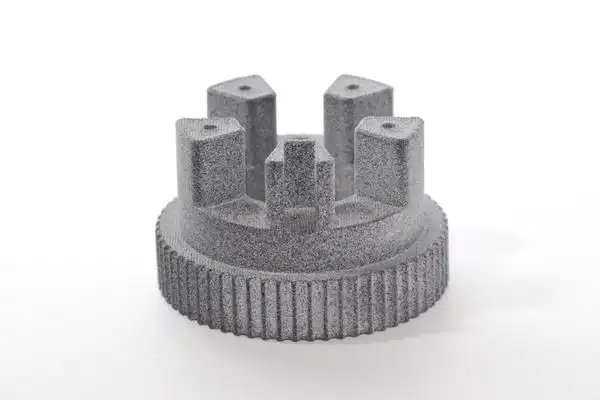
Material selection for powder-bed printing is a small decision with a long tail. The grade decides whether the part bends or cracks, whether it holds a thread, whether it can be machined afterwards, and how much finishing it needs. Those consequences are settled before the first build, and they are difficult to correct later without restarting the design conversation.
Two habits make the choice durable. Write the load case down before comparing grades, so the comparison has a criterion rather than a preference. And record the grade, orientation, and finishing recipe against the part number, so the second order produces the same part as the first. The remaining variables, such as surface texture and finish, are best resolved by building one sample of the final geometry rather than by comparing data sheets.
FAQ
Can SLS nylon parts be machined after printing?
Yes, and it is a standard practice rather than rework. Unfilled nylon machines cleanly and is often faced or bored where a tight interface is needed, which is how powder-bed parts end up with sealing faces and bearing bores. Glass-filled grades are more abrasive and wear tooling faster, and elastomeric parts are difficult to hold to tolerance at all. Where an interface must be exact, designating that face for machining in the original request avoids a second production step later.
Do SLS materials meet food-contact or medical requirements?
That depends on the specific grade and the specific application, and a process description cannot answer it. Regulatory evaluation considers the material, the manufacturing process, the cleaning method, and the intended contact together rather than the material alone. Porosity is normal in powder-bed parts, which is one reason sealing and cleaning validation matter for these applications. Treat any general claim that a powder is suitable for food contact or for medical use as a starting point for a documented evaluation, not as an approval.
How should colour and finish be specified on a nylon part?
Specify them separately from the material. Colour is normally applied by dyeing after blasting, which colours the surface rather than coating it, and the result depends on the base shade of the powder and on part thickness. Finish should be described by function: matte and uniform for cosmetic faces, machined where a face must seal, or sealed where the part holds fluid. Naming both on the drawing prevents a part that meets the colour requirement but not the surface requirement.
Does powder condition affect part quality between batches?
It can, which is why powder management is part of a supplier’s process control rather than a housekeeping detail. Powder that has been through repeated build cycles changes in flow behaviour and in how it fuses, and those changes can appear as differences in surface finish or in mechanical behaviour between batches. Ask how powder condition is tracked and how it is documented against the part record, and treat a clear answer as evidence that repeat orders will be comparable.
If the powder choice is still open, describe the load case rather than the material and let the geometry follow. 6CProto reviews manufacturability before production and runs powder-bed processes alongside machining and finishing, so a face that needs to be machined after printing stays inside the same order. Upload the model at the 6CProto quote page, or send the drawing to projects@6cproto.com.