

The two terms are used loosely, and the difference between them decides how the finished surface behaves. One uses spherical media that strike the surface and peen it; the other uses angular media that cut it, removing material and leaving a much rougher profile. The consequence shows up in the appearance, in the dimensional effect, in what happens to a thin section, and in whether a subsequent coating bonds. This comparison sets out how each process behaves, which substrates tolerate it, and how to choose based on the next step in the process rather than on habit.
Bead blasting or sandblasting: which should be used?
Bead for finish and coating prep, sand for heavy cleaning.
Bead blasting produces a gentle satin finish with minimal material removal, while sandblasting cuts aggressively and is used where heavy contamination or a deep profile is needed.
The distinction is one of intent. Bead blasting is chosen when a part needs to look uniform, when the surface is being prepared for a coating that requires a moderate key, or when a machined surface should be left dimensionally close to what it was. Its materials are spherical, and their effect is largely a peening action that deforms rather than removes.
Sandblasting, and the angular media used in the same equipment, are chosen when the requirement is removal. Heavy scale, thick rust, old coatings and contamination that has penetrated the surface all need a cutting action. The profile left behind is rough, which is exactly what some coatings need for a mechanical key, and exactly what disqualifies the process on a cosmetic part.
A third case sits between them: a part that needs cleaning but must keep its dimensions is better served by bead blasting or by a chemical process, because the cutting action of angular media removes measurable material and rounds edges quickly.
How does media hardness change behaviour?
Harder media cut; softer media deform.
The relationship between the media and the substrate determines whether the surface is peened or eroded, which is why the same process performs differently on steel and on aluminium.
Hardness relative to the workpiece is what matters rather than an absolute figure. A bead that is hard relative to the substrate will cut it; the same bead against a harder substrate will deform itself or bounce. That is why glass beads produce a gentle finish on steel but a more pronounced effect on aluminium, and why media selection has to consider both the abrasive and the material it strikes.
Media durability follows from the same relationship. Softer media break down as they are used, which gradually changes the composition of the media in the machine: the mix becomes finer, the finish becomes gentler, and the operating cost rises because the media is consumed. Harder media such as ceramic last longer and hold a steadier result, at a higher purchase price.
The practical implication is that the finish a shop produces on one day may differ from another if the media has degraded, which is one reason an approved reference sample matters more than a stated media specification. Where a program needs consistency, the media management practice belongs in the supplier conversation.
How do the surface profiles compare?
One is smooth and dimpled, the other rough and angular.
The profile produced by blasting is measured in terms of roughness and of the anchor pattern it provides, and the two processes sit at opposite ends of that scale.
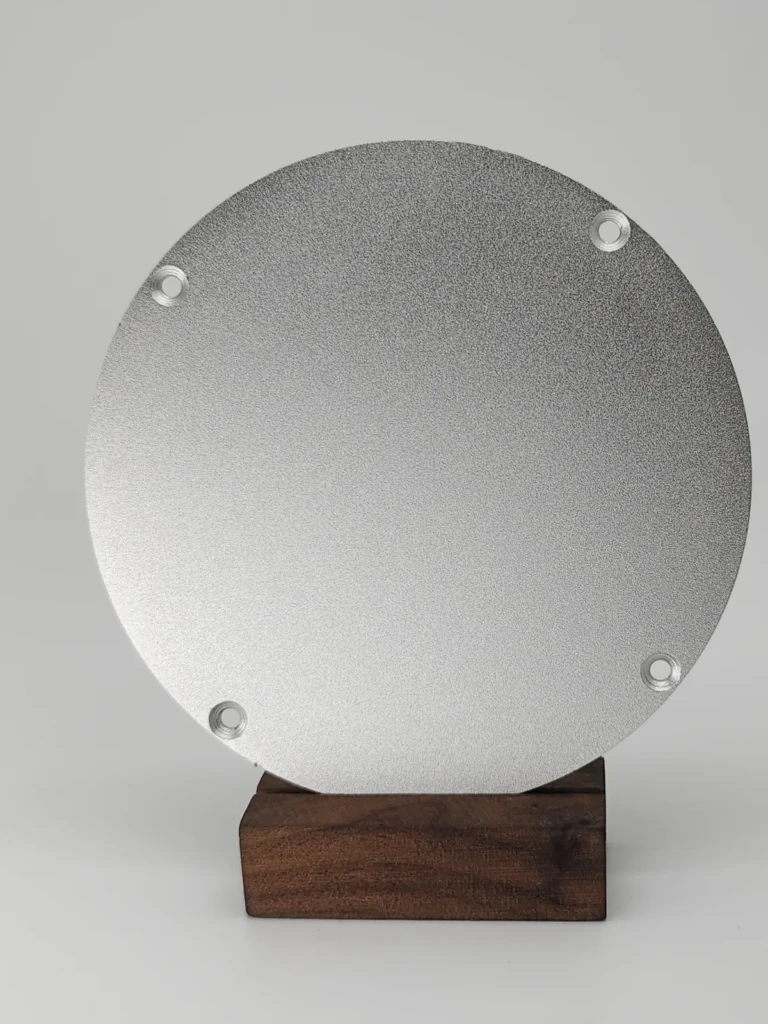
A bead-blasted surface has a dense, rounded texture. Its roughness is relatively low, and the profile is made up of overlapping dimples rather than sharp peaks. That surface scatters light evenly, which is why it reads as satin, and it provides a moderate key for coatings without removing much material.
An angular media produces a harsher surface with sharper peaks and deeper valleys. Its roughness is higher, and the resulting profile provides a stronger mechanical key for thick coatings and for adhesive bonding. The same profile is visible as a dull, rough surface that shows every edge and detail differently from a satin finish.
The measurement of those surfaces is described by the standards that cover surface texture and preparation, and the appropriate profile for a given coating is usually defined by the coating’s own specification rather than chosen independently. Where a coating supplier requires a specific anchor pattern, that requirement determines the media. The coating framework that defines those profiles is published by ASTM committee B08.
How do health, containment and equipment differ?
The dust differs, and so does containment.
Blasting generates airborne particulate regardless of the media, and the respirable fraction is a serious occupational consideration, which shapes the equipment and the operating practice.
Silica sand in particular carries a well-established health hazard when it becomes airborne and is inhaled, which is why its use is regulated and why many shops have moved to alternative media for general work. Glass beads and ceramic media present their own dust, which also requires containment and extraction, but the hazard profile differs.
Containment is part of the equipment rather than an accessory. Cabinets, extraction, ventilation and personal protective equipment form the system that keeps the dust away from the operator, and the requirement scales with the volume of work and the media used. Those controls contribute to the cost of the operation, which is one reason blasting is priced by handling time rather than by media consumption.
The regulatory framework for airborne contaminants and for industrial waste governs the practice, and the general industrial waste framework is published by the US Environmental Protection Agency. From a buyer’s perspective, the practical implication is that a supplier’s containment and practice are part of the quality of the service rather than an overhead. The materials behaviour that determines which media suit which substrate is documented by bodies such as ASM International.
| Factor | Bead blasting | Angular media (sandblasting) |
|---|---|---|
| Media shape | Spherical | Angular |
| Effect on the surface | Peens and cleans | Cuts and removes |
| Material removed | Minimal | Measurable |
| Finish | Uniform satin | Rough, dull profile |
| Edge behaviour | Rounds edges slightly | Rounds edges quickly |
| Coating key | Moderate | Strong anchor pattern |
| Typical use | Appearance, light cleaning, coating prep | Heavy scale, rust, strong bonding profiles |
Which substrates tolerate which media?
Soft substrates need gentle media.
Aluminium, brass and thin sections are sensitive to aggressive media, while steel and cast iron tolerate heavier profiles.
Aluminium is the classic case. It is soft, so angular media cut into it quickly, embed particles and distort thin sections. Glass beads at reduced pressure are the usual choice where an aluminium part needs a matte finish, and the process is managed carefully to avoid the smearing that soft metal produces under impact. The details are covered in the companion article on bead blasting aluminium.
Brass and copper behave similarly, being soft and prone to marking. A light bead blast produces an attractive satin finish on brass, while aggressive media produce a rough surface and remove detail from fine features. Where appearance matters on these materials, the gentler process is almost always the right answer.
Steel and cast iron tolerate more. Angular media are routinely used to remove scale and rust, and the resulting profile is acceptable because the surface will usually be coated or painted. Cast iron presents an additional consideration, because its surface includes graphite flakes and porosity that respond unevenly to blasting.
Thin sections are sensitive regardless of material. A panel that is a few tenths of a millimetre thick can be distorted by the peening action even with gentle media, which is why pressure, support and sometimes masking are part of the specification for those parts.
How does each affect tolerances and thin walls?
One leaves dimensions largely intact; the other cuts.
Bead blasting changes dimensions mainly at edges, while cutting media remove measurable material from every blasted surface and round edges quickly.
Where a part has a tight callout on a blasted face, that callout has to be considered. A cutting media will remove material from that face, and the amount depends on the media, the pressure and the time, all of which are controlled but not precise. On a dimension that was specified close to its limit, that removal can be the difference between conforming and not.
Edges respond faster than faces. A sharp edge presents many surfaces to the media stream and loses its definition quickly, producing a radius that may not be acceptable on a functional edge. Masking is the usual protection where an edge must stay crisp, and it is far more reliable than attempting to blast lightly enough to preserve it.
Thin walls can move as well as thin out. The peening action induces compressive stress at the surface, and on a thin section that stress is enough to bow the part. Where a thin-wall component must be blasted, the practical approach is to reduce pressure, support the part from behind and accept a gentler finish rather than to use an aggressive setting and correct the distortion afterwards.
How does cost compare?
Both are priced by handling, with masking as the variable.
Neither process is expensive per part at volume, and the difference in price comes from how long each part occupies the operator’s attention.
Cutting media remove material faster, so heavy cleaning is quicker with an angular media than with beads. Where the requirement is only appearance, beads may take longer to reach the desired finish but remove nothing that has to be corrected. The two effects roughly balance, and the deciding factor is usually whether the part also needs cleaning.
Masking is the largest controllable cost. A part with several threads and bores that must stay unblasted carries labour at both ends of the process, and each masked feature is a chance for an error. Reducing the masking list by allowing an allowance on non-critical features, or by choosing which features genuinely need protection, is the most effective way to control the cost of a blasting operation.
Media consumption is a smaller factor for beads, which break down and are partially consumed, and a smaller factor still for the hardest media. What matters more is the consistency of the result, because a rework cycle costs more than the media it saves. The surface preparation standards that describe the profiles are published by ASTM committee B08, and adhesion testing after coating by ASTM D3359.
Choosing by the next process step
The choice between bead blasting and an angular media is made by looking forward rather than backward. If the part needs to look uniform or is being prepared for an anodized or painted finish that requires a moderate key, beads are usually correct. If the part carries heavy scale, rust or an old coating, or if a thick coating needs a strong anchor pattern, an angular media is the practical route.
Two questions resolve most cases. What is on the surface that has to come off, and what has to happen afterwards? Adding the substrate to those two answers covers the sensitivity of the material, and the media follows. Where the part is soft, thin or dimensionally tight, the gentler process is the safer starting point, and a sample confirms whether it reaches the required finish. The media types available are compared in the existing 6CProto guide to blasting media.
FAQ
What is bead blasting used for?
Producing a uniform matte or satin finish, cleaning light contamination, rounding sharp edges slightly and preparing a surface for a coating. Because the media is spherical, it peens rather than cuts, so it removes very little material and leaves a dense texture that scatters light evenly. That makes it the usual choice for cosmetic machined parts and for surfaces that will be anodized.
What is the most effective blasting method?
There is no single best method, because effectiveness is defined by the requirement. For removing heavy scale and rust, angular media are the most efficient. For producing a cosmetic satin finish, beads are the most appropriate. For preparing a surface for a thick coating, a profile that matches the coating supplier’s recommendation is the effective choice. Matching the process to the requirement is what determines effectiveness.
Does blasting change the dimensions of a part?
Cutting media remove measurable material from any blasted surface and round edges quickly, so tight callouts have to account for them. Bead blasting removes far less, and its main dimensional effect is at edges, which lose definition as they are peened. On thin sections, the compressive stress from peening can also bow the part. Masking the features that must stay exact is the standard protection.
Can blasting be used on aluminium?
Yes, with gentle media and reduced pressure. Aluminium is soft, so aggressive media cut into it, embed particles and distort thin sections, and the metal can smear under impact rather than cutting cleanly. Glass beads at low pressure produce a uniform satin finish when the process is controlled. The outcome depends heavily on the media and pressure used, so a sample is worth producing before a batch runs. The test methods referenced in this article are published by ASTM committee D20.
If a part needs blasting before coating or for appearance, send the model with the substrate, the masking list and the finish that follows. 6CProto reviews the part together with the finishing route and returns a DFM report with the quote, so the media and the profile are matched to what happens next. Upload the file at the 6CProto quote page or send it to projects@6cproto.com.