

Vacuum casting is a casting method first and a prototyping service second. The vacuum exists for one reason: to remove the air that would otherwise leave voids and bubbles in a part that is supposed to look like a production component.
How vacuum casting works
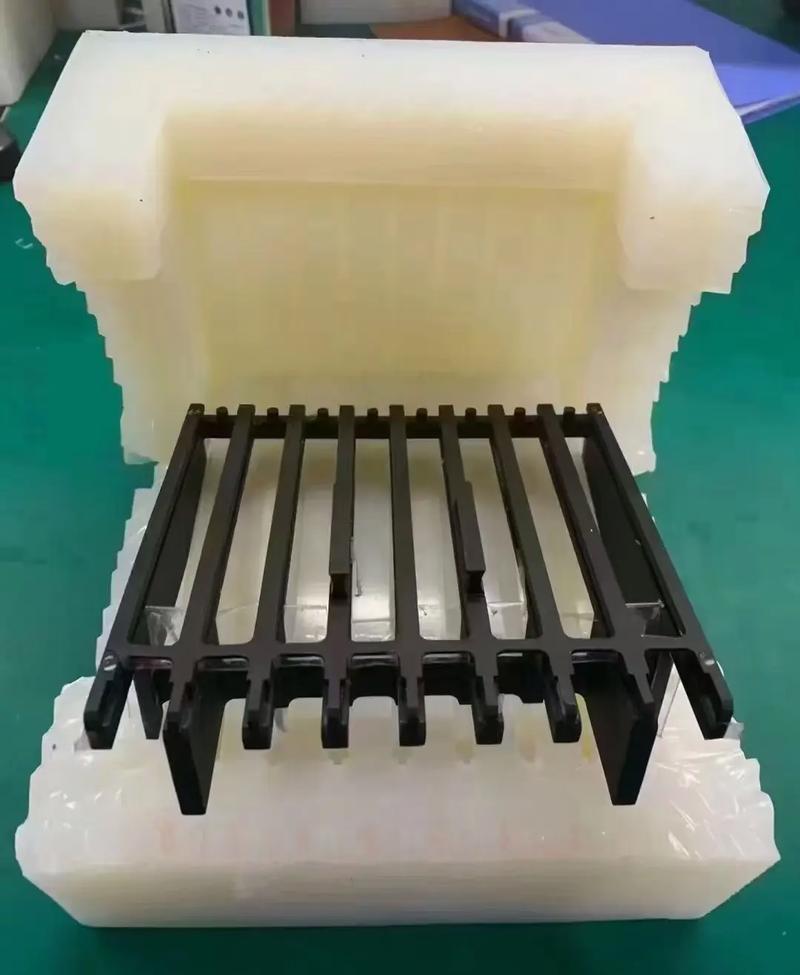
A master pattern is produced by machining or printing to the surface quality the cast part needs. A silicone mold is cast around it and cut open to release the pattern. The mold is then placed in a chamber, the air is evacuated, and polyurethane is introduced so that it fills the cavity without entraining bubbles. After curing, the part is removed, trimmed and finished. The vacuum is applied to both the mold and the resin, which is what distinguishes the process from simply pouring into an open mold.
| Step | Purpose | What it controls |
|---|---|---|
| Master pattern | Defines geometry and surface | Every part’s surface finish and detail |
| Silicone tool | Reusable mold, flexible release | Tool life, undercut capability |
| Evacuation | Removes air from mold and resin | Void and bubble content |
| Casting and cure | Fills the cavity and sets the material | Mechanical properties, warpage |
| Finishing | Trimming, painting, texture | Appearance and parting line quality |
Why vacuum rather than open pouring
Pouring polyurethane into an open mold traps air at the mold surface and inside any recess, which shows up as bubbles on a visible face or voids inside the part. Evacuating before and during the pour gives the air somewhere to go and lets the resin fill fine detail without turbulence. For parts with undercuts, thin sections or fine surface texture, that difference is the gap between a part that looks moulded and one that looks handmade.
The technique also affects mechanical consistency. Voids are stress raisers, so a part with internal bubbles will fail earlier than the same geometry without them, which matters when a prototype is going to be tested rather than only displayed. Where a cast part is used for functional trials, removing air is part of making the test meaningful.
Vacuum or pressure casting: which to specify
Vacuum for detail, pressure where density matters.
Vacuum casting removes air from the mold and resin before filling, which suits parts where surface quality and detail reproduction are the priority. Pressure casting, by contrast, forces resin into a closed mold under positive pressure, which fills difficult geometry and compresses any remaining bubbles. Some processes combine the two, evacuating first and then applying pressure.
For most prototype and appearance work, vacuum is the appropriate choice, and the decision only becomes interesting for parts that must be structurally consistent or must fill very thin sections. Rather than specifying the method, the clearer instruction is to state what the part must achieve — a visible surface free of voids, or consistent density for testing — and let the caster choose the technique.
Is vacuum casting expensive?
Cheap to set up, moderate per part.
It is cheap to set up and moderate per part. The silicone tool costs a small fraction of a steel mold and can be produced quickly, which makes the process economical for the tens to low hundreds of parts. The per-part cost reflects manual filling, curing, demoulding and finishing rather than machine time, so it does not fall as steeply with volume as injection molding does.
Where it becomes expensive is when the requirement exceeds what the process can hold. Tight tolerances, very large parts and long production runs all raise the cost of a cast route above a molded or machined alternative, and the answer in those cases is to change process rather than to push casting further.
Design limits that come with the silicone mold
The flexible tool is the source of both the process’s strengths and its limits. It releases undercuts that a rigid mold could not, which allows shapes like interlocking features and enclosed forms. It also deforms, so deep narrow cores can shift during casting and demoulding, and long thin features may not reproduce cleanly. Wall thickness should be kept within a workable range and reasonably uniform, and internal corners should be radiused so the material flows and the silicone resists tearing.
Tolerances are wider than injection molding, because both the tool and the cure contribute variation. The practical approach is to control the interfaces that matter — the features that assemble with other components — and allow the rest to sit under a general tolerance. Where a tight fit is essential, the usual solution is to cast the body and machine the critical feature afterwards. Material and property data are published by ASM International, and material and process terminology follows ASME standards.
What to send with a vacuum casting enquiry
The model or a description of the pattern is the starting point, but the useful enquiry adds four items: the quantity, the material properties the part needs, the surfaces that must be free of marks, and the tolerances that affect assembly. Mentioning that several cosmetically matching parts are required is also valuable, because it tells the supplier that colour and finish consistency across the batch matters as much as geometry.
It also helps to say what happens next. A part intended for a photograph has different finishing priorities from one that will be assembled and tested, and a part intended to validate a production design has to reproduce the features that carry function. That context lets the caster choose the pattern quality and the finishing level rather than applying a default. Inspection practice for the resulting part is described by the NIST Manufacturing Extension Partnership, coating and surface terminology follows ASTM Committee B08, the tooling-light alternative to casting is covered under 3D printing, and process obligations are set out by the US EPA.
Send the model with the quantity and the surfaces that must be clean, and request a vacuum casting quote with the pattern route stated.
FAQ
How does vacuum casting work?
A silicone mold is made from a master pattern, then placed in a chamber where air is removed from both the mold and the resin before filling. The part cures, is removed, trimmed and finished, with the vacuum preventing the voids that open pouring would leave.
Is vacuum casting expensive?
Set-up is inexpensive because the mold is silicone, while the per-part cost reflects manual filling, demoulding and finishing. It is economical for tens to low hundreds of parts and becomes uncompetitive when tolerances, size or volume point to molding or machining.
Should I specify vacuum or pressure casting?
Vacuum suits parts where surface quality and detail matter; pressure casting fills difficult geometry and compresses remaining bubbles. Stating what the part must achieve is more useful than naming a technique, since some processes combine both.