

Sheet metal is the fastest route from a drawing to a real enclosure, because nothing has to be tooled. The trade-off is that the same flexibility makes it easy to keep changing the part, and the point where a prototype stops being a prototype is usually a decision about tooling rather than about design.
How a sheet metal prototype is actually produced
The route is short: the flat pattern is developed from the model, the blank is cut, the edges are formed on a press brake, hardware is pressed or riveted, and the part is finished. Each stage uses general-purpose equipment, which is why a first article can be produced without tooling cost and why a late design change can usually be absorbed by rewriting the program rather than rebuilding a die.
| Stage | What it does | What it costs |
|---|---|---|
| Flat pattern development | Converts the formed part into a blank using a bend allowance | Engineering time, once |
| Blanking | Laser cutting or punching the outline and features | Machine time per part |
| Forming | Bends performed in sequence on a press brake | Setup plus cycle time |
| Hardware insertion | Press-fit inserts, standoffs, clinch nuts | Per insert, plus tooling if special |
| Finishing | Deburring, blasting, coating, anodizing | Handling plus process |
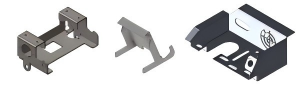
Which process choices matter at prototype quantity
Three choices move cost more than anything else at low quantity. Blanking by laser is cheaper to set up and slower per part than punching, so it suits one-off parts; the reverse applies as quantity grows. Forming sequence determines how many times the part is handled on the brake, and every extra handling is a chance for a bend angle to drift. Hardware insertion can be done before or after finishing, and the choice affects whether the coating survives the press.
The fourth variable is the flat pattern itself. A blank developed with an inconsistent bend allowance produces a part that is dimensionally correct in the model and wrong on the bench, and correcting it means recutting rather than adjusting. It is worth confirming that the same assumption was used on both sides before the first blank is cut, because a blank recut from a corrected pattern costs more than the confirmation would have.
Should you send a flat pattern or a formed model?
Send the formed model, not the flat pattern.
A solid model of the finished part tells the supplier what the result must be, and the flat pattern is derived from it using a bend allowance the shop can justify. Sending a flat pattern without the formed model removes that reference, so any difference between your development assumption and theirs only appears after forming.
There is one situation where the flat pattern is the more useful file: when the part already exists and the goal is to reproduce it. In that case supplying both the flat pattern and a measured sample removes the ambiguity, because the sample settles questions about bend radius and springback that a model alone cannot.
Tolerances worth specifying on formed parts
Formed sheet metal accumulates tolerance differently from a machined part. Bend angle, bend position and material springback all contribute, so error grows across a series of bends rather than staying constant. The features that usually deserve individual control are the hole positions that locate an assembly, the overall envelope, and any face that seats against another component.
Everything else can follow a general note. That structure keeps the drawing readable and concentrates inspection where it changes whether the part fits. Where a part carries a flatness requirement — a mounting face, for example — it is worth stating it explicitly, because a formed face that looks flat can still be twisted enough to rock on a mating surface. Drawing conventions follow ASME standards, and dimensional verification practice is described by the NIST Manufacturing Extension Partnership.
When does prototype sheet metal become a production part?
When setup time stops dominating the unit price.
At low volume, the cost of a part is mostly the time spent setting up the brake, the laser and the hardware press. As quantity rises, that fixed time is spread across more pieces and the per-part cost falls; eventually the point arrives where dedicated blanking or forming tooling becomes cheaper per part, and the process switches.
That switch is not purely financial. Dedicated tooling fixes the bend sequence, which reduces variation between parts and makes the process easier to control across a long run. Where a design is expected to change again, staying on general-purpose equipment keeps revisions cheap; where it is frozen, moving to tooling improves consistency as well as cost.
Where a prototype has to satisfy a written requirement rather than only fit, three references settle most of the questions that arise. Drawing and tolerance conventions follow ASME standards, coating and surface-condition callouts follow ASTM Committee B08, and the environmental obligations that apply to cutting, blasting and coating lines are published by the US EPA. Measurement practice for the finished item is described by the NIST Manufacturing Extension Partnership, and material behaviour data comes from ASM International.
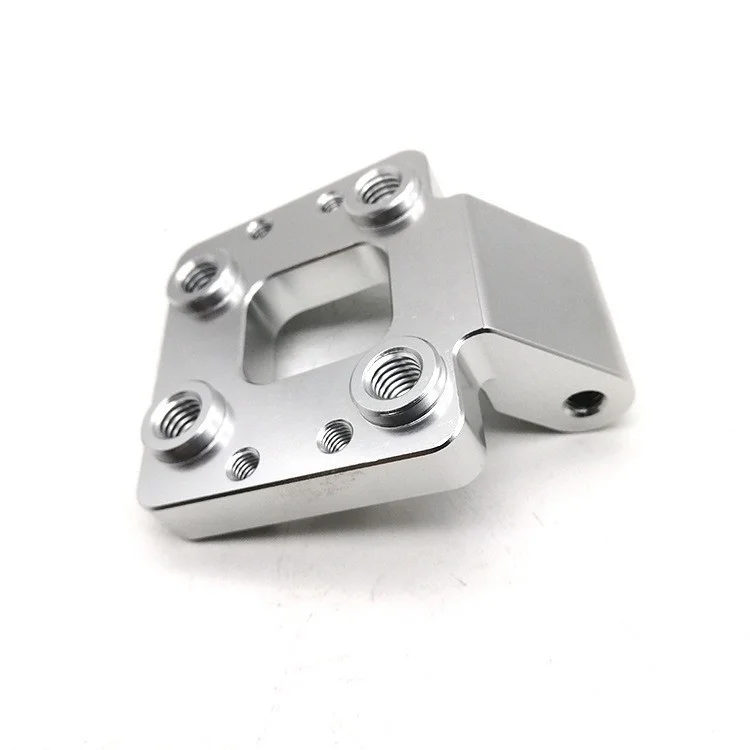
Send the formed model with your quantity, material and hardware list, and request a sheet metal prototype quote.
FAQ
What drives the cost of a sheet metal prototype?
Setup time dominates at prototype quantity: brake and laser setup, the number of bends, and the hardware operations. Material and cutting time matter, but they rarely explain why two quotes for the same bracket differ.
How many sheet metal prototypes should I order?
Enough to assemble, test and keep a reference sample, and no more. Ordering extra pieces mainly spreads the setup cost, so the useful number is set by how many tests the design has to survive rather than by a price break.
Can sheet metal prototypes be finished like production parts?
Yes, and it is worth doing when appearance or corrosion matters, because the finish affects how the part assembles. Coatings add thickness, so hardware fitted before coating may no longer accept a mating component afterwards.