

Aluminium is chosen for weight, corrosion behaviour and thermal conduction, and then it behaves nothing like steel on a press brake. Springback is larger, the surface marks more easily, and the material will not tolerate being welded directly to a steel structure without consequences.
Which aluminium alloys actually form
Formability varies enormously between the alloy families. The 5052 grade is the usual default for formed parts: it bends cleanly, resists corrosion in marine and wet environments and takes anodizing predictably. The 6061 alloy is stronger and machines well but bends less generously, particularly in thicker sections, and it is more prone to cracking on a tight radius. Pure and near-pure grades bend very well but carry little strength. The 7075 family is a machining material rather than a forming one.
| Alloy family | Forming behaviour | Typical use |
|---|---|---|
| 5052 | Excellent; generous bend radii | Panels, brackets, corrosive environments |
| 6061 | Moderate; needs larger radius in thick sections | Structural brackets, machined and formed parts |
| 3003 | Very good; lower strength | Non-structural covers and ducting |
| 7075 | Poor; not a forming grade | Machined components only |
Why springback matters more on aluminium
Aluminium has a lower elastic modulus than steel, which means it deflects more under the same stress and recovers more when the forming force is removed. The result is greater springback: the brake has to over-bend further to leave the target angle. The effect grows with the radius-to-thickness ratio, so a part that forms easily in thin 5052 can need significant compensation in thicker 6061.
The practical consequence for a drawing is that bend angles should carry a realistic tolerance rather than an exact value, and that the bend sequence should be planned by a shop that works with aluminium regularly. A supplier who forms mostly steel will produce the correct blank and the wrong angle.
Why aluminium and steel should not be left in contact
Because the pair forms a galvanic couple.
When two dissimilar metals are joined and moisture is present, the more active one corrodes preferentially, and aluminium is the one that gives way when paired with steel. The effect concentrates at the joint, which is exactly where structural load is carried, and it accelerates in wet, salty or humid conditions.
The standard responses are to isolate the joint or to avoid it. Isolation can be achieved with a coated interface, a gasket, a non-conductive washer or a plated fastener, and the choice depends on whether the joint also has to conduct electricity or heat. Where the joint must carry load, an isolating layer that creeps under pressure is a poor solution, so the design usually separates the materials or uses a transition piece.
Surface condition, and where finishing fits
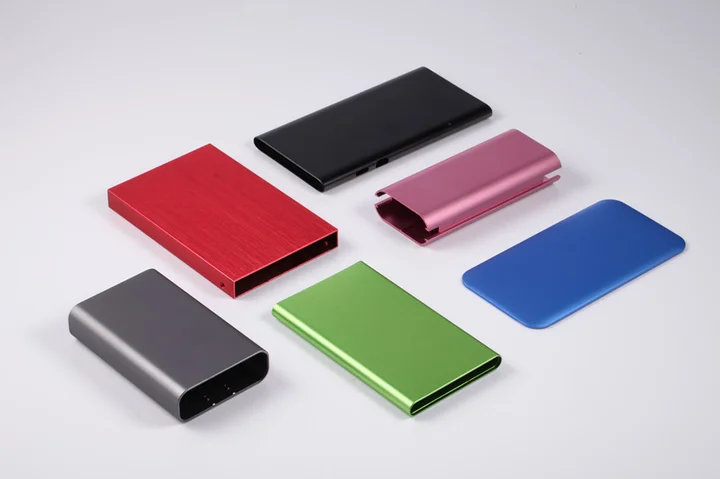
Aluminium marks easily, which makes handling a design consideration rather than a workshop detail. A protective film applied before forming and removed after coating keeps a visible panel clean, and naming the cosmetic faces on the drawing tells the shop which surfaces to protect. Anodizing is the usual finish for structural and visible parts, and its thickness and colour class should be stated because both affect appearance and, on tight features, fit.
Two interactions are worth remembering. Anodizing grows a layer on the surface, so threads and press fits sized before coating may not accept their mating parts afterwards; masking is available but is a handled cost. And a brushed or grained finish has a direction, which matters if the panel is formed after finishing. Coating and surface-condition classifications follow ASTM Committee B08, material properties are published by ASM International, and drawing conventions follow ASME.
Cost comparison with steel, in context
Aluminium sheet is generally more expensive per unit weight than mild steel, and because it is also less stiff, a part made in aluminium often needs a thicker gauge or an added flange to match the rigidity of a steel equivalent. The weight saving therefore has to justify both the material cost and any geometry that had to change to reach the same performance.
That calculation usually favours aluminium where weight affects the whole system, where corrosion resistance removes a finishing step, or where thermal conduction is part of the function. It usually favours steel where stiffness is the dominant requirement and weight is not critical, because the cheaper material also needs less section. Measurement practice for formed aluminium parts is described by the NIST Manufacturing Extension Partnership, and the environmental rules covering coating and cleaning lines are published by the US EPA. Fabrication detail sits under forming and bending and laser cutting.
Getting the best out of aluminium on the shop floor
Three practical habits improve the result on formed aluminium parts. Keep the drawing’s bend radii within what the chosen alloy tolerates, because a radius that works in steel can crack 6061 in a thicker section. Specify the material direction relative to the bend line where a part is formed from an anisotropic sheet, since bending across the rolling direction behaves differently from bending along it. And protect visible faces during handling, because aluminium marks more readily than steel and a cosmetic panel that is scratched during forming cannot always be recovered by anodizing.
Where a part is both machined and formed, stating which operation produces the controlled features avoids a mismatch between the two. Aluminium machines quickly, so it is often cheaper to establish a critical face by machining after forming than to hold it through the forming operation. Machining detail for these features is covered under CNC milling.
Send the model with the alloy and finish you intend to use, and request a quote for aluminium sheet metal fabrication.
FAQ
Why can’t aluminum and steel be joined without protection?
The pair forms a galvanic couple, and in the presence of moisture the aluminium corrodes preferentially at the joint. Isolating the interface with a coating, gasket or plated fastener, or separating the materials, prevents the reaction.
Is aluminium sheet cheaper than steel?
Usually not per unit weight, and the gap widens in practice because aluminium is less stiff, so a part often needs a thicker gauge or added flanges to match a steel equivalent. The weight saving has to justify that difference.
Which aluminium alloys are best for formed sheet parts?
The 5052 grade is the usual default because it bends cleanly and resists corrosion; 3003 forms well at lower strength, while 6061 needs larger bend radii in thicker sections and 7075 is a machining grade rather than a forming one.