

A narrow slot reaches quotation with a closed floor, but the request asks for wire EDM. The shop must clarify the geometry before it can price the intended feature. A wire EDM vs sinker EDM decision begins with electrode access and the required surface, not simply the material hardness or the smallest visible corner.
Feature types each process owns
Choose wire EDM for conductive features accessible to a continuous wire path, and sinker EDM for suitable cavities formed by a shaped electrode. Confirm openings, depth, corner geometry, material state, and surface-integrity requirements. Review milling as an alternative or preceding operation, then quote the complete route through finishing and inspection.
Sodick’s EDM explanation distinguishes wire and die-sinking approaches. That distinction matters when a drawing shows a closed-bottom cavity: a wire path through the material is a different manufacturing arrangement from an electrode approaching the cavity from an accessible direction.
Mark which regions are through features and which must retain a floor. For an internal wire-cut contour, identify how the wire enters and how the remaining material is supported. Do not assume that calling a feature EDM-ready resolves access. The EDM machining review should show the proposed route for the actual geometry.
Surface integrity and recast concerns
Specify surface integrity separately from roughness and appearance. EDM is a thermal removal process, so a smooth-looking surface does not by itself establish an acceptable near-surface condition. Identify whether the application requires additional treatment or verification and what evidence the supplier must provide.
Makino’s discussion of EDM surface effects distinguishes the heat-affected region from recast material. Avoid treating the terms as identical, and do not demand an unspecified recast-free result without defining the required evaluation and process scope.
Keep the surface-texture requirement on the drawing as a separate characteristic. Mitutoyo’s roughness resource addresses that measurement topic. An Ra result cannot stand in for a metallurgical assessment. Where integrity is critical, agree the relevant acceptance method with the responsible engineer before comparing quotes based only on geometry and visible finish.
Electrode vs wire consumables impact on lead time
Wire and sinker routes create different preparation work. A sinker proposal may include electrode design, manufacture, setup, wear management, and more than one electrode or finishing stage. A wire proposal may include starting access, path planning, threading, support of the remaining material, and finishing cuts. Ask what the quoted scope includes.
Reliable EDM’s wire-process handbook section discusses starting methods and planning for wire-cut features. A starting hole is not merely a shop convenience when its location or remaining witness affects the part. Review it with the controlled geometry.
Request a project-specific schedule based on that work rather than publishing a universal lead-time comparison. A repeated sinker feature can reuse approved electrode design knowledge, while a one-off cavity can require significant preparation. Conversely, a difficult wire path or demanding finish can add work beyond a simple through-profile cut. Quantity and drawing stability can change the comparison.
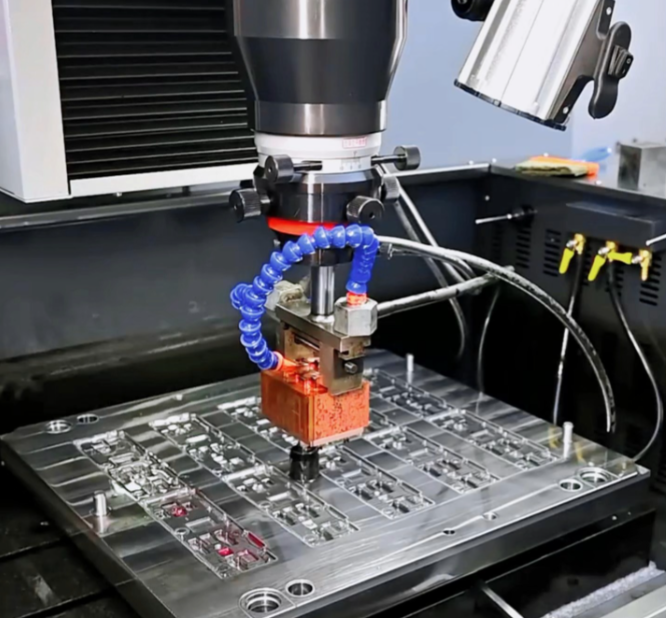
Table: selection matrix
Select the route by the feature that must be delivered and the evidence needed to accept it. The same component can combine milling, wire cutting, and sinker work if each operation has a clear role. Do not force one process to own every feature merely to simplify the purchase description.
The table identifies the first questions to resolve. It does not imply that every example is feasible on every machine or with every material condition.
| Feature or requirement | Wire route question | Sinker route question | Decision evidence |
|---|---|---|---|
| Through contour | Is a continuous path and starting access available? | Would a shaped electrode add unnecessary work? | Geometry and support plan |
| Closed-bottom cavity | Does the required floor prevent the proposed path? | Can the electrode approach and remove material effectively? | Section view and electrode access |
| Small internal corner | What radius follows from wire and process conditions? | What electrode geometry and wear are practical? | Quoted corner requirement and trial evidence |
| Critical surface condition | Which finishing or verification steps are needed? | Which finishing or verification steps are needed? | Defined texture and integrity criteria |
Drawing notes for EDM
State material grade, condition, critical sections, datum relationships, surface requirements, and the final acceptance state. Identify whether dimensions apply before or after another finishing operation. If a corner radius is functionally important, dimension the allowed result rather than asking for a theoretically sharp corner.
ASME Y14.5 provides the language for geometric requirements. Use it consistently with the selected drawing standard, and show the relationship between the EDM feature and any surfaces produced earlier. A precise cavity cut in the wrong relationship to the assembly datums is still nonconforming.
For the precision machining review, ask how the part is located, how access is created, and how the final feature is inspected. Include any prohibition on start holes, witness marks, or local hand finishing. If those restrictions make the route uncertain, resolve them before electrode or fixture preparation begins.
FAQ
These questions address specification details that should be settled before sample approval.
Can a nonconductive material be quoted for ordinary wire or sinker EDM?
Not on the same assumptions as a conductive workpiece. Identify the actual material and required process before accepting an EDM route. Specialized variants or alternative manufacturing methods require their own feasibility review. A generic hard-material description is insufficient, and a supplier should not silently substitute another process without approval of the resulting geometry and surface requirements.
Does a smaller corner automatically make sinker EDM preferable?
No. Review depth, access, electrode geometry, material condition, wear, and the actual allowed radius. Wire may be suitable for an accessible through feature, while sinker may suit a cavity with a different approach. The final corner requirement should be agreed from the application and verified on the part rather than selected from an isolated process label.
Can the same surface test approve both roughness and recast requirements?
Not by default. They address different characteristics and may require different methods. Define the texture parameter and its measurement conditions separately from any metallurgical or surface-integrity evaluation. If additional finishing removes material, include its effect on dimensions and the inspection sequence. A favorable appearance or roughness reading alone does not close an integrity requirement.
Related process selection notes
Consider EDM when the feature, conductive material, or access makes the proposed cutting route useful. Consider milling or another preceding operation where it can efficiently create the open geometry or remove bulk material without compromising the final requirement. Hardness alone does not settle the decision.
Review the complete CNC machining sequence, including material condition changes and any operation after EDM. If heat treatment, coating, or surface removal can alter the accepted feature, define when final inspection occurs. Keep processing and inspection responsibility visible even when several operations are combined in one quotation.
A useful technical response explains why wire or sinker is selected for the specific feature and identifies the work that remains outside that operation. It should not rely on an unverified machine accuracy or a generic promise that EDM eliminates every finishing requirement. The drawing and application determine the accepted result.
Internal links and next steps
Submit the model and controlled drawing with section views of the EDM features, material and condition, quantity, required records, and any surface-integrity acceptance criteria. Mark the surfaces used for location and the regions where starting access or witness marks are prohibited.
Ask the supplier to return the proposed wire path or electrode approach, preparation scope, finishing sequence, and inspection method. Keep uncertain assumptions explicit, including the minimum acceptable radius and any additional access feature. Approval should close these questions before work starts rather than transfer them to the final inspection team.
Send 6CProto the production-feature drawing for an EDM quote and DFM review. Request the process choice and its preparation, finishing, and verification assumptions as part of the response.