

Plastic extrusion is the quiet process behind thousands of everyday parts: a profile with a constant cross-section that runs for meters and gets cut to length. It is also one of the most often mis-specified processes, because people treat it like machining or injection molding when it has its own rules. Extrusion produces a continuous shape from a die, and the material, profile geometry, and post-processing decide whether the part is right. This article explains how plastic extrusion works, which materials and profile shapes it suits, and how to specify a custom profile so it comes out straight, stable, and fit for its application.
How Plastic Extrusion Works
Plastic extrusion feeds resin pellets into a heated screw, which melts and mixes the material, then forces it through a die with the profile opening. The profile emerges continuously, cools, and is pulled and cut to length. The die sets the cross-section; everything downstream maintains it. That is both the strength and the constraint: a constant profile is cheap to produce in length, but the die is the tool, and the profile has to be formable and keep its shape as it cools, in the orientation it is pulled.
Why Extrusion Fits Constant Profiles
Extrusion wins for profiles that are constant along their length: seals, gaskets, edging, tubing, tracks, channels, and strips. The economics favor it because the die cost is moderate and the per-meter cost is low, so a profile with steady demand for length pays off quickly. When the cross-section changes along the part, or the part is short and complicated, extrusion stops being the answer, and machining, molding, or a combination takes over. The decision begins with one question: is the cross-section constant?
Materials for Extruded Profiles
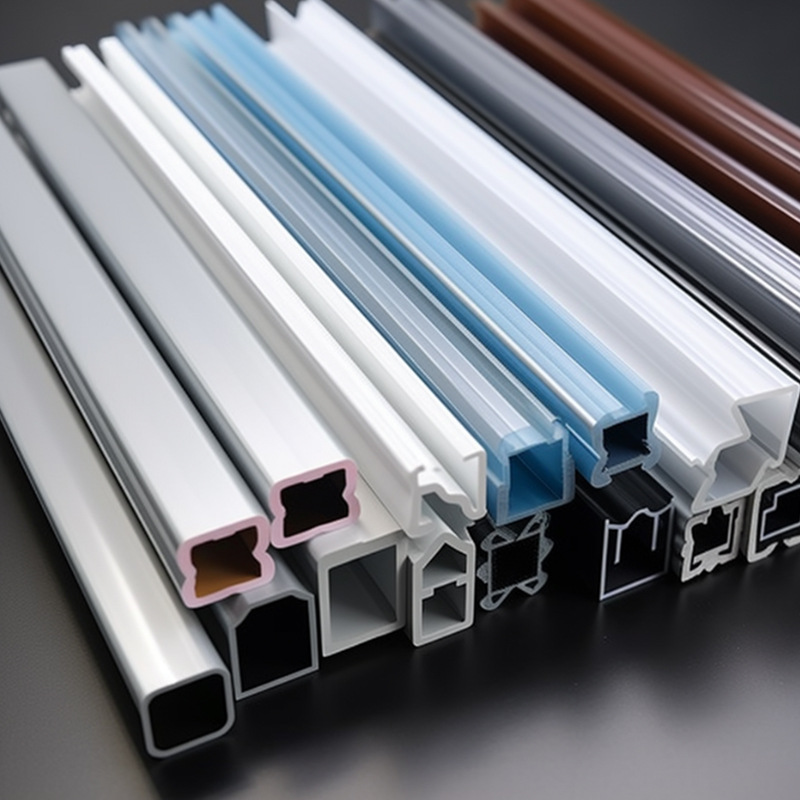
The material is chosen by the service environment and the physical requirement. PVC is common for edging and conduit, flexible and rigid grades both available. Polyethylene and polypropylene suit chemical resistance and light mechanical duty. Nylon and glass-filled materials add strength and hardness for functional profiles. TPEs and thermoplastic elastomers make flexible seals and gaskets. Each material sets the die design, the pull speed, and the cooling behavior, and a profile that works in one material may require a different geometry in another, so the material and the profile are specified together.
Profile Design Rules
Profile geometry has to obey extrusion rules or the part warps at the die. Wall thickness should be reasonably uniform: thick and thin sections cool at different rates and pull to different drawdown, causing warpage. Sharp internal corners concentrate stress and cool fast; add radii. Deep, narrow slots are hard to fill and can trap air. The drawdown, the slight shrinkage as the profile cools and is pulled, has to be allowed for in the die, so the cold profile matches the drawing. A profile design that follows these rules extrudes straight and stable; one that ignores them fights the process for its whole length.
Post-Processing and Finishing
Extruded profiles are rarely used raw. They are cut, machined, drilled, and sometimes finished: anodizing and painting apply to metals; plastics get pad printing, texturing, or color matching. Profiles are also joined into assemblies with brackets, hardware, and welds. The finish and the secondary operations affect the part, so state them at RFQ and confirm whether they change the dimension. A profile that is machined or drilled after extrusion carries the machining tolerance at the feature, and the profile tolerance along its length.
Length, Straightness, and Tolerances
Profiles are specified over length, and the practical tolerances are along the length, not the cross-section. Straightness, twist, and cut length matter; the profile can wander as it cools or in the pull. Confirm what the application needs: a straight strip for edge installation, a length that is cut square, a profile that must not twist over its length. The supplier holds what the die and the line can deliver, so a straightness or twist requirement has to be realistic for the profile’s aspect ratio.
When Machining or Molding Is Better
Extrusion loses when the part is short, has a changing cross-section, or needs features that the die cannot form. A short complex plastic part is usually machined or molded. A profile with a changing section along its length is an extrusion contradiction, so it is assembled from profiles or produced another way. The honest analysis compares extrusion’s low per-meter cost against the tooling and the geometry match; the process that fits the shape and the volume is the one to use.
What to Put in the RFQ
- The profile drawing with the cross-section and the length, squared.
- Material grade and any fill or additive, with the environment it must survive.
- Post-processing and finish, and whether they change dimensions.
- Tolerance classes: cross-section, length, straightness, and twist.
- Quantity in length and any ordering by the meter.
Bottom Line
Plastic extrusion is the efficient answer for constant-profile plastic parts, producing low-cost length from a die, in materials from PVC to nylons and elastomers. It works when the cross-section is constant and the profile follows the rules of wall uniformity, radii, and drawdown. Specify the material, the post-processing, and the length-related tolerances, and keep the geometry extrusion-friendly. A profile specified that way extrudes straight, stays stable, and does its job for its whole length.
Material Behavior in the Die and the Drawdown
Plastic extrusion is a thermal process, and the material’s behavior inside the die decides the profile’s quality. Every resin has a processing window of temperature and pull speed, and the drawdown, the slight shrinkage as the profile cools and is pulled, has to be accounted for in the die so the cold profile matches the drawing. A profile designed outside the material’s window extrudes with surface defects, dimensional error, or warpage. The die design and the line settings carry the material knowledge; a supplier that can explain the drawdown for your material is one that will hit the dimension.
Post-Processing and Assembly With Profiles
An extruded profile is rarely used raw. It is cut, machined, drilled, joined, and sometimes finished, and each step carries its own tolerance and cost. The machining tolerance at a cut or drilled feature is independent of the profile tolerance along the length, so state both and confirm where each applies. Joining profiles into assemblies adds the joint tolerance, and finishing changes the surface. The RFQ that lists the post-processing and assembly steps gets a quote that covers the real part.
Short Profiles and the Extrusion Minima
Extrusion economics depend on length, and a short profile order pays for the die and the line setup over few meters. Confirm the minimum order and the per-meter cost at the real quantity, because the extrusion savings appear only over length. For a very short profile, machining a formed part or a short run of a hybrid route may be cheaper than opening the extrusion die. The volume and the length decide whether the process pays, and the comparison belongs in the RFQ.
When to Combine Extrusion With Other Processes
The strongest profiles are often part of a system: an extruded track with a machined bracket, an extruded housing with a molded end cap, an extruded seal with a metal insert. Combining extrusion with machining, molding, or sheet metal gives a part that is cheap in length and precise at the features. The interface between the processes has to be tolerant and the joining method confirmed, but the combination is how constant-profile economics meet the features the profile alone cannot carry.
Quality Control on the Extruded Length
Quality control on a profile is about the length and the section both. The cross-section is set by the die and checked with a gauge or micrometer at intervals; the straightness and twist are about the pull and the cooling line; the length and the squareness are about the cut. A profile that passes the section check and fails on length or twist is a profile that binds at assembly. Confirm the checks and the tolerance classes at RFQ, and inspect a first article rather than trusting the length.
The Tolerance Classes a Profile Runs On
A profile drawing carries several tolerance classes at once: the cross-section inside the die, the wall thickness through the wall, the length of the cut, and the straightness or twist along the run. Each is set by a different piece of the line, and each should be stated separately so the inspection can check it. A profile that is within cross-section tolerance and out of straightness binds at installation, and a length cut to a loose class turns a precise assembly into an exercise in shimming. State the classes and confirm the inspection, because the wireline is only as good as the spec that runs on it.
Confirming the Die and the First Run
Extrusion quality is locked at the die trial. The first run through the die proves the profile, the drawdown, and the pull settings before any length is committed. Confirm that the supplier runs a die trial and a first-article check on the profile’s cross-section, length, and straightness before cutting the order. A die that comes out slightly wrong and is patched on the first order leaves the error in every meter. The die trial is the extrusion equivalent of a first article, and skipping it is how a profile carries its defect for its whole life.