

Explore Injection Molding Design & Tooling
Three different checks can lead a housing team to three different resin choices: a cold drop, a warm loaded assembly, and a finished cosmetic sample. A PC vs ABS injection molding comparison should preserve those separate questions. A material that passes one is not automatically qualified for the other two.
What housings ask of the resin
For PC vs ABS injection molding, select a specific grade against the housing’s impact temperature, heat exposure, assembly loads, finish, and chemical environment. PC, ABS, and PC/ABS describe material families rather than guaranteed performance levels. Compare equivalent test conditions, then validate representative molded housings with their actual bosses, snaps, coatings, and interfaces.
Start a selection checklist with what the enclosure must survive: handling drops, fastener loads, operating temperatures, cleaning, outdoor exposure, and any optical or electrical requirement. Separate essential acceptance limits from preferences so that a more expensive material is not chosen to solve a requirement the product does not have.
The PC material page and ABS material page are starting points for the manufacturing discussion. The RFQ still needs the exact proposed grade and the evidence supporting its use. Color, additives, and processing history belong in that identification.
Impact and heat deflection trade-offs
Check the test method and conditions before ranking impact values. A notched coupon result is not an enclosure drop-test result, and values measured at different temperatures may lead to the wrong selection. ASTM D256 addresses Izod pendulum impact testing of plastics; it does not duplicate every load path in a finished housing.
Keep thermal screening separate from the operating requirement. ASTM D648 addresses deflection temperature under flexural load. Its result should not be presented as a universal continuous-service temperature or a guarantee for a loaded snap assembly.
Covestro’s Makrolon portfolio shows that polycarbonate is offered in multiple grades and property combinations. Select candidate grades with the required temperature and impact evidence, then test the housing in its actual assembled state. Pay particular attention to corners, screw bosses, and other features that concentrate load during a drop.
Cosmetic and coating readiness
Approve appearance on the molded and finished condition that will be delivered. A natural-resin plaque does not represent a textured, pigmented, painted enclosure. Gate location, flow marks, texture, and local geometry can affect the visible surface even when the resin identity is unchanged.
Ask whether color will be integral or applied through a coating, and identify any areas that must remain uncoated. A mating surface or flexible latch can need different treatment from the main cosmetic panel. Keep coating chemistry and cure exposure within the material and assembly review rather than approving them only by appearance.
ABS is available in different processing and application grades, as illustrated by INEOS Styrolution’s product portfolio. Do not infer painting or plating suitability for an unspecified grade from the family name. Obtain the relevant supplier guidance and a representative finished sample. Check the required cleaner and handling environment on the selected resin and coating combination.
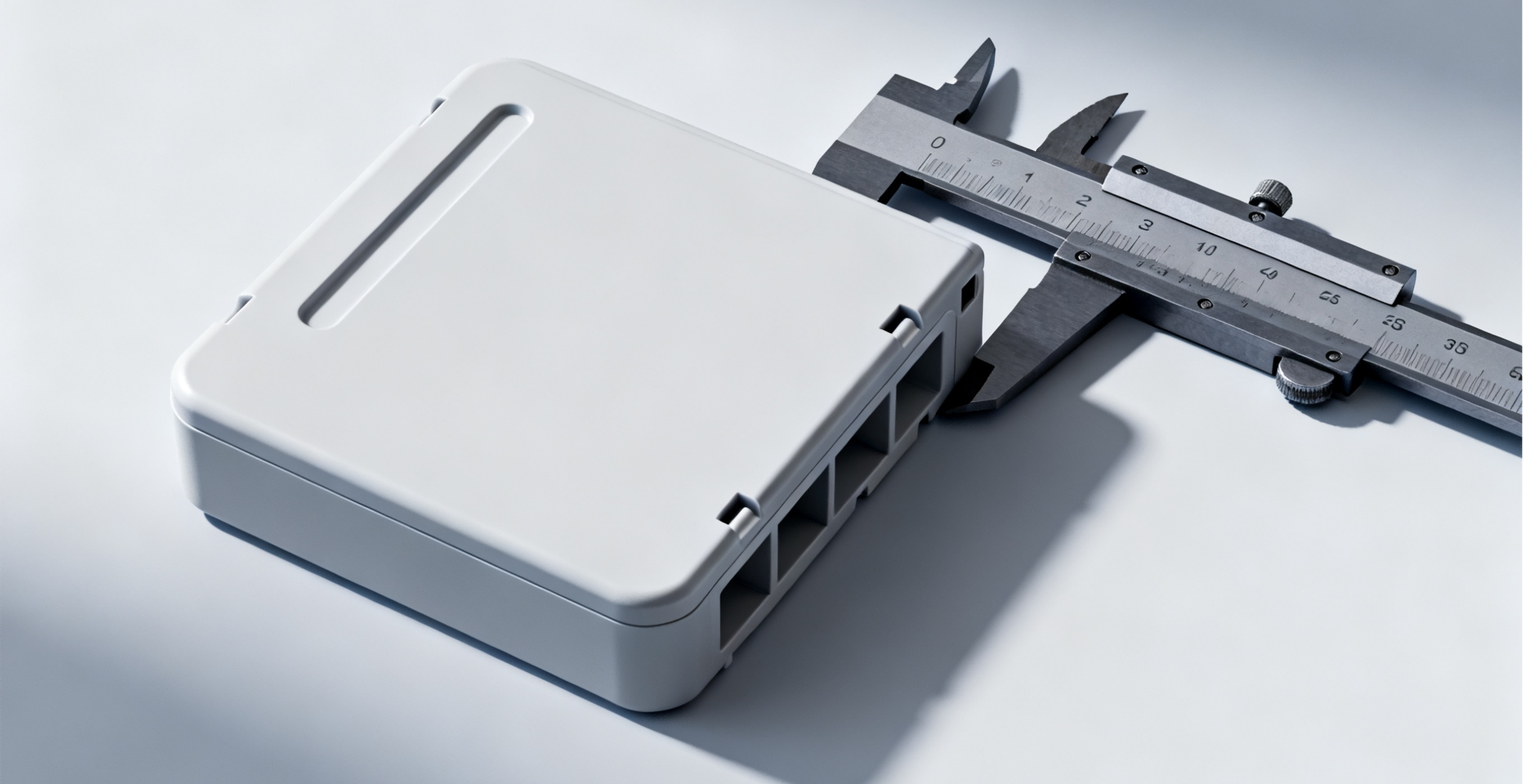
Table: PC vs ABS vs PC/ABS
Use a comparison table to decide which evidence to collect, not to invent universal property values. PC can be a candidate when clarity or a particular impact and thermal profile matters; ABS can be a candidate where its available grades meet the requirements; PC/ABS can offer another engineered balance. Every choice remains grade-specific.
Covestro’s Bayblend range provides examples of engineered PC blends. A blend is a defined formulation, not simply an arithmetic average of two datasheets.
| Requirement | PC candidate | ABS candidate | PC/ABS candidate |
|---|---|---|---|
| Optical appearance | Evaluate a suitable transparent or opaque grade | Evaluate the specified opaque finish | Confirm the grade’s available appearance |
| Impact and heat | Compare grade data at relevant conditions | Check the required conditions without extrapolation | Evaluate the formulated balance |
| Surface finishing | Confirm coating and cleaner compatibility | Confirm application-specific grade suitability | Approve the complete resin/finish system |
| Assembly features | Validate actual snap and boss geometry | Validate actual snap and boss geometry | Validate actual snap and boss geometry |
Leave unsupported numerical cells out of the comparison. Replace them with matched-condition data once actual candidate grades are identified.
DFM notes for bosses and snaps
Check bosses and snaps as structural features, not only moldability details. A change of resin can alter stiffness, allowable deflection, shrinkage behavior, and assembly force. Reusing the old geometry may be possible, but the material substitution should trigger a review rather than an automatic approval.
Covestro’s snap-fit design guide connects joint behavior to geometry and material response. Use it to frame a grade-specific design review. Do not turn a guide’s example geometry into a universal wall thickness or allowable strain for every enclosure.
Inspect latch root radii, deflection during assembly, stops, disassembly access, and any weld region near a loaded feature. For screw bosses, identify the actual fastener and torque requirement and check the part after repeated assembly where reuse is required. A molding DFM review should also flag sink-prone sections and ejection effects that could compromise the visible panel.
RFQ material callouts
Write the requested resin as a controlled material specification. Include manufacturer and grade where selected, color or masterbatch requirements, allowed substitutions, and any evidence needed for the intended electrical or other application. A generic flame-retardant note is incomplete without the relevant grade, thickness, and required evaluation.
Attach the controlled drawing, cosmetic surface map, assembly details, intended exposure, and functional test protocol. Ask suppliers to identify a proposed alternative explicitly rather than silently supplying a different grade under the same PC or ABS family label.
For consumer-electronics housings, include the actual temperature and handling scenario as well as appearance expectations. Record which test closes each requirement: supplier data can screen a material, dimensional inspection can establish fit, and a representative assembly trial can evaluate the actual housing. Keep those forms of evidence separate so that a successful cosmetic sample does not become an unsupported performance approval.
FAQ
These questions address specification details that should be settled before sample approval.
Can a PC/ABS blend be substituted for PC without changing the drawing?
Only after the controlled material and functional requirements are reviewed and the change is approved. A blend can differ in appearance, processing, mechanical behavior, and application-specific documentation. Compare the exact candidate grades and assess the existing assembly features and finish. Keep the substitution traceable rather than treating a similar resin family as an interchangeable purchasing description.
Does a high impact datasheet value remove the need for enclosure drop testing?
No. Coupon geometry, notch condition, temperature, and loading differ from a finished enclosure containing fasteners and internal components. Use material data to screen candidates, then evaluate the assembled housing against its actual handling requirement. Record the drop configuration and acceptance criteria so that later material or geometry changes can be assessed against the same test.
Should a color change trigger another material review?
It should at least trigger a check against the approved formulation and requirements. A new colorant or concentrate can change the material system and may affect appearance, processing, or application documentation. Decide the required validation according to the change and the function. Visual approval alone should not silently authorize a different base resin or an uncontrolled additive package.
Related process selection notes
Choose the material when the candidate grade, molded geometry, and finishing system meet the same acceptance checklist. PC/ABS deserves evaluation where its specific formulation solves the combination of requirements, but it is not a default compromise that avoids testing. An ABS enclosure that meets the specification can be appropriate; a PC enclosure still needs application evidence.
Before changing tooling, review what the new material means for gate design, shrinkage compensation, finishing, and assembly. Ask for a trial plan that measures the characteristics most likely to change. Retain the approved material identity and sample records for reorders.
Send 6CProto the housing CAD, material candidates, and acceptance checklist for a quote and DFM review. Identify the unresolved impact, heat, or cosmetic requirement so that the response can focus on the evidence needed to choose a grade.