

PTFE is often chosen precisely because it is soft, slippery and chemically inert, and those same properties are what make it awkward to machine. A part that looks like a simple turned bushing can drift out of tolerance after it leaves the chuck, with nothing visibly wrong on the machine.
What makes PTFE different from other machined plastics
Three properties drive everything else. PTFE has a high coefficient of thermal expansion for a plastic, so a small temperature difference between machining and inspection shows up as a measurable size change. It creeps under sustained load, meaning a part clamped tightly during machining keeps deforming after the clamp is released. And it is soft enough that a sharp tool cuts it cleanly while a dull one smears it, producing a finish that looks acceptable and measures badly.
| Property | Effect on machining | Practical response |
|---|---|---|
| High thermal expansion | Size depends on part temperature | Let the part stabilise before inspection; state the measurement temperature |
| Creep under load | Chucking pressure distorts a bore | Light clamping, soft jaws, support the bore while cutting |
| Low stiffness | Deflection and chatter on thin walls | Thicker sections, reduced overhang, sharp tooling |
| Low friction | Part can shift in the fixture | Positive stops rather than friction alone |
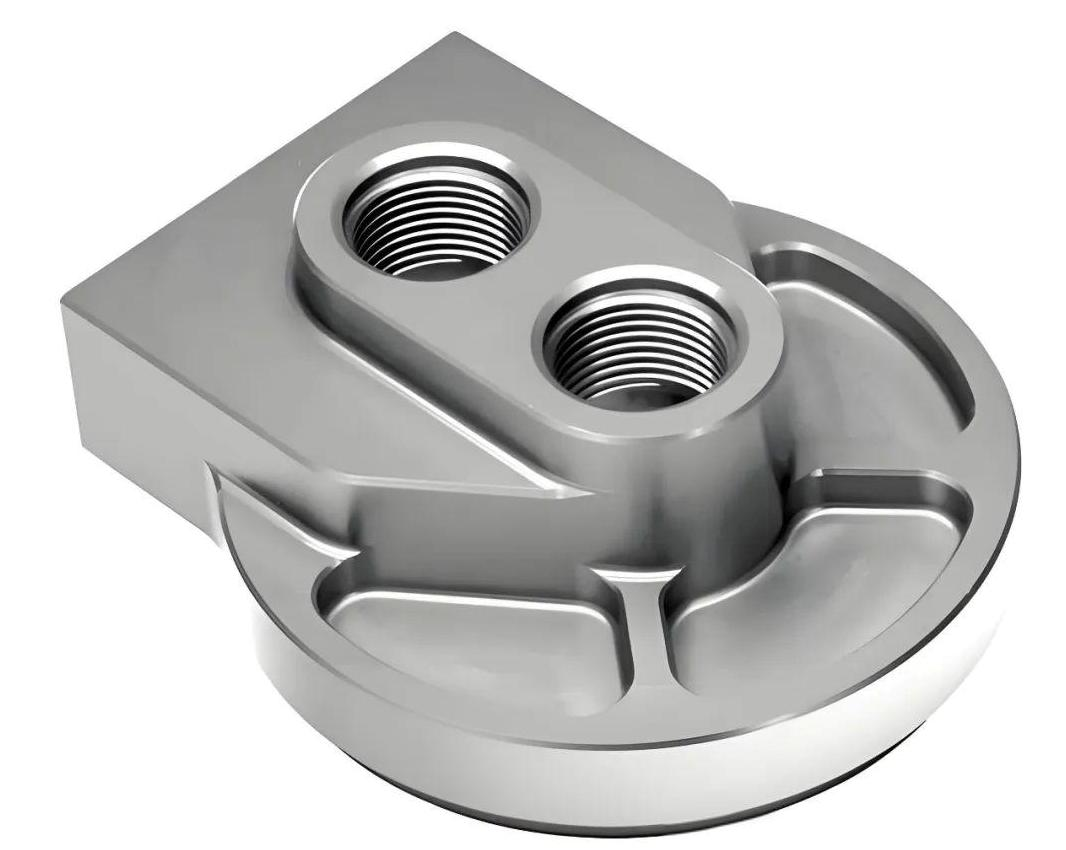
How clamping pressure distorts a PTFE part
The part is measured after the clamp is released.
A bore turned in a chuck is round while the jaws are closed and slightly oval once they open, because the material compressed under the jaws springs back. The effect is largest on thin-walled parts and on any feature close to the clamping diameter. Soft jaws machined to the part profile spread the load, and a support ring or a plug inside a bore keeps the section from collapsing during the cut.
The same logic applies to the inspection. Measuring a PTFE part straight from the machine records a size that will not repeat an hour later, so letting the part reach room temperature and agreeing that condition in advance avoids a disagreement about a dimension that was never wrong.
Tooling and feeds that produce a usable finish
Sharp, polished tooling with a positive rake cuts PTFE cleanly and leaves a surface that does not need secondary work. A dull edge rubs instead of cutting, generating heat and producing a smear that a visual check will not catch but a surface measurement will. Feeds need to be positive and continuous, because dwelling on the material causes local heating and a dimension change at that point.
Coolant is usually applied to control temperature rather than to lubricate. Where a part is large, roughing and finishing in separate passes with a pause between them lets heat dissipate, at the cost of an extra operation. For thin sections, a sacrificial support or a temporary backing ring is often the cheapest way to hold a dimension that would otherwise be lost to deflection.
Design choices that make a PTFE part manufacturable
The design decisions that help are mostly about avoiding thin, unsupported sections and sharp internal transitions. Generous wall thickness, chamfered or radiused corners rather than sharp internal steps, and a bore that does not sit immediately next to a clamping diameter all improve repeatability. Where a part needs a sealing groove, the groove geometry should account for the fact that the material deforms under the seal load, not only that it was cut to size.
It also helps to say what the part is for. A PTFE part used as a chemical-resistant sleeve can carry a general tolerance; the same shape used as a sealing seat needs the bore and the groove controlled individually, with the measurement condition stated. Drawing conventions for these callouts follow ASME, and polymer property data for the grade in question is published by ASM International.
Quality checks that survive the material
Inspection on PTFE needs to be planned around the material rather than applied afterwards. Record the temperature and the time since machining, use a method that does not apply significant clamping force to the feature being measured, and avoid gauges with sharp contact points that mark a soft surface. Where a feature has to be verified to a tight limit, agreeing the measurement method in advance is worth more than debating the limit.
Two external references are relevant to the process. Chemical-resistance and food-contact questions are regulated in the United States through the US Food and Drug Administration for applications that touch food or the body, and the handling of machining waste and coolants falls under US EPA rules. Measurement practice for this class of part is described by the NIST Manufacturing Extension Partnership, and surface-condition terminology by ASTM Committee B08.
Where PTFE parts are usually specified, and why it matters
Most PTFE parts fall into four uses: chemical-resistant seals and gaskets, low-friction bearings and wear pads, insulating components in electrical assemblies, and liners or sleeves that protect a metal body from a corrosive medium. Each use shifts the critical feature. A seal depends on the groove and the bore; a wear pad depends on thickness and flatness; an insulator depends on wall thickness and the absence of conductive contamination from a previous job.
Telling a supplier which of those roles the part plays changes the inspection plan more than the drawing does. It also affects tooling and cleanliness: parts destined for electrical or food-adjacent use should not be machined on equipment carrying residue from a previous material. Machining detail for these operations is covered under CNC turning and CNC milling.
Send the drawing with the measurement condition you intend to use, and request a quote for machining PTFE and other engineering plastics.
FAQ
Is PTFE the same as Teflon?
Teflon is a brand name and PTFE is the material it refers to, so a drawing should call out the material specification rather than the brand. Grades differ in filler content and in the properties that matter for machining and sealing.
Can PTFE be injection molded instead of machined?
Its melt viscosity is very high, which makes conventional injection molding impractical, so parts are usually machined from stock or compression molded. That is why small PTFE quantities are economical even when the geometry is complex.
Why does a machined PTFE part change size after inspection?
Because the material both expands with temperature and continues to relax after the clamping load is released. Measuring after the part has stabilised at a stated temperature, using a method without heavy contact, is what makes the recorded dimension repeatable.