

For anything flat, laser cutting turns a drawing into a part faster than almost any other process. The limit is not the cutting itself but the fact that a laser produces a flat blank: every three-dimensional feature has to come from a second process or a different one.
What a laser actually does to the edge
The beam removes material by melting and vaporising it, leaving a narrow kerf and a characteristic edge. On mild steel and stainless the cut face is clean and slightly oxidised, on aluminium it is rougher because the material conducts heat away quickly, and on thicker sections the edge shows striations from the cut. The result is usually acceptable as-is, but a functional sealing face or a bearing surface needs a subsequent machining or grinding operation.
| Material | Edge condition after cutting | Typical follow-up |
|---|---|---|
| Mild steel | Clean, light oxide, small heat-affected zone | Deburr; paint or coat directly |
| Stainless steel | Clean, may discolour at high power | Pickle or passivate where corrosion matters |
| Aluminium | Rougher edge, higher reflectivity | Deburr; anodize for appearance |
| Brass and copper | Reflective; needs appropriate laser and settings | Deburr; the edge is not usually a cosmetic issue |
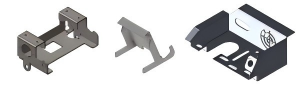
Design rules that keep a flat part cuttable
The rules are few and mechanical. The smallest hole a laser can cut reliably is related to the material thickness, because the beam needs to pierce without excessive spatter. Internal corners carry a small radius by nature rather than a sharp point, so a drawing that asks for a true internal corner is asking for a limitation the process does not have. Features must also be spaced far enough apart that the heat from one cut does not distort the other.
Two further points affect the flat pattern. Nesting determines how much material is consumed, so a part that tiles efficiently costs less to cut than one that leaves large offcuts. And the cut path itself takes time, so a profile with hundreds of small holes is slower than its outline suggests, which is why hole count is worth checking before assuming a flat part is automatically cheap. A panel with a few large openings cuts noticeably faster than one with many small ones covering the same area.
What laser cutting cannot do, and what to use instead
A laser cannot produce a counterbore, a thread, a chamfer at an angle or a pocket floor, because it cuts through material rather than removing it selectively. Where a flat prototype needs those features, the usual answer is a hybrid part: laser cut the profile and add the machined detail as a separate operation, or machine the whole part if the quantity is small and the features are few. Related machining detail is covered under CNC milling and CNC turning.
The choice is often decided by the quantity of flat geometry. A part that is mostly profile with two tapped holes is cheaper to cut and drill than to mill from solid, while a part that is mostly pockets with a small outline belongs on a mill. Geometry, not material, is the deciding factor.
How close can features sit to a laser cut edge?
Close enough to matter, but not close enough to ignore.
The heat-affected zone extends a short distance from the cut, and small features placed inside it can distort or lose strength. The practical guideline is to keep a ligament of at least the material thickness between adjacent cuts and between a cut and an edge feature that must remain sound, and to keep threads and press fits further away because they rely on material integrity.
Where a design needs features at the limit, the answer is usually to move the operation rather than to ignore the rule: drill or mill the critical hole so its position is set by a machine tool rather than by a cut edge, and leave the laser to the profile.
Combining laser cutting with forming
Most laser cut prototypes become formed parts, and the sequence matters. Cutting before forming is normal, and the flat pattern must account for the bend allowance so the formed part lands on dimension. Cutting after forming is possible for flat panels but awkward for anything with bends, because the part must be held and located in a different orientation.
Where a part is both cut and formed, it is worth confirming which features are controlled after forming rather than before. A hole that is dimensionally correct in the flat pattern can still be in the wrong place on the finished part if the bend allowance differs from the one used to develop it. Practices for these interfaces are described under forming and bending, with material data published by ASM International, drawing conventions by ASME, surface and coating terminology by ASTM Committee B08, and inspection practice by the NIST Manufacturing Extension Partnership. Workshop environmental requirements are published by the US EPA.
Where a flat part carries a written surface requirement, the relevant references are the coating and surface-condition classifications published by ASTM Committee B08 and the drawing conventions published by ASME.
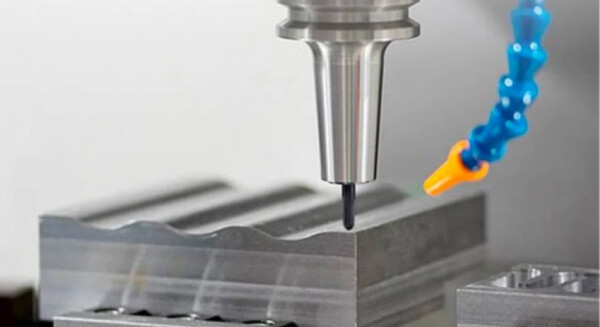
Send the flat pattern or the formed model with your material and thickness, and request a laser cutting quote.
FAQ
When is laser cutting better than machining a flat part?
When the geometry is mostly profile and cut-outs rather than pockets and bores. Laser cutting is fast on outlines and holes through the part, while machining suits features that remove material selectively, such as pockets, counterbores and threads.
Does laser cutting harden the material along the cut edge?
A narrow heat-affected zone forms along the cut. On common mild and stainless grades it does not affect the part, but where the edge will be heavily loaded or subsequently formed, the condition is worth confirming against the material and thickness.
Can laser cut parts be anodized or coated directly?
Usually yes, after deburring. Aluminium and stainless edges accept anodizing and coating, though an oxide layer left in place can affect adhesion on some grades, which is why the finishing route is worth confirming before the parts are cut.