

Co-extrusion exists because a single material is often a compromise. A profile may need a rigid body for stiffness and a soft lip for sealing, or a weather-resistant outer layer over a cheaper core, and co-extrusion produces both in one pass rather than assembling them later.
How co-extrusion works
Two or more materials are plasticised in separate extruders and fed into a single die, where they meet and bond before the profile is cooled. The result is a continuous length in which each material occupies a defined region of the cross-section: a rigid body with a flexible edge, a coloured surface over an uncoloured core, or a barrier layer inside a structural shell. The bond forms as the materials meet hot, which is why the process works with compatible pairs and less well with unrelated ones.
| Combination | Why it is used | What it demands of the die |
|---|---|---|
| Rigid body with flexible lip | Sealing or grip without a separate part | Precise separation of the two flow paths |
| Cap layer over a core | Weather or chemical resistance on the visible face | Even layer thickness across the section |
| Two colours | Contrasting surfaces without painting | Sharp interface and consistent colour dosing |
| Recycled core with virgin skin | Cost reduction with an acceptable surface | Compatible melt behaviour between the two materials |
What co-extruded profiles are used for
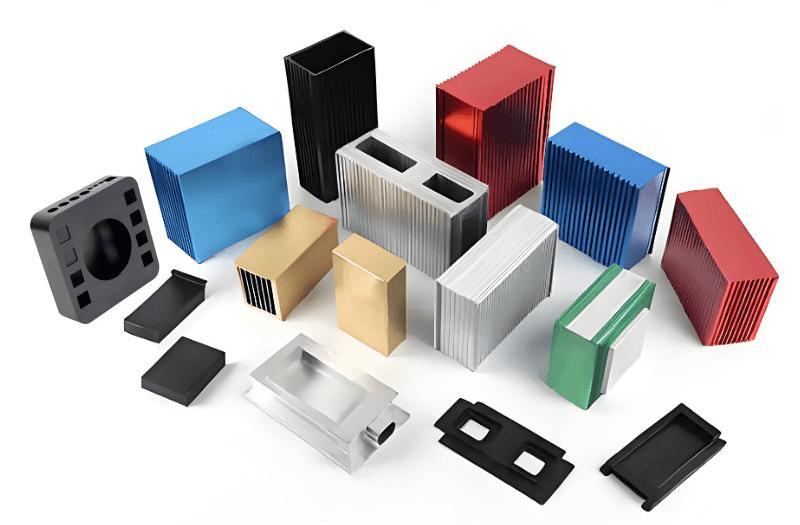
The applications follow the reason for combining materials. Window and door profiles use a rigid frame with a flexible sealing lip, which removes a separate gasket and a fitting operation. Trim and edge profiles combine a decorative face with a body that has to grip or clip. Cable ducts and covers use a flexible hinge section between rigid panels so the profile can bend where it needs to. And packaging and consumer profiles use a barrier layer where the contents demand it.
The common thread is that co-extrusion replaces an assembly step. Instead of producing two parts and joining them, the profile arrives with both functions built into its cross-section. That is the same logic that makes any extrusion attractive: features that would otherwise be separate operations become properties of the die.
What are co-extruded films?
The same principle applied to flat sheet, not a profile.
Co-extruded film is produced by feeding two or more polymers through a flat die, so the layers form a single sheet: a barrier layer inside a sealable skin, for example, or a printable surface over a structural core. The film is used where one material cannot provide both the mechanical and the barrier or sealing properties the application needs, and where laminating separate films would add cost and a bond that could fail.
The distinction from profile co-extrusion is the geometry rather than the principle: a film is a flat, thin, wide product measured in layers and gauges, while a profile is a shaped section measured in wall thicknesses and features. Both depend on material compatibility, on layer thickness control, and on a die designed to keep the flow paths separate until the right moment.
Tolerances and where they are hardest
Co-extruded sections are harder to hold to tight tolerance than single-material ones, because two materials shrink at different rates and the interface between them is a variable. The features that suffer most are the thin layer thickness and the position of the interface: a cap layer that is slightly thin in one region may not provide the protection it was specified for, and an interface that wanders affects both appearance and function.
The practical specification therefore concentrates tolerance where it matters. Overall dimensions and interface positions that mate with other components deserve individual control, while the envelope and the non-functional surfaces can follow a general note. Where a soft lip is involved, its dimensions should be specified at the condition in which it will be measured, because a flexible feature has no single size. Material references for shrinkage and bonding behaviour are published by ASM International.
When co-extrusion is worth the extra die cost
Co-extrusion costs more than single-material extrusion: more extruders, a more complex die and a narrower process window. It pays back in three situations. When it removes a separate component and its fitting operation, which usually dominates the calculation. When it eliminates a secondary operation such as painting or laminating a surface. And when the combination of properties simply cannot be achieved in one material, so the alternative would be an assembly rather than a simpler profile.
Where none of those applies, a single material with a secondary operation is often cheaper, particularly at low volume where the die cost dominates. The honest comparison is between the co-extruded profile and the finished alternative after all assembly and finishing, not between the two profiles alone. Drawing conventions follow ASME standards, coating and surface terminology follows ASTM Committee B08, inspection practice is described by the NIST Manufacturing Extension Partnership, and process obligations are set out by the US EPA.
Design rules for a co-extruded section
Three rules keep a co-extruded profile manufacturable. Give each material enough area to flow properly, because a very thin layer is difficult to control across a complex section. Keep the interface where it can be formed cleanly, avoiding long, thin tongues of one material reaching into the other. And choose a material pair that bonds, since co-extrusion relies on the two melts adhering as they meet rather than on an adhesive.
It also helps to state which material is functional and which is decorative, because the answer changes the design. A cap layer for weather resistance has to be continuous and thick enough to be effective, while a decorative layer mainly needs to look consistent, and those are different requirements for the die. Related process detail sits under custom extrusion, and the metallic equivalent is described on the aluminium materials page.
Send the section with the two materials and the function of each region marked, and request a co-extrusion quote with the die cost broken out.
FAQ
What is co-extrusion?
It is a process in which two or more materials are plasticised separately and fed into a single die, where they meet and bond before cooling. The result is one continuous profile in which each material occupies a defined region of the cross-section.
What are co-extruded films?
The same principle applied to flat sheet: multiple polymers pass through a flat die to form a layered film, such as a barrier layer inside a sealable skin. The geometry differs from a profile, but the requirement for material compatibility is the same.
When is co-extrusion worth the extra die cost?
When it removes a separate component and its fitting operation, eliminates a secondary finishing step such as painting, or achieves a combination of properties no single material provides. Compare against the finished alternative, not the simpler profile.