

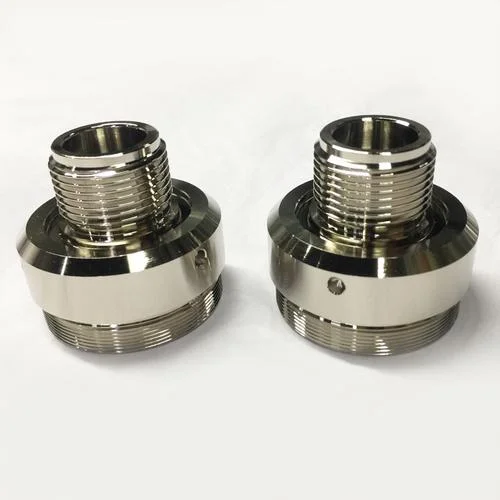
A machined stainless fitting looks perfect when it arrives and pits within a season in a saltwater environment. The drawing said “316 stainless,” the certificate agreed, and the part still failed — because the alloy was right and the design was wrong: a crevice trapped saltwater, a dissimilar-metal contact drove galvanic corrosion, and the finish did not protect the surface as specified. Marine hardware fails at interfaces, not on the flat faces that look good on the bench. Choosing the alloy, designing the joints, and specifying the finish are one continuous decision, and it starts before the CAD file is finished.
What “marine grade” actually requires
“Marine grade” is not a material; it is a performance requirement for a specific environment and location. A deck fitting above the waterline sees spray and UV; a through-hull or underwater fitting sees continuous immersion, biofouling, and possibly galvanic coupling; an engine-room component sees heat, vibration, and oil. The same alloy can be excellent in one location and wrong in another. Define the service zone first, then choose the material and finish for that zone — and confirm the definition with the person who will use the boat or equipment, because “saltwater” covers a wide range of severity.
Alloy selection for shafts, housings, and deck hardware
Austenitic stainless steels dominate marine machined hardware, with 316L preferred over 304 where chloride exposure is real; 17-4PH appears where strength is needed; and aluminum alloys such as 6061-T6 appear above the waterline when weight matters, with protection from a suitable coating. Bronze and nickel-aluminum-bronze appear in propellers, shafts, and underwater fittings where bearing and corrosion behavior justify the cost. Each choice is a compromise: 316 resists corrosion but machines and costs more than 304; 17-4PH offers strength but needs careful passivation and is not immune to pitting in crevices; aluminum is light but cannot be trusted bare in saltwater service.
Name the exact grade and temper on the drawing, and request the certificate. “Stainless” is not a marine specification, and the difference between 304 and 316 shows up in the pitting, not in the first inspection.
Design details that create crevice corrosion
Crevice corrosion is the most common marine failure mode, and it is designed in. Tight gaps under washers, between mating flanges, under hose clamps, or inside threaded joints trap stagnant seawater, deplete oxygen, and drive localized attack — even on 316. The design responses are to eliminate or drain crevices, use gaskets that do not wick water, seal threaded joints with appropriate compounds, and avoid geometries that trap debris. Where a crevice cannot be avoided, the material and finish must be chosen for it, or the part must be inspected on a schedule.
Dissimilar metals are the second design driver. Aluminum fittings on stainless fasteners, bronze components connected to stainless shafts, and any galvanic couple in seawater accelerates corrosion of the less noble metal. Isolate dissimilar metals with insulating washers or sleeves, or accept the galvanic risk consciously with the anodic part designed for replacement. The assembly drawing should show the material of every contacting part, not just the machined component.
Finishing and coating callouts tied to salt-spray class
Machined marine parts usually need a finish, and the finish should be specified against a test class rather than a color. Passivation improves the corrosion resistance of stainless by removing free iron; anodizing protects aluminum but must be sealed and chosen for the alloy; and paint or powder systems protect aluminum and steel parts above the waterline. Write the coating type, thickness or class, and the acceptance test together — for example, a salt-spray hour target per the applicable standard — and confirm with the finisher which surfaces are coated and which are masked, because threads and mating faces may need to stay bare.
| Part zone | Common material route | Finish direction |
|---|---|---|
| Above-waterline hardware | 316L stainless or protected aluminum | Passivation or sealed anodize/paint; avoid bare dissimilar contact |
| Underwater fittings | 316L, bronze, or nickel-aluminum-bronze by function | Minimal coating; manage galvanic coupling and crevices |
| Shafts and drive components | 17-4PH, alloy steel with protection, or bronze | Corrosion-resistant route matched to bearing surface |
| Engine-room and auxiliary | 304/316 by environment; anodized aluminum where light | Coating chosen for heat, oil, and cleaning agents |
The table is a starting map, not a rulebook: confirm the actual service condition and the coating specification with the finisher and the design authority before release.
Inspection and documentation for marine parts
Marine hardware deserves documentation that matches its service. Request the material certificate with the lot, the inspection report on the functional dimensions, and the finish or passivation record where applicable. For critical underwater or safety hardware, confirm the alloy and heat treatment with the certificate and keep the records with the part number, because a later failure can only be traced if the lot is known. Dimensional inspection should include the mating features that create crevices or seal faces, not just the easy-to-measure outside dimensions.
If the part is welded, add the weld procedure and any post-weld treatment to the record; welded marine hardware fails at the weld and the heat-affected zone before it fails in the parent material, and the documentation should reflect that risk. A supplier that can produce this file set understands the environment; one that cannot is quoting a part, not a marine component.
A worked example clarifies the trade. A boat builder needs a shaft coupling and a deck cleat. The coupling sits below the waterline, drives through a bronze or stainless shaft, and sees saltwater plus galvanic coupling; the cleat lives above the waterline and carries mooring loads in spray. Specifying 316L for both is defensible but not optimized: the coupling needs the chloride resistance and the galvanic management of the surrounding system, while the cleat could be a protected aluminum part that saves weight and cost if the finish and the isolation from stainless fasteners are designed. The wrong move is choosing 316L for the cleat and 304 for the coupling to save money, because the failure risk follows the environment, not the budget line. The right move is writing the service zone on each drawing, naming the exact grade, and checking the assembly for galvanic couples: stainless fasteners through aluminum need isolation, and a bronze component in a stainless system needs its cathodic relationship understood. The finish notes follow the same logic — passivation on the stainless, a sealed anodize or paint on the aluminum, and bare, well-designed surfaces underwater where coatings fail. When the parts arrive, the certificate and the finish record confirm the grade and the process, and the first season is the test the drawing was designed for. That is how a marine part is specified: by zone, by assembly, and by the environment it will live in.
Before sourcing marine hardware, confirm the service zone with the end user, name the exact alloy and temper on the drawing, review the assembly for galvanic couples and crevices, and specify the finish with its acceptance test. Ask for the material certificate, the dimensional report on the functional features, and the finish or passivation record. The checklist turns the environment into the specification — and the specification is what the supplier quotes against.
Frequently asked questions
Is 304 stainless acceptable for saltwater?
304 is suitable for mild, above-water exposure with good design and cleaning, but it is more prone to pitting and crevice corrosion in saltwater than 316 or 316L. For immersion, crevices, or marine atmospheres, specify 316L and design out the crevices; the cost difference is small relative to a season of pitting.
Can aluminum be used underwater?
Yes, when it is the right alloy, protected, and galvanically managed — or when it is designed as a sacrificial element. Bare aluminum underwater corrodes quickly and couples galvanically with most metals. If weight drives the design, specify the protection system and the insulation from dissimilar metals together, and validate with the application standard.
How do you prevent thread seizure in marine stainless fasteners?
Use anti-seize compounds approved for the environment, choose compatible material pairs, and avoid mixing similar stainless grades that gall. Design for disassembly with the compound specified in the assembly note, because a seized fastener in a crevice-laden marine environment is both a corrosion trap and a maintenance failure.
Before you send the RFQ
State the service zone, name the exact alloy and temper, mark the crevice-prone joints and the mating materials, specify the finish with its test class, and define the documentation set. A marine part is specified by its environment as much as its geometry, and the suppliers who respond well to that brief are the ones who have shipped hardware that survives the season. The CNC machining and surface finishing teams on this site can review the alloy, finish, and documentation together before you commit the drawing.
If you are sourcing machined marine hardware, send the drawing with the service zone and the mating assembly to the 6CProto team for a corrosion-and-finish review before quoting.