

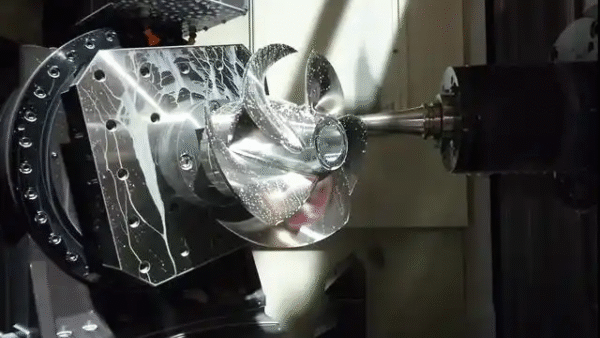
Multi-axis work is often presented as a precision upgrade, but its real value is economic: it removes setups. The right question is therefore not whether 5-axis is better, but whether the features on your part would otherwise need three or four separate clampings.
When does 5-axis machining replace extra fixtures?
When features sit on several faces of one part.
Each additional setup adds a fixture, a datum transfer and an inspection step, so the cost of multi-setup work grows faster than the geometry does. A part with angled ports, contoured faces or pockets opening in different directions can be cut from one clamping on a 5-axis machine, which also protects positional relationships between those features because nothing is re-referenced between operations.
Where the part is essentially two-and-a-half-dimensional, however, extra axes add programming and collision-checking effort without removing a setup, so the cost case usually does not hold. Our 5-axis machining page shows the part features that gain most from the change.
How to design a part for tool and holder clearance
Five axes widen the reachable envelope but they do not remove the physical size of the cutter and holder. Deep cavities still need clearance for the holder behind the flute, and long tools deflect, so a feature that is reachable can still finish badly. Designing with generous internal radii, avoiding pockets deeper than the tool can reasonably span and keeping angled faces accessible keeps the operation in a single setup.
| Design choice | Effect on multi-axis work |
|---|---|
| Internal corners sized to a standard cutter | Removes a second, slower operation |
| Angled faces reachable without tilting beyond the machine range | Keeps a single setup viable |
| Deep pockets with poor holder clearance | Forces long tools, slower feeds and finish risk |
| Sharp internal edges left unrelieved | Adds hand finishing after machining |
Is 5-axis machining faster in every case?
No. Cycle time falls only when setups disappear.
No. Cycle time can be shorter when a part would otherwise need several setups, and longer when the geometry is simple, because the programming and simulation work sits in the fixed block of the quote. The honest comparison is total time from quote to acceptable part, which includes fixture design, datum verification and the cost of scrapping a part at a late stage.
Where a programme runs from prototype through low-volume production, the same advantages reappear: keeping the part on one machine family avoids re-qualifying the geometry later. Machining terminology in this section follows the public reference material published by ASME and the NIST Manufacturing Extension Partnership.
When the part has to satisfy a written requirement rather than only fit the assembly, three references settle most arguments: material and heat-treatment data from ASM International, geometric and machining terminology from ASME, and coating or surface-condition callouts from ASTM Committee B08. Metalworking fluid and waste handling obligations that apply to the machine shop itself are published by the US EPA, and the NIST Manufacturing Extension Partnership covers how small shops structure inspection for tight work. Compare those requirements against your own drawing before releasing a batch to precision machining.
When 5-axis is not the answer: fixture strategy on 3-axis machines
Multi-axis work earns its price when it removes setups, so the honest alternative is not “stay on three axes” but “design a fixture that removes the setups instead.” A well-made tombstone or multi-part fixture can present three faces of a part to a 3-axis spindle and hold position between them, which captures much of the same benefit on simpler geometry. The trade-off is that fixture design is engineering work you pay for once and then own.
The decision usually turns on part count and geometry stability. For a single prototype with angled features, a fixture is rarely worth building and multi-axis is the shorter route. For a family of similar brackets running in repeat batches, a fixture amortises across every release and keeps the work on a machine type that is easier to schedule and re-quote.
How to compare a 3-axis and a 5-axis quote honestly
The two quotations are rarely the same scope, which is why comparing totals misleads. A 3-axis quote may exclude the fixture, the additional operations and the extra inspection implied by repeated clampings; a 5-axis quote may include all three but carry a larger fixed block for programming and simulation. Put both quotes on the same footing by asking each supplier to state the setups, the fixtures, the operations and the inspections included.
Then price the risk rather than only the parts. Every additional setup is another opportunity for a datum error that may not appear until assembly, and a scrapped late-stage part costs the whole accumulated value of the operations already performed on it. Where the part sits in a development programme with a fixed deadline, removing a setup often matters more than the visible unit price.
Positional tolerance when a part is cut in more than one setup
Positional relationships are the real cost of leaving multi-axis behind. When a feature is cut in a second clamping, its position depends on how accurately the part was located the second time, not on the accuracy of either cut. That is why a drawing that ties two angled features to a single datum is easier to satisfy from one setup than from three, even if the individual tolerances look identical on paper.
If the part must be re-clamped, the drawing should say which feature the second operation is referenced to, so the fixture and the measurement agree. Where that reference is impractical, a generous positional callout combined with a functional check on the assembled part often controls the requirement better than a tight dimensional limit that no fixture can repeat.
Send the model plus a note on which features drive the fit, and request a quote with a DFM review of fixture count and tool access.
FAQ
What are the five axes on a CNC machine?
Three linear axes move the tool in X, Y and Z, and two rotary axes tilt either the tool head or the work table. The two rotary movements are what let the cutter reach faces that would otherwise need the part to be unclamped and repositioned.
Is 5-axis machining more expensive per part?
Programming and simulation are fixed costs that raise the price at low quantity, while the saved setups lower it. Above a certain batch size, or on parts with several faces, the second effect usually outweighs the first.
Can a 5-axis machine produce a prototype and the production run?
Yes, and that continuity is useful: the same process holds the positional relationships between angled features, so the validated prototype and the later low-volume parts come off a comparable setup rather than a re-engineered one.