

Explore Manufacturing Materials Guides
Both materials are specified when ordinary plastics fail, and both are expensive. The difference between them is not a matter of quality but of which requirement is hardest on a particular part: continuous temperature, chemical exposure, wear behaviour or cost.
The comparison that matters
Ultem, or PEI, is an amorphous material with high stiffness, good dimensional stability and inherent flame resistance. PEEK is semi-crystalline, with higher continuous temperature capability, better chemical resistance and excellent wear behaviour in sliding contact. Amorphous materials generally hold tighter dimensions and machine more predictably; semi-crystalline materials generally resist chemicals and fatigue better.
| Consideration | Ultem (PEI) | PEEK |
|---|---|---|
| Structure | Amorphous | Semi-crystalline |
| Temperature capability | High, but lower than PEEK | Highest of the common engineering plastics |
| Chemical resistance | Attacked by some solvents | Resistant to a wider range |
| Wear and sliding contact | Moderate | Good, often used for bearings and seals |
| Dimensional stability | Very good | Good, with more sensitivity to processing |
| Cost | High | Higher |
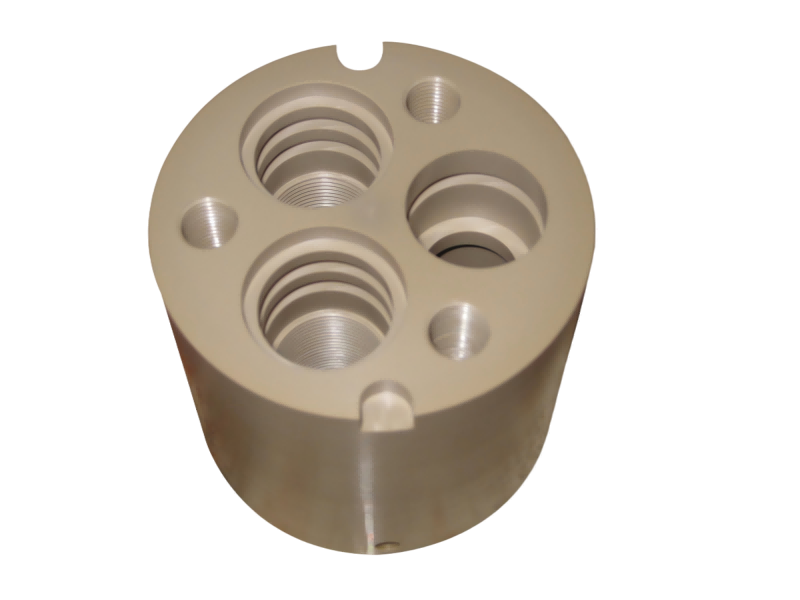
Why PEEK costs so much
Three factors keep PEEK expensive. The polymer itself involves a demanding synthesis route, so the raw material is costly before any processing. It processes at very high temperatures, which requires specialised equipment and consumes more energy. And it is supplied in lower volumes than commodity engineering plastics, so it does not benefit from the same economies of scale.
Those costs are passed on in the stock price and in the machining rate, because PEEK also demands careful process control: it must be dried before processing, and it is sensitive to thermal history. The practical consequence is that PEEK is rarely the default choice; it is specified when a requirement genuinely demands it, such as continuous high-temperature service, aggressive chemical exposure or long-term wear.
Is PEEK the strongest plastic?
Close to the top, though strength is not a single number.
PEEK has high tensile strength and stiffness for a thermoplastic, and it holds those properties at temperatures where most polymers have softened. That combination, rather than any single peak value, is what makes it notable. But strength depends on the grade, on whether the material is filled with glass or carbon fibre, and on the direction of loading relative to the part’s geometry.
Two qualifications matter in practice. Strength at room temperature is not the same as strength in service, because creep under sustained load changes the answer over time. And a stronger material does not automatically make a stronger part: a notch-sensitive design, a sharp internal corner or a poor surface finish can make a high-performance plastic fail before a modest one would. The property tables are a starting point, not a design. Material data is published by ASM International.
Is PEEK harder than Delrin?
Yes, harder and far more heat resistant.
Yes in surface hardness and stiffness, though the comparison hides why each material is chosen. Delrin, or POM, is a semi-crystalline acetal with low friction and good wear behaviour at moderate temperatures, and it machines easily at a fraction of the cost. PEEK is harder, stiffer and far more temperature and chemical resistant, which is what justifies its price. For a conveyor bushing running at room temperature, Delrin is usually the sensible choice; for a component in a hot chemical environment, only PEEK will do.
Choosing between them for a real part
Four questions settle most decisions. What is the continuous service temperature, not the peak? What chemicals will the part contact, and at what concentration? Does the part see sliding contact or sustained load, and for how long? And what happens if the material fails — is it a cosmetic issue or a functional one? The answers usually point clearly to one material, because the requirements are not evenly distributed.
Where the answer is genuinely close, the tie-breakers are processing and cost. PEI machines predictably and holds tight dimensions, which is helpful on a complex part with several critical fits. PEEK tolerates more extreme environments and performs better in sliding contact, which matters on a part that will wear. Selecting on the hardest requirement, rather than on the average of all of them, is what keeps a material specification honest.
Machining and specifying both materials
Both are machined from rod or plate, and both reward sharp tooling, rigid setups and controlled feeds, because heat at the cutting edge degrades the surface. PEEK benefits from stress relief and from awareness that its semi-crystalline structure can move slightly after machining, particularly on asymmetric parts. PEI is notch sensitive, so internal corners should carry radii and threads need generous engagement.
Specifications should name the polymer family and grade rather than a brand, state whether a filled grade is required, list the temperature and chemical exposure the part will see, and identify the features that carry load or seal. Where the part replaces metal, giving the load and temperature is more useful than naming a plastic, because those numbers are what justify the expense. Drawing conventions follow ASME standards, surface and coating terminology follows ASTM Committee B08, measurement practice for these parts is described by the NIST Manufacturing Extension Partnership, and process obligations that apply to polymer machining and molding are set out by the US EPA. Process options are set out under CNC machining and materials.
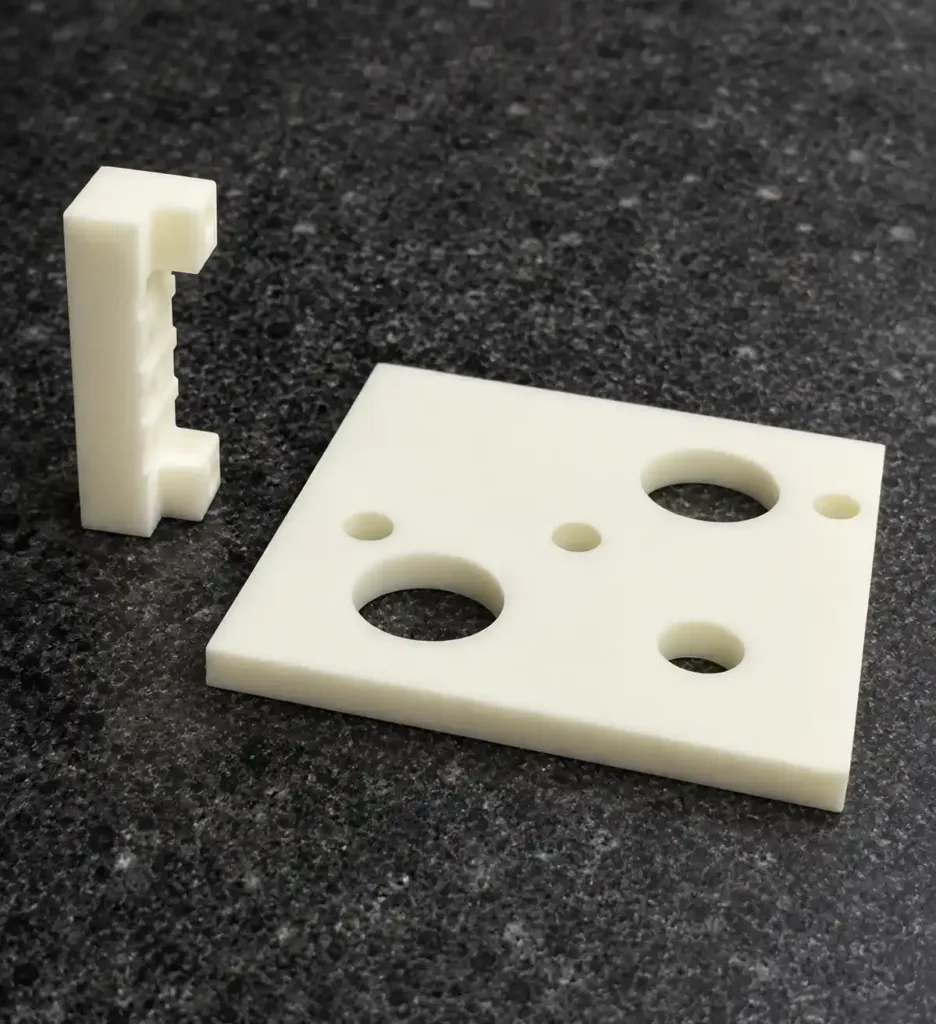
Send the part with the service temperature, the chemicals and the load path, and request a quote for machining in PEI or PEEK.
FAQ
Is PEEK the strongest plastic?
Among common engineering plastics it is near the top, with high strength and stiffness that hold up at elevated temperature. Strength still depends on the grade, on whether it is fibre filled, and on the design, since a notch or sharp corner can fail before the material does.
Why is PEEK so expensive?
A demanding synthesis route makes the raw polymer costly, it processes at very high temperatures requiring specialised equipment, and it is supplied in lower volumes than commodity plastics so it gains fewer economies of scale.
Is PEEK harder than Delrin?
Yes, PEEK is harder and stiffer and tolerates far higher temperatures and more chemicals, which is what justifies its price. Delrin remains the sensible choice for a low-friction part at moderate temperature where those extremes are not required.