

Extrusion produces a continuous length of constant cross-section by pushing material through a die. The die is the whole design, which is why the useful conversation on an extruded part is about the profile rather than the process: once the section is agreed, the process is largely determined.
What profile extrusion produces
Material is heated until it flows, forced through a shaped die, and cooled so the profile holds its shape as it leaves. The result is a constant section of any practical length, cut to size afterwards. That constancy is the point: a profile can carry a structural feature, a sealing groove, a cable channel and a mounting flange along its entire length without any machining, because all of those details are features of the cross-section rather than of the part.
| Profile feature | How it is produced | Design consideration |
|---|---|---|
| Wall and rib thickness | Shaped into the die | Keep sections uniform so cooling is even |
| Hollow chambers | Die with internal mandrels | Sizing and support affect achievable tolerance |
| Sealing grooves | Formed directly in the profile | Groove dimensions must suit the seal, not only the die |
| Surface texture | Die finish or post-processing | Texture from the die is free; added texture is a second operation |
| Colour | Compounded into the material | Colour is set in the resin, so matching across batches matters |
What profile extrusion is not good at
Extrusion cannot produce features that vary along the length. A taper, a local thickening, a hole through one face or a change in cross-section requires a secondary operation, because the die produces the same shape continuously. Close tolerances on a hollow profile are also harder than on an open one, since the internal mandrel has to be supported and the material has to shrink evenly around it.
Two further limits matter commercially. Very thin walls relative to the overall size are difficult to hold consistently, and profiles that are asymmetric in a way that cools unevenly tend to bow or twist. Those are the reasons a drawing for an extruded profile should state which dimensions matter — the ones that fit with other components — rather than applying a tight tolerance across the whole section.
Which plastics extrude well
Rigid PVC, ABS and polycarbonate, among others.
The common extrusion materials are chosen for a combination of melt behaviour, dimensional stability and cost. Rigid PVC is the workhorse for profiles that need stiffness and weather resistance, ABS is used where impact resistance and appearance matter, and polycarbonate suits profiles that must survive heat or impact. Polyethylene and polypropylene extrude readily but are softer, so they serve applications where flexibility or chemical resistance is the priority.
Material choice also decides what secondary operations are possible. A grade that takes paint or an applied texture extends the design options, while a very soft material may be difficult to cut or drill cleanly after extrusion. Filled grades improve stiffness and heat resistance but wear the die faster and can make surface finish less predictable. Material property data is published by ASM International.
What drives the cost of an extrusion die
Complexity is the main driver. A simple open profile needs a straightforward die, while a hollow section with internal chambers requires mandrels and a more elaborate flow path. Section size matters too, since a larger profile requires a larger die and more careful cooling. Precision requirements raise cost again, because closer tolerances need more attention to the die and to the downstream cooling and sizing equipment.
The volume being ordered changes the picture. Die cost is charged once and amortised over the order or the programme, so a complex die makes more sense for a long run than for a limited quantity. Where only a short length is needed, machining the profile from solid or printing it can be cheaper than making a die, and the comparison is worth making explicitly rather than assuming extrusion is always the low-cost route.
Secondary operations and finishing
The profile leaves the line as a continuous length, so almost every part needs something afterwards: cutting to length, drilling, punching, milling a notch, or assembly with another component. Those operations are where the tolerance on the finished part is often lost, because a cut length or a drilled hole is measured from a cut end rather than from the die. Naming the datum for those dimensions is as important as naming them.
Finishing follows the same logic. Applied colour, texture, printing or coating are separate operations with their own tolerances and handling, and some interact with the material: a coating applied after extrusion may not adhere as well as one applied to a molded part, and a printed surface may be scuffed by subsequent cutting. Stating the order in which operations must be performed prevents a batch that is correct in isolation but damaged in sequence. Drawing conventions follow ASME standards, coating terminology follows ASTM Committee B08, and process obligations are set out by the US EPA. Fabrication detail for machined profiles is covered on the CNC machining pages.
Design rules that make a profile manufacturable
Four rules carry most of the weight. Keep wall thickness as uniform as the function allows, because thick regions cool more slowly than thin ones and pull the profile out of shape. Avoid very sharp external corners and abrupt changes in thickness, which create flow problems in the die and stress concentrations in use. Where a hollow section is needed, allow enough internal space for the mandrel and keep the walls accessible to cooling. And where a groove will hold a seal or a strip, design it to suit the component rather than to suit the die.
It also helps to show the profile in its installed orientation, because a section that looks balanced on paper may bow in the direction of its heavy wall. The die designer can compensate for a known asymmetry, but only if the functional orientation is understood. Dimensional and tolerance practice for these sections is described by the NIST Manufacturing Extension Partnership, drawing conventions follow ASME standards, and material behaviour references are published by ASM International. Related design guidance is collected under custom extrusion, and material selection for metallic profiles is described on the aluminium materials page.
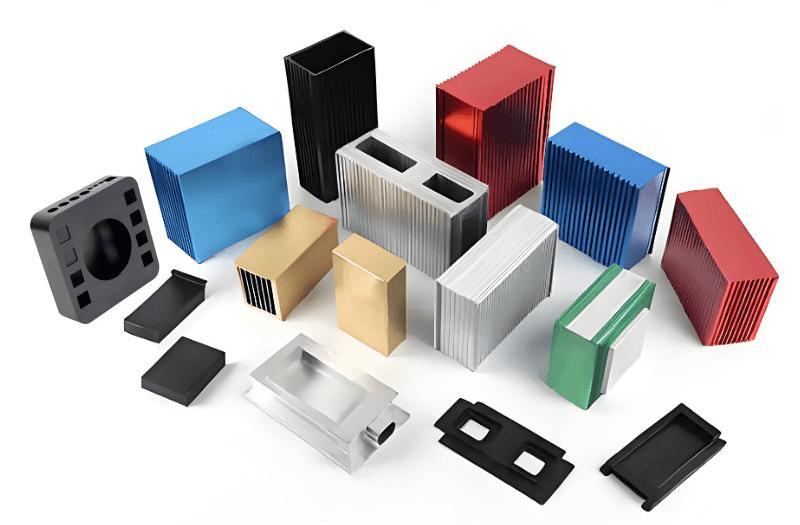
Send the section drawing with the dimensions that mate with other components and the length required, and request a profile extrusion quote with the die cost broken out.
FAQ
What is profile extrusion?
It is a process that pushes softened material through a shaped die to produce a continuous length of constant cross-section. Features such as ribs, grooves and internal chambers are formed by the die, so they run the full length without machining.
Which plastics are best for extrusion?
Rigid PVC for stiffness and weather resistance, ABS for impact resistance and appearance, and polycarbonate where heat or impact resistance matters. Polyethylene and polypropylene extrude easily but are softer, suiting flexible or chemical-resistant applications.
What drives the cost of an extrusion die?
Profile complexity, section size and the tolerance required. Hollow sections need internal mandrels and a more elaborate flow path, and larger or more precise profiles need more careful cooling and sizing, all of which raise the one-time die cost.