

Choosing the polymer with the higher headline heat rating can make a purchasing comparison less useful. PEI machining for an insulating component needs a defined operating envelope and evidence for the actual stock and geometry. The useful PEI vs PEEK question is whether each candidate meets that complete requirement, not which material name sounds more demanding.
Heat and dielectric needs
Specify PEI machining for insulating parts through the exact grade, stock form, temperature and load history, electrical environment, chemical exposure, critical geometry, and acceptance records. Compare PEI with PEEK using applicable material data and representative validation. A resin heat rating or dielectric test result does not establish the performance of every finished component.
Distinguish continuous exposure, short peaks, heat deflection under a test load, and the installed component temperature. They are different inputs. Also distinguish dielectric strength, resistivity, tracking behavior, and the insulation geometry required by the assembly. A single electrical number cannot represent all of them.
Mitsubishi Chemical Group’s Duratron U1000 PEI stock-shape data identifies test methods and conditions and describes its values as indicative. Use the specified product and the applicable design basis. Do not transfer a stock property’s meaning into a finished-part service guarantee.
Machining behavior
Review thin sections, deep holes, edges, mounting features, and material removal before committing to close dimensions. Support the component without forcing it into an artificial shape, and inspect the required released or defined restrained condition. A stable setup and a stable delivered component are related but separate goals.
Mitsubishi Chemical Group’s machining guide discusses polymer heat behavior, tooling, cooling, and stabilization. Ask the supplier to propose a route suitable for the actual PEI stock and geometry. A familiar cutter or coolant from another material is not sufficient process justification.
Ensinger’s machinable-plastics FAQ addresses dimensional stability and compatible processing. Include cleaners, lubricants, adhesives, and service fluids in the review where they affect the part. A machining choice that produces an acceptable initial surface still needs compatibility with the subsequent assembly and exposure.
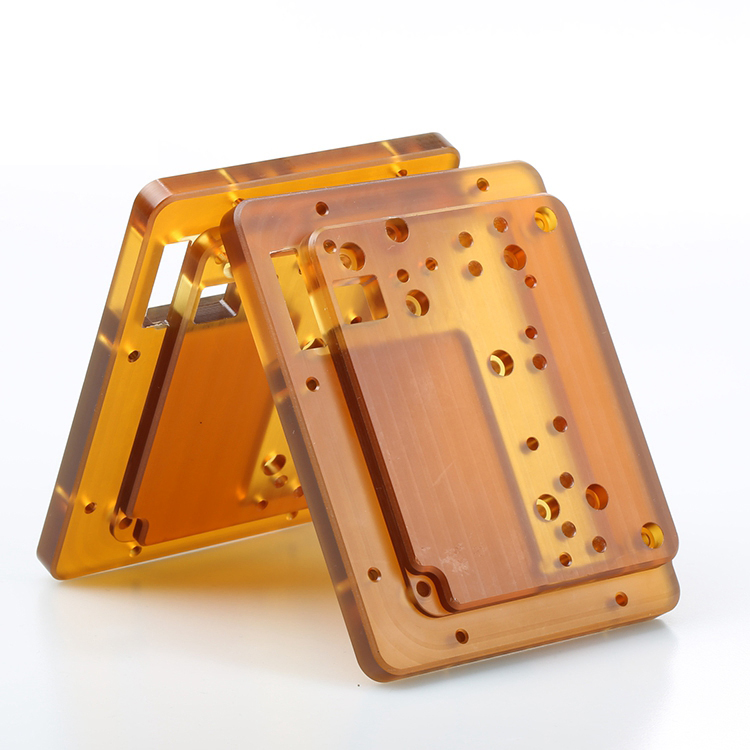
Table: PEI vs PEEK decision factors
Compare candidates by a common requirement set. Identify the grade and product form behind every datum and avoid matching values from different test conditions as though they were interchangeable. Resin specimen data and stock-shape data may serve different stages of the assessment.
| Requirement | PEI candidate | PEEK candidate | Decision evidence |
|---|---|---|---|
| Thermal exposure | Grade-specific time, load and temperature data | Grade-specific time, load and temperature data | Installed envelope and relevant validation |
| Electrical function | Applicable properties and surface conditions | Applicable properties and surface conditions | Defined insulation and electrical tests |
| Fit | Stock behavior and mating-part response | Stock behavior and mating-part response | Conditioned dimensional and assembly checks |
| Exposure | Compatibility under actual stress and temperature | Compatibility under actual stress and temperature | Material evidence and required exposure testing |
| Procurement | Stock, route, documentation and acceptance | Stock, route, documentation and acceptance | Comparable complete quotations |
Victrex’s 450G PEEK resin data illustrates condition-dependent properties and differing electrical specimen thicknesses. It is a resin reference, not confirmation that any offered machined PEEK stock has identical values.
RFQ notes
State the exact PEI product or approved material specification. Ultem is a trade name rather than a complete grade description. Identify reinforcement, color restrictions, stock form, traceability, and required records. If substitutions are permitted, define who approves them and which requirements must be reassessed.
Use a thermal-expansion check to identify a fit question early. The cited U1000 stock-shape sheet gives an indicative coefficient of 50 µm/(m·K) over 23–100°C. For an illustrative 50 mm unrestrained span heated from 30°C to 70°C, a constant-coefficient estimate is 50 × 0.05 × 40 = 100 µm, or 0.10 mm.
That calculation is not a tolerance or a prediction for every PEI part. It omits restraint, stress, moisture, time effects, and the mating component’s response. NIST’s dimensional-metrology guidance supports controlling the temperature context of dimensional measurements. Include the inspection and service conditions with critical fit requirements.
FAQ
These questions address specification details that should be settled before sample approval.
Is PEI automatically adequate whenever the operating temperature is below a brochure value?
No. Review the actual grade, stock form, loading, exposure duration, chemical environment, fit, and electrical requirements. Different thermal test values answer different questions. A material brochure value is not a blanket approval of a finished insulating component.
Does a resin dielectric-strength value establish the finished part voltage rating?
No. The specimen, thickness, test conditions, geometry, surfaces, environment, and insulation-system requirements matter. Identify the relevant electrical acceptance and validation plan. Do not assign a component rating by multiplying a convenient resin test value by the nominal wall thickness.
Related process selection notes
Compare machining with molding only after the material and geometry requirements are stable enough to support that decision. A machined prototype can help assess fit and access, but it may not reproduce the processing history or reinforcement orientation of a molded part.
Use the PEI material review and PEEK material review to confirm offered stock and documentation. Ask the CNC machining quotation to identify the manufacturing assumptions and any unresolved acceptance requirements.
Keep material qualification, manufacturing inspection, and assembly validation distinct in the order. A component may be dimensionally correct while the application still needs thermal or electrical verification. Allocate those tasks and records explicitly so neither party assumes the other has already completed them.
Internal links and next steps
Provide CAD, the controlled drawing, quantity, proposed grade, operating envelope, exposure conditions, critical interfaces, finish, and required evidence. Identify whether the sample must demonstrate geometry only or participate in a broader functional validation.
Compare PEI and PEEK offers with the same acceptance scope. A lower price or a more demanding material label does not settle whether the supplied component answers the design requirement. Review any proposed material or route change before authorizing manufacture.
Request a 6CProto PEI machining review with the thermal, electrical, and fit requirements. Use the response to close stock, process, and inspection assumptions before approving the sample.
FAQ
These questions address specification details that should be settled before sample approval.
Must PEI always be replaced with PEEK for a demanding application?
No. Compare grade-specific evidence against the complete operating envelope. PEI may meet some requirements, while another application may need a different material. Approve the choice through the relevant mechanical, thermal, chemical, dimensional, and electrical assessments rather than a family-level ranking.
Can an amber component be accepted as Ultem without further evidence?
No. Color does not establish resin brand, grade, reinforcement, stock history, or compliance with the purchase specification. Identify the material requirement and the evidence needed from the supplier. Keep that identity traceable through machining and sample acceptance.