

PEEK is machined because it does something no metal can do at the same weight, and it is expensive enough that a scrapped part hurts. The material rewards sharp tooling, rigid setups and a plan for the heat that cutting generates.
Is PEEK difficult to machine?
Not difficult, but unforgiving.
PEEK cuts cleanly with sharp, polished tooling at positive rake angles and generous feed rates. The difficulty is that it conducts heat poorly, so friction at the cutting edge stays in the material rather than being carried away, and a worn or slow-moving tool raises the temperature until the surface softens, smears or discolours. Most PEEK machining problems are thermal rather than mechanical.
Two material behaviours complicate the setup further. PEEK is notch sensitive, so a sharp internal corner becomes a stress concentration that can crack under load or during clamping. And because it is supplied in extruded or compression-moulded stock, internal stresses in the billet can be released as material is removed, causing a long thin part to bow after machining rather than during it. Stress relieving the stock before final machining is the standard response.
Machining practices that work
Four practices cover most of the ground. Use sharp, uncoated carbide or diamond-tooling with a polished edge, since a dull edge rubs rather than cuts. Take positive, continuous feeds and avoid dwelling, because hesitation generates heat in the same spot. Provide chip clearance and cooling, often an air blast rather than flood coolant, to remove the heat-carrying chip without a thermal shock. And support thin sections with soft jaws, custom fixtures or a backing material so the part cannot deflect away from the cutter.
| Machining issue | Cause | Countermeasure |
|---|---|---|
| Smearing or discoloured surface | Friction heat with a dull or slow tool | Sharp polished tooling, higher feed, air blast |
| Dimension drift after machining | Released internal stress or thermal growth | Stress relief before finishing; measure after stabilising |
| Cracking at internal corners | Notch sensitivity plus clamping load | Generous radii; distributed clamping |
| Thin walls moving away from the cutter | Low stiffness | Support the section; take lighter finishing passes |
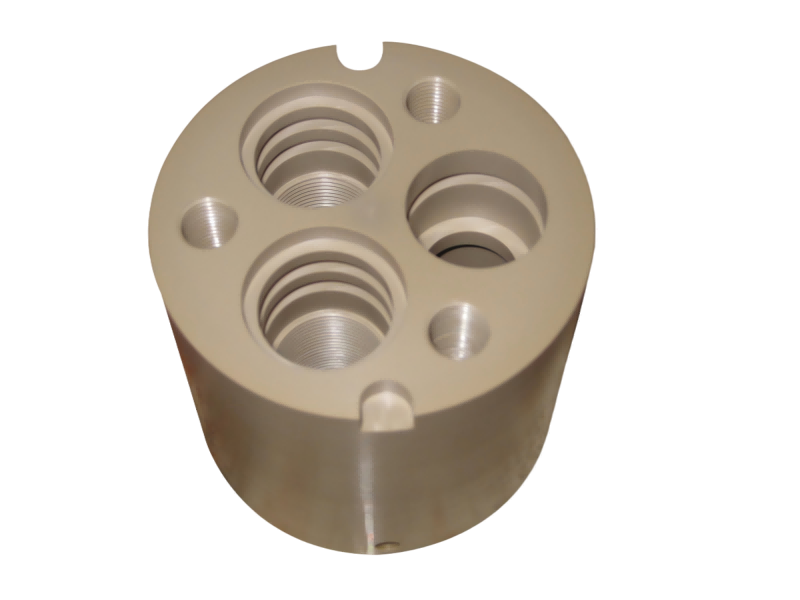
What are the disadvantages of PEEK?
Cost, UV sensitivity and higher thermal expansion.
Three limitations are worth knowing before a design is committed. Cost is the first, and it applies to both the stock and the processing, since the material demands careful conditions. Ultraviolet sensitivity is the second: PEEK degrades in prolonged sunlight unless a stabilised grade is used, which rules it out for unprotected outdoor parts. And its thermal expansion is higher than metals, so a PEEK part operating across a temperature range moves more than a metal equivalent would.
Two further characteristics affect design. The material is notch sensitive, so abrupt section changes and sharp corners are structural liabilities rather than cosmetic details. And while PEEK is chemically resistant, that resistance is not absolute: strong acids and some specific solvents attack it, and the practical answer is to check the actual media rather than to assume the family name covers every chemical. Material property data is published by ASM International.
Is PEEK stronger than aluminium?
Not in absolute terms; per weight it competes.
The comparison is not straightforward, because the two are measured differently and used differently. PEEK has high strength and stiffness for a polymer, and per unit weight it compares favourably with some metals. Aluminium is stiffer in absolute terms, conducts heat far better, and is generally cheaper per part at any reasonable volume. PEEK wins where weight, chemical resistance, electrical insulation or a non-metallic requirement matter more than raw stiffness.
The practical test is what the part has to survive. A bracket that must be stiff needs aluminium; a bushing in a chemical environment that must not gall a mating metal surface is a PEEK application; a component that must insulate electrically cannot be aluminium at all. Material selection follows the requirement rather than the material’s reputation. Related high-performance options are described under materials.
Design choices that suit the material
Keep wall sections reasonably uniform, since thick-to-thin transitions create differential cooling and internal stress. Radius the internal corners, which both reduces notch effects and lets the cutter pass smoothly. Allow generous engagement on threads, because a thin PEEK thread strips, and consider metal inserts where a joint will be tightened repeatedly. Where a part must hold a tight tolerance over a temperature range, state the reference temperature, because expansion over the range is larger than any machining tolerance being specified.
It also helps to say what the part replaces. A PEEK part is often a substitute for metal in a specific environment, and knowing which metal and which failure mode allows the design to be assessed properly rather than simply reproduced in plastic. Drawing conventions follow ASME standards, and measurement practice is described by the NIST Manufacturing Extension Partnership.
Specifying a PEEK part
Name the grade, including whether it is unfilled or reinforced with glass or carbon fibre, since the two machine differently and behave differently in wear. State the temperature range and the chemicals the part will meet, identify the features that carry load or seal, and state the measurement condition for critical dimensions. Where the part will run against a mating surface, say what that surface is made of, because wear behaviour depends on the pair rather than on PEEK alone.
Two notes prevent common failures. Mention ultraviolet exposure if any, so a stabilised grade can be quoted, and allow for a pre-machining stress relief step if the part has close tolerances over a long dimension, because otherwise the final geometry will move after the machine. Surface and coating terminology follows ASTM Committee B08, and process obligations are set out by the US EPA. Machining and molding routes are described under CNC machining and injection molding.
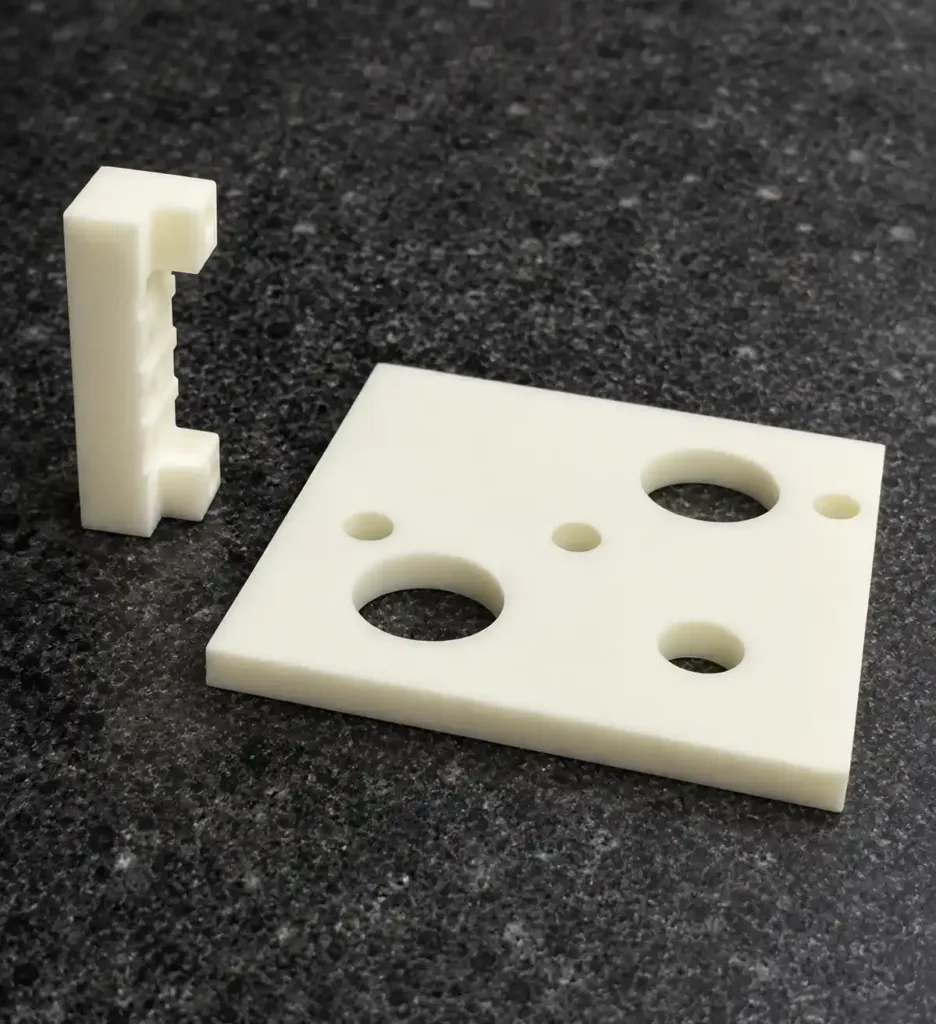
Send the part with the chemicals, temperature and mating surface, and request a PEEK machining quote with the grade and stress relief stated.
FAQ
Is PEEK difficult to machine?
It cuts cleanly with sharp tooling and positive feeds, but it is unforgiving. Poor heat conduction means friction heat stays in the material and softens the surface, and the material’s notch sensitivity and internal stress make clamping and stress relief as important as the cutting parameters.
What are the disadvantages of PEEK?
High material and processing cost, susceptibility to ultraviolet degradation without a stabilised grade, and higher thermal expansion than metals. It is also notch sensitive and its chemical resistance is not absolute, so the actual media should be checked rather than assumed.
Is PEEK stronger than aluminium?
It is strong for a polymer and compares well per unit weight, but aluminium is stiffer in absolute terms, conducts heat far better and usually costs less. The choice follows the requirement, such as chemical exposure, insulation or weight, rather than raw strength.