

Medical devices have been shrinking for decades, and component manufacturing has followed. The challenge is not only producing small features but doing so consistently enough that a device assembled from thousands of parts behaves predictably.
What micro parts are used for in medical devices
Four application areas dominate. Minimally invasive instruments, where shafts, linkages and cutting elements must be small enough to pass through a narrow access route while still transmitting force. Diagnostic and analytical equipment, where fluid channels, nozzles and sensor components operate at small scale. Implantable and wearable devices, where the envelope is tightly constrained. And surgical instruments, where fine tips and mechanisms determine what the surgeon can do.
| Application | Typical components | What drives the design |
|---|---|---|
| Minimally invasive instruments | Shafts, linkages, cutting elements | Force transmission within a small envelope |
| Diagnostics and analysis | Fluid channels, nozzles, sensors | Flow behaviour and cleanliness |
| Implantable and wearable | Housings, electrodes, seals | Material compatibility and reliability |
| Surgical instruments | Fine tips, pivots, springs | Precision and repeatable actuation |

What a CNC machine does in this field
Machining remains central to medical micro parts because it offers control over material and dimension that other processes struggle to match at small scale. It produces instrument bodies and linkages, cuts fine features in stainless and titanium, and establishes the interfaces that determine whether an assembly works. In medical work the machine is usually paired with a specialised setup: small-diameter tooling, high-speed spindles, precise workholding and, often, a temperature-controlled environment.
The limitation to understand is that machining accuracy and feature size are linked. As the tool diameter falls, its stiffness falls faster, which limits how hard it can be pushed and how accurately it can hold a dimension under load. That is why micro machining is slow, tool-hungry and sensitive to vibration, and why it is quoted differently from conventional machining.
Why medical micro parts are difficult to manufacture
Four difficulties compound. Tool deflection at small diameters makes the achievable tolerance dependent on the feature rather than on the machine specification. Heat concentration at the cutting edge shortens tool life, particularly in stainless and titanium. Chip evacuation becomes unreliable, so chips are re-cut and the surface deteriorates. And handling becomes a process risk in itself, because a part that can be dropped and lost is also a part that can be bent by force that would be harmless at larger scale.
A fifth factor applies to medical work specifically. Cleanliness and material traceability must be maintained through operations that involve very small quantities of material and, often, several handling steps. Losing track of a lot number on a batch of small components is easy, and recovering it is not. Process measurement practice is described by the NIST Manufacturing Extension Partnership.
Materials that suit medical micro parts
Stainless steels dominate, particularly the austenitic grades and the precipitation-hardening grades where higher strength is needed, because they combine corrosion resistance with machinability. Titanium appears where weight and biocompatibility matter, at the cost of more difficult machining. Cobalt-chromium alloys and specific nickel alloys serve wear-resistant or high-strength applications. Polymers appear where the component does not need metal, with grades chosen for chemical compatibility and, where relevant, for contact with the body.
Two selection criteria are specific to this field. The material must be able to accept the cleaning and sterilisation the device will undergo without degrading, and it must be available in a form and grade that can be traced through the supply chain. Both considerations are usually settled by the device’s own documentation rather than chosen by the manufacturer. Material data is published by ASM International.
How micro parts are inspected
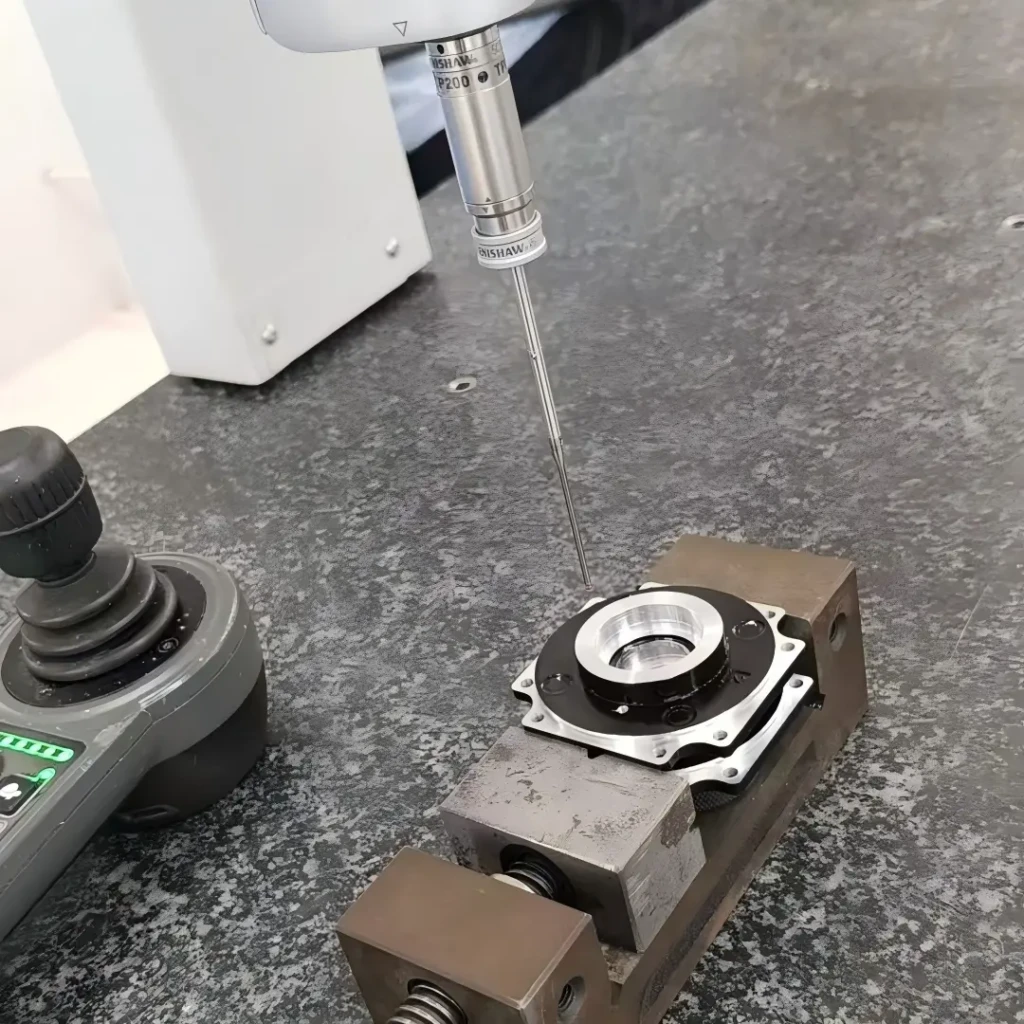
Three approaches cover most requirements. Optical and vision systems measure features that can be seen without contact, which suits fine profiles and surfaces. Coordinate measurement with a small stylus verifies dimensions and positions where contact is acceptable and the feature can be reached. Non-contact scanning suits delicate surfaces and complex geometry. For internal features that no probe can reach, the choice is often between a destructive check on a sample and an indirect method such as flow or force testing.
Two practical points decide whether the inspection is useful. The measurement method should be agreed before production, because the geometry sometimes has to accommodate probe access. And the uncertainty of the method should be small relative to the tolerance being checked, since a measurement whose uncertainty approaches the tolerance provides an indication rather than evidence. Drawing conventions follow ASME standards, surface terminology follows ASTM Committee B08, and process obligations are set out by the US EPA and, for devices contacting patients, by the US Food and Drug Administration. Machining routes are described under precision machining.
Briefing a medical micro parts project
State which features are at micro scale, since they drive process and cost more than overall part size. State the material and its specification, because it is usually fixed by the device documentation. State the inspection requirement with the method, since the two have to be compatible. State the cleanliness and packaging requirement, and say whether the part contacts the patient or a sample. And say whether the component is a prototype or part of a production programme, because that changes the appropriate level of process documentation.
Two further notes reduce iteration. Say whether any feature must be reached by a measuring probe, so the geometry can be arranged to allow it. And expect tool consumption to appear as a visible cost line, because in micro work the tooling is consumed rather than amortised.
Send the component with its intended use, material and inspection requirement, and request a micro parts quote with the tooling assumption stated.
FAQ
What is a CNC machine used for in the medical field?
It produces instrument bodies, linkages, housings and precision components, often with small-diameter tooling and high-speed spindles. Machining is valued because it controls both material and dimension, which matters where the component carries force or must fit into an assembly.
What materials suit medical micro parts?
Austenitic and precipitation-hardening stainless steels dominate for corrosion resistance with machinability, titanium where weight and biocompatibility matter, cobalt-chromium and some nickel alloys for wear or strength, and polymers where metal is not required.
How are micro parts inspected?
Optical and vision systems for visible features, coordinate measurement with a small stylus where contact is acceptable, and non-contact scanning for delicate surfaces. Internal features often need a destructive check on a sample or an indirect functional test.