

A tooling quote arrives with a single line: “Mold steel: P20.” For a 10,000-shot prototype run of a matte ABS part, that is a reasonable default. For a 300,000-shot run of glass-filled nylon with a high-gloss surface, the same line is the most expensive sentence in the quote, because P20 will wear early and polish unevenly, and the tool will need rework or replacement before the program ends. Mold steel selection is a volume-and-resin decision, not a default: the steel determines how many shots the tool survives, how well it polishes or textures, how it handles corrosive resins, and how much the tool costs to build and maintain. One naming note before the comparison: in this article, “718” means 718/718H, the ASSAB-718-type prehardened mold steel common in Asian and European tooling practice — not Inconel 718, the nickel superalloy used in machined parts.
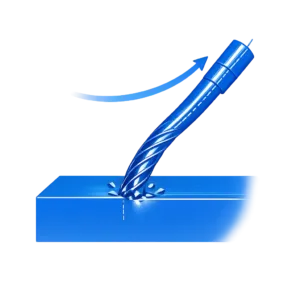
Mold steel works four jobs at once
A mold steel works four jobs at once: it resists wear where plastic flows and ejection slides, it polishes or textures to the finish the part needs, it survives coolant and corrosive gases from the resin, and it conducts heat well enough for the cooling layout to function. No single grade wins all four, which is why tooling engineers match the steel to the resin, the part volume, and the cosmetic class instead of defaulting to one material.
Two of these jobs are routinely underestimated. Wear shows up first at thin core edges, gate inserts, and ejection surfaces — invisible in the early shots, expensive at shot 50,000. Corrosion shows up in tools running PVC and other resins that release acidic byproducts, where a standard steel can pit and rust between runs. Both failures are slow, which is why they are discovered after the program is committed to the steel.
P20 covers moderate programs; 718 covers volume and abrasion
P20 is the workhorse of standard molds: prehardened, easy to machine, and inexpensive enough for moderate-volume tools. It suits low-to-mid volume runs with friendly resins and matte or lightly textured finishes. Its limitation is hardness: P20 wears faster in abrasive resins, high-cavitation tools, and high-gloss surfaces that demand frequent polishing. P20 is also a family rather than a single chemistry — regional equivalents such as 1.2311 or 1.2312 and different suppliers’ 718H deliveries are not automatically identical, so confirm the actual grade, hardness, and heat-treatment state with the tool steel supplier before treating them as interchangeable. For many projects the real decision is not P20 versus an exotic grade but P20 versus 718, because the volume forecast decides whether the extra steel cost pays back in tool life and reduced maintenance.
If the part is a prototype or bridge run below roughly the low tens of thousands of shots, P20 is usually the economically correct answer; upgrading the steel spends money on life the program will not use. If the forecast is uncertain, price the tool both ways: the delta between P20 and 718 is small relative to a tool change in the middle of production.
718 upgrades wear resistance for volume and abrasive resins
718/718H is a tougher, higher-hardness prehardened grade with better wear resistance than P20, commonly chosen for higher volumes, larger cavities, or tools running abrasive and glass-filled materials. It machines less easily than P20 and costs more, but it holds detail longer and polishes to a higher class, which matters when the part surface is cosmetic. How much the upgrade helps depends on the filler type and percentage, the gate and core geometry, and the tool’s maintenance plan, so treat “glass-filled resins need 718” as a starting point for review rather than a rule.
The trade-off shows in maintenance. A 718 tool running the same resin as a P20 tool will need cavity polishing less often and will hold its steel condition longer between services. If the program has a maintenance plan, the steel choice changes the schedule; if it does not, the steel choice is even more important, because wear will not wait for a service interval that was never defined.
H13 and S136 earn their cost in heat and corrosion
H13 is a hot-work tool steel with good toughness at elevated temperatures, suited to tools that run hot, see thermal cycling, or face severe abrasive wear. High cavity count alone is not a reason to choose H13; the grade earns its place where heat and wear concentrate — gate inserts, cores in hot-running tools, and slides or lifters that see thermal and mechanical load — while the rest of the cavity can remain in a prehardened grade. S136 is a stainless mold steel prized for corrosion resistance and excellent polishability, the standard answer for PVC-type resins that attack standard steel and for cosmetic parts needing mirror finishes; its hardened state and polish class should be confirmed with the supplier because they vary by delivery condition.
| Grade | Typical supplied condition (confirm supplier data) | Choose it when |
|---|---|---|
| P20 | Prehardened, typically around 28–32 HRC | Moderate volume, friendly resins, standard finish |
| 718/718H (ASSAB-type) | Prehardened, typically around 32–40 HRC | Higher volume, abrasive resins, cosmetic surfaces |
| H13 | Machined annealed, then hardened to typical 44–52 HRC | High mold temperature, thermal cycling, severe wear |
| S136 | Stainless tool steel; supplied annealed or prehardened by grade | Corrosive resins, mirror finishes, cleanroom-friendly tools |
Both H13 and S136 cost more and machine slower than P20, so they are specified for conditions, not as upgrades. A corrosive resin in a low-volume tool may still justify S136 because pitting ruins the surface finish of every shot; a hot-running abrasive application may justify H13 because the alternative is repeated cavity replacement.
Matching steel to volume, resin, and finish starts before quoting
Select the grade from three inputs: the resin and its abrasiveness and corrosiveness, the forecast volume and desired tool life, and the cosmetic class of the part. Write the steel expectation into the tooling discussion before quoting so the price you compare includes the same tool life and finish capability. If the part surface is a visible class-A finish, say so in the RFQ; if the resin is glass-filled, name the filler percentage, because it drives wear more than the base polymer.
Also confirm the steel on the drawing or tooling spec rather than leaving it to the mold maker’s default. A tool built in the wrong steel is difficult to upgrade later — cavity steel can be replaced, but the frame, cooling, and ejection system were built around the original decision. The rapid tooling team can quote the same geometry in different steel grades so the volume decision is visible in the price, and the surface finishing options on this site show what each steel can deliver on the part side.
Steel selection should also consider where in the tool the wear happens, because one grade rarely needs to serve the whole tool. Cavity faces that see flowing resin and textured surfaces may need a polishable, wear-resistant grade, while cores and ejector pins that see sliding wear may be made from through-hardened tool steel or coated inserts even when the cavity is P20. Many molds are built as hybrid constructions: a P20 frame with hardened inserts at the gate area, wear strips on sliding surfaces, and stainless details where corrosion concentrates. Quoting a single steel grade for the whole tool is a simplification that can cost money in the wrong direction — either spending premium steel where it is not needed or leaving a cheap grade where wear concentrates. Ask the mold builder to identify the wear-critical zones and price them separately, and confirm how the tool will be serviced: a tool designed for insert replacement is easier to repair than one whose wear area is machined into a solid block. For bridge tooling, the hybrid approach is especially attractive because it gets the program running on a P20 frame while the production-volume steel decision is made later with real wear data.
Steel selection also interacts with the mold’s moving parts. Slides, lifters, and ejector pins see sliding wear that cavity faces do not, and they are often made from or coated with harder materials even when the cavity is P20 or 718. If the drawing or tooling spec calls out one steel for the whole tool, ask how the moving elements are treated; the answer affects tool life and maintenance intervals. Thermal treatment is part of the grade story too: the same steel in different hardness conditions behaves differently, and the mold builder should state the specified hardness range and the heat-treatment route for the cavity and core. A tool built from the right grade but heat-treated inconsistently will wear unpredictably. For programs where the resin is abrasive or the tool runs hot, request the hardness certificate with the tool, and confirm the recommended service points so wear is caught early, when a small repair is still possible.
Frequently asked questions
Can a P20 tool be upgraded to a harder steel later?
Partially. Cavity and core inserts can be remade in a harder grade if the frame and cooling layout allow it, but the cost approaches a new tool. Upgrading is practical when only one cavity wears early or when the program volume grows after the tool is built. Plan for it by keeping insert-based construction in the original tool design.
Does harder mold steel always mean better parts?
No. Harder steel resists wear but is harder to machine, which raises tool cost and can limit the detail or texture that is practical. For friendly resins at low volume, a P20 tool can produce parts identical to an H13 tool. Steel selection optimizes tool life and maintenance cost, not part quality directly; part quality comes from the tool design and process.
How does the steel choice affect cooling?
Different steels conduct heat at different rates, which changes cycle time and cooling balance. Stainless grades conduct less heat than standard tool steels, so a cooling layout designed for P20 may need more or better-placed channels in S136. Confirm the thermal conductivity of the chosen grade with the mold designer when cycle time matters.
Conclusion
Mold steel is a forecast decision: match the grade to the volume, the resin, and the finish class, and price the tool with the steel stated. P20 handles the majority of moderate programs; 718 covers higher volume and abrasive resins; H13 and S136 answer hot, corrosive, and mirror-finish conditions. The wrong steel is rarely visible on the first part — it shows up in the maintenance schedule and the tool life, which is exactly when it is hardest to change.
If you are quoting a new tool or a bridge tool and want the steel recommendation tied to your volume forecast, send the part, the resin, and the expected shot count to the 6CProto tooling team. The quote should state the steel, the expected maintenance interval, and the reason for both.