

A clear machined part that must survive impact is made from acrylic because it polishes beautifully, and it cracks in service; the replacement in polycarbonate survives the impact but scratches and yellows where the acrylic would have stayed clear. Clear plastics are a trade between optics, impact, and durability, and the choice between acrylic (PMMA) and polycarbonate (PC) is one of the most common material decisions in machined clear parts. The right material follows the part’s environment and its loading, and the machining and the finishing complete the decision.
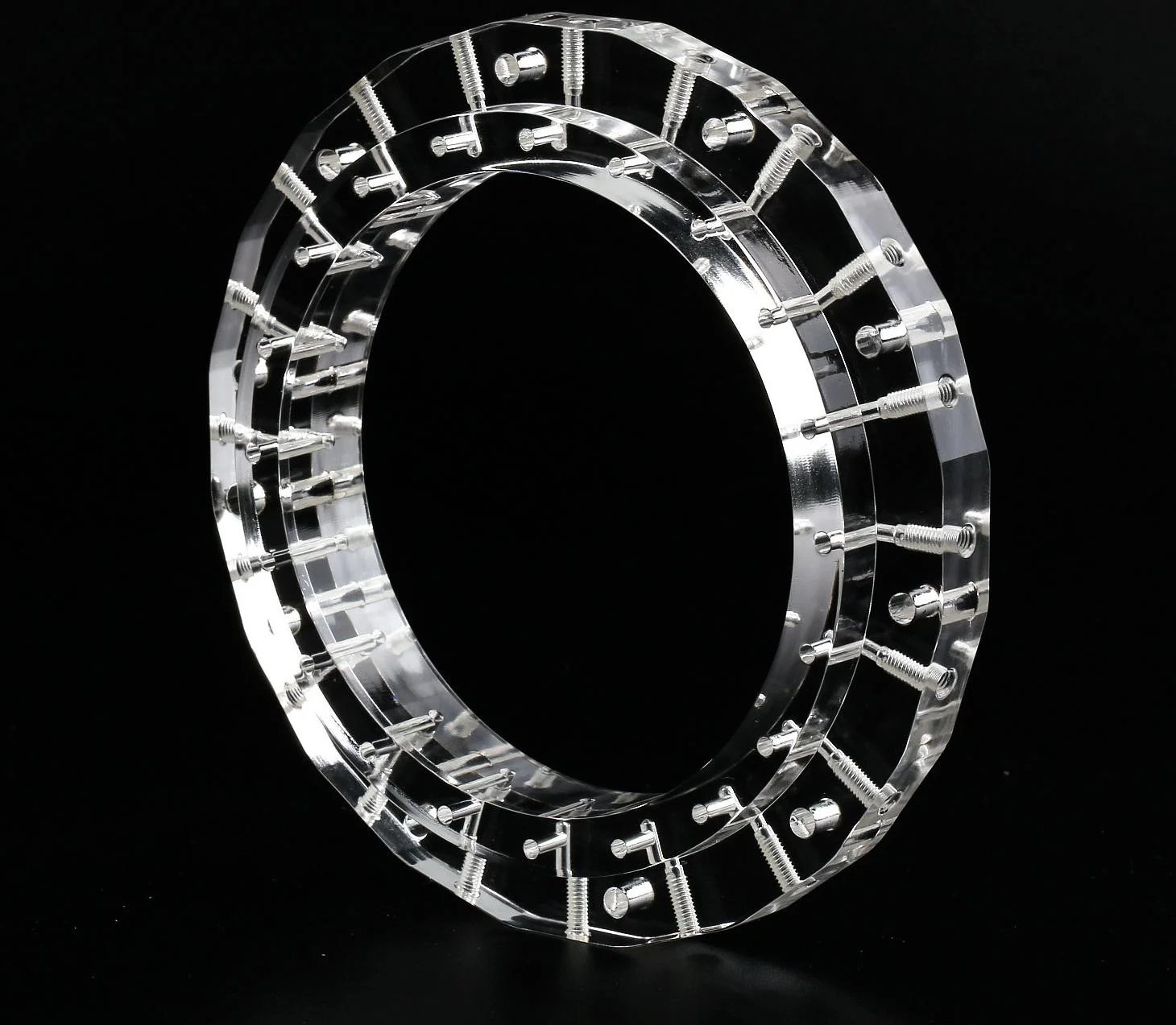
Clarity and optics: PMMA vs PC in machined parts
Acrylic offers the best optical clarity of the common plastics, with high light transmission and low haze, which makes it the choice for lenses, windows, and displays where the optics matter most. Polycarbonate is also transparent but has a slightly lower transmission and can carry a yellow tint, especially as it ages. For an optical part where the clarity is the function, acrylic leads; for a window that must also survive impact, the trade moves toward polycarbonate. The optical requirement should be stated — the transmission, the haze, and the viewing condition — because the material choice follows the number the part must meet.
The machined surface also affects the optics: the clarity of the finished part depends on the machining and the polishing, and the material’s optical quality is only the starting point.
Impact and chemical resistance differences
Polycarbonate is the impact champion, with far higher impact resistance than acrylic, which is why it appears in safety glazing, machine guards, and protective covers. Acrylic is brittle and can crack or shatter under impact, but it resists scratching better than polycarbonate and has better resistance to many chemicals and to UV yellowing when formulated for it. Polycarbonate scratches easily and can be attacked by solvents and by UV exposure without the right protection. The service requirement decides the balance: impact and toughness favor polycarbonate; scratch resistance, chemical resistance, and long-term clarity favor acrylic. The part’s environment — the cleaning agents, the UV exposure, and the impact risk — is the input to the choice.
The chemical resistance is grade-specific, and the material should be confirmed against the actual cleaning and service chemicals.
Machinability: cracking, melting, and edge finish
The two materials machine differently. Acrylic is brittle and can crack or chip if the tooling and the feed are not controlled, and it needs sharp tools and light cuts to avoid the fractures that start at the edge. Polycarbonate is tougher but softer, and it can melt, smear, or leave a fuzzy edge if the heat is not controlled; it needs sharp tools, controlled speed, and good chip clearance. Both materials need the machining parameters matched to their behavior, and the edge quality is set by the process. The machining guide for acrylic covers the one material; this page compares the two, and the shop should confirm the parameters for the specific grade and the feature.
The machining also affects the residual stress and the clarity: a part machined with too much heat can show stress marks or haze, and the process should be verified on the optical surfaces.
Surface finishing for clear machined components
The clear finish is created by the machining and the polishing. Machined surfaces carry tool marks that scatter light, and the optical surfaces are polished, flame-polished, or coated to restore the clarity. Acrylic polishes to excellent clarity and can be flame-polished for a smooth edge; polycarbonate is softer and more difficult to polish without scratching, and it often needs a scratch-resistant coating to protect the surface. The finish requirement should be specified with the material: a diamond-polished or coated surface on the optical faces, with the machining marks limited on the visible edges. The finishing step is where the clear part’s optics are made, and the material and the finish are chosen together.
The scratch-resistant coating on polycarbonate adds a process and a cost, and the coating should be included in the comparison when the surface durability matters.
Choosing by environment: windows, lenses, housings, and covers
The part type and the environment make the call. A lens or a display window where the optics dominate favors acrylic; a machine guard or a protective cover that must survive impact favors polycarbonate; an outdoor window favors a UV-stable grade with the right coating; and a cover that is cleaned frequently favors the material and the coating that resist the cleaner. The choice should also include the machining and the finishing cost, because the material that needs the scratch-resistant coating or the careful polishing carries that cost in the part price. The clear part decision is a full comparison of optics, impact, environment, and finish, and the material that wins is the one that meets the whole requirement set.
The acrylic and polycarbonate material pages on this site cover the grades; this page is the machined clear-part selection decision. When the optics, the impact, the environment, and the finish are on the table, the material choice is an engineering decision with a clear answer for the part.
Validating the clear part on samples
The clear part should be validated on samples before the design is locked. The sample part is machined and finished with the candidate material and the process, and the result is checked for the clarity, the edge quality, and the fit. The validation should also test the material in the service condition: an impact test for the guard, a cleaning-agent test for the cover, or a UV test for the outdoor window. The sample results decide the material and the finish with evidence, and they set the acceptance reference for the production parts. A clear part that is validated on the sample is a part whose optics and durability are confirmed; one that is chosen from the material table carries the risk into the first production run, where the failure costs more than the sample would have.
The validation should also cover the machining and the finishing consistency: the clarity of the production parts depends on the process, and the inspection should check the optical surfaces and the edges at the interval that catches the drift. The material lot and the tooling condition can change the result, and the process should be monitored with the sample as the reference. When the clear part is validated on the sample and controlled in production, the optics and the durability are engineered properties — and the part that ships looks and performs as the sample that was approved.
The clear part decision should also include the tolerances and the mounting, because the material’s expansion and its behavior affect the fit. Polycarbonate and acrylic expand differently with temperature, and a window or a cover that is held in a frame needs the clearance for the movement; a lens that is mounted in a bore needs the fit that does not stress the plastic and distort the optics. The material’s thermal behavior and its creep belong in the design, and the drawing should state the operating temperature and the mounting clearance. The machining tolerance also differs between the materials, with the acrylic’s brittleness and the polycarbonate’s softness setting the achievable edge and feature quality. When the clear part is designed with its mounting, its temperature, and its tolerance in view, the material choice is complete — and the window, the lens, or the cover fits, stays clear, and survives its service because the design accounted for the plastic’s behavior, not just its appearance.
Keep the clear-part validation and the samples with the drawing, so the optics and the finish are reproducible across the lots. The record is the reference for the production inspection and the material review when a substitute is proposed.
Confirm the machining and the polishing parameters with the supplier on the first article, because the clear part’s optics are set in the process. The first article should be measured for the clarity and checked for the edge quality, and the process should be recorded so the production parts match the approved sample.
Confirm the optics and the impact on the production material, and keep the approved sample with the drawing so the clear part is reproducible across the lots.
Confirm the optics and the impact on the production material with a sample, and keep the sample with the drawing so the clear part is reproducible and the acceptance is clear.
Verify the optics and the edge quality on the first article, and keep the sample and the process record with the part so the clear components are reproducible and inspectable across the lots.
Verify the optics, the impact, and the fit on the production material with a first article, and keep the approved sample and the process record with the part for the inspection and the reorder.
If you are choosing between polycarbonate and acrylic for a machined clear part and want the optics, the impact, and the finish compared, the 6CProto CNC team can work from your environment and your loading to the material and the machining plan.