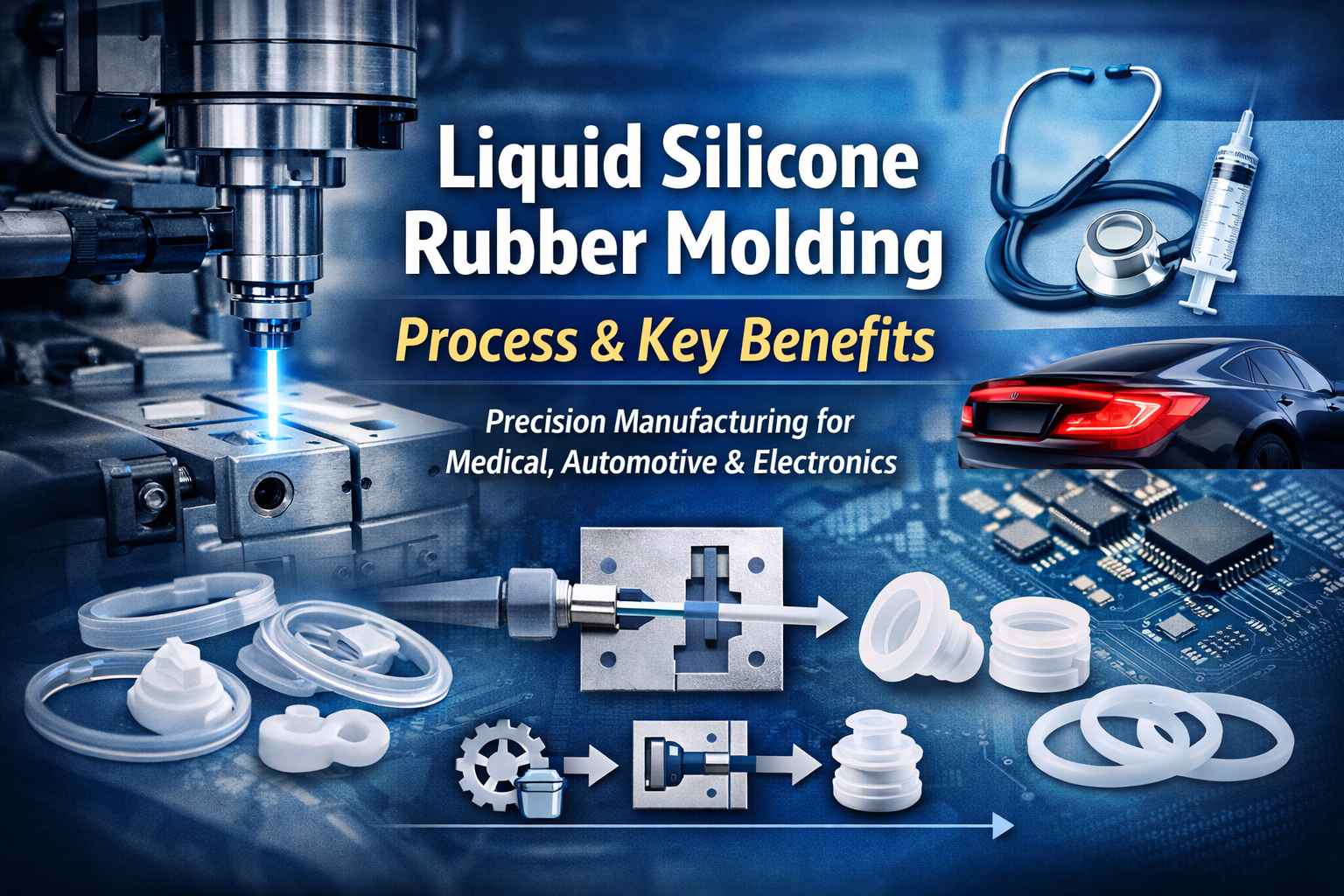
Liquid Silicone Rubber Molding is an advanced manufacturing process widely used to produce high-precision, flexible, and durable silicone components. As industries demand higher performance, tighter tolerances, and safer materials, Liquid Silicone Rubber Molding (LSR Molding) has become a preferred solution for medical devices, automotive parts, consumer electronics, and industrial applications.
What Is Liquid Silicone Rubber Molding?
Liquid Silicone Rubber Molding is a specialized injection molding process designed for liquid silicone elastomers. Unlike solid silicone rubber, LSR is supplied as a two-part platinum-cured system that remains liquid before molding.
Key Characteristics of Liquid Silicone Rubber
Liquid silicone rubber used in LSR molding offers several defining properties:
- Low viscosity and excellent flowability
- Thermosetting behavior activated by heat
- High elasticity and flexibility
- Superior resistance to heat, chemicals, and UV
- Long-term durability and stability
These characteristics allow Liquid Silicone Rubber Molding to produce complex geometries with consistent quality and minimal defects.
How the Liquid Silicone Rubber Molding Process Works
The Liquid Silicone Rubber Molding process is highly automated and optimized for precision and repeatability.
Step 1 – Material Metering and Mixing
Liquid silicone rubber consists of Part A and Part B, which are stored separately. A precision metering system pumps equal ratios into a static mixer.
Additives and Color Pigments
At this stage, pigments, self-adhesive agents, or performance additives can be added to customize color, hardness, or bonding properties.
Step 2 – Injection into the Mold
The mixed LSR material is injected into a closed mold cavity through a cold runner system. The material remains liquid until it enters the heated mold.
Step 3 – Heat Curing and Crosslinking
Inside the mold, heat triggers a platinum-catalyzed curing reaction. The silicone rapidly crosslinks and solidifies into its final elastic form.
Step 4 – Demolding and Finishing
After curing, the silicone part is demolded. Due to optimized mold design and material elasticity, Liquid Silicone Rubber Molding typically produces flash-free parts, reducing secondary operations.
Advantages of Liquid Silicone Rubber Molding
Liquid Silicone Rubber Molding offers advantages that are difficult to achieve with traditional rubber or plastic molding technologies.
High Precision and Tight Tolerances
LSR injection molding enables excellent dimensional control, making it suitable for micro components and precision sealing applications.
Outstanding Material Performance
Liquid silicone rubber provides:
- High temperature resistance (up to 200–250°C)
- Excellent chemical and aging resistance
- Low compression set
- Long service life
Biocompatibility and Safety
Medical-grade Liquid Silicone Rubber Molding materials are:
- Biocompatible and hypoallergenic
- FDA and ISO 10993 compliant
- Free from plasticizers and toxic additives
This makes LSR molding ideal for medical and food-contact products.
Design Freedom and Flexibility
Because of its low viscosity, Liquid Silicone Rubber Molding supports:
- Thin wall designs
- Complex undercuts
- Integrated sealing features
- Multi-cavity and high-volume production
Automation and Production Efficiency
LSR molding is highly automated, reducing labor costs and improving production consistency for large-scale manufacturing.
Liquid Silicone Rubber Molding vs Other Manufacturing Methods
LSR Molding vs High Consistency Rubber (HCR) Molding
Compared to HCR molding, Liquid Silicone Rubber Molding offers:
- Faster cycle times
- Better dimensional accuracy
- Less material waste
- Improved repeatability
LSR Molding vs Thermoplastic Injection Molding
Unlike thermoplastics, LSR parts remain elastic across extreme temperatures and provide superior sealing, insulation, and biocompatibility.
Applications of Liquid Silicone Rubber Molding
Liquid Silicone Rubber Molding is widely used across multiple industries.
Medical and Healthcare Applications
- Medical device seals and gaskets
- Respiratory masks and valves
- Catheters and tubing components
- Wearable and implantable silicone parts
Automotive Industry Applications
- Connector and sensor seals
- Grommets and vibration dampers
- High-temperature engine components
Consumer Electronics Applications
- Waterproof seals for smartphones and wearables
- Silicone keypads and buttons
- Protective overmolded components
Baby Care and Food-Grade Products
- Baby bottle nipples
- Pacifiers
- Food-grade valves and seals
Industrial and Electrical Applications
- Electrical insulation components
- Chemical-resistant seals
- Custom industrial silicone parts
Overmolding and Insert Molding with Liquid Silicone Rubber
One of the most powerful capabilities of Liquid Silicone Rubber Molding is multi-material integration.
Liquid Silicone Rubber Overmolding
LSR can be overmolded onto:
- Thermoplastics such as PC, PA, PBT, ABS
- Metals including stainless steel and aluminum
This process improves waterproofing, sealing, and ergonomics.
Insert Molding with Liquid Silicone Rubber
Insert molding places metal or plastic components into the mold before injection. Liquid Silicone Rubber Molding encapsulates these inserts, creating integrated assemblies in a single process.
Liquid Silicone Rubber Material Options
Liquid Silicone Rubber Molding supports a wide range of material grades.
Common LSR Material Types
- Medical-grade liquid silicone rubber
- Food-grade liquid silicone rubber
- Optical-grade transparent LSR
- High-tear-strength LSR
- Self-bonding LSR for overmolding
Hardness typically ranges from Shore A 5 to Shore A 80, depending on application requirements.
Design Considerations for Liquid Silicone Rubber Molding
Proper design is critical to achieving optimal performance and manufacturability.
Wall Thickness and Uniformity
Uniform wall thickness ensures consistent curing and dimensional stability.
Draft Angles and Demolding
Although silicone is flexible, appropriate draft angles improve demolding efficiency and extend mold life.
Parting Lines and Gate Design
Optimized mold design minimizes flash, improves surface finish, and enhances overall part quality.
Tolerances and Functional Dimensions
Liquid Silicone Rubber Molding supports tight tolerances, but functional designs must account for material elasticity.
Quality Control in Liquid Silicone Rubber Molding
High-quality LSR molding relies on strict quality management systems.
Quality Control Measures
- Material traceability
- Automated process monitoring
- Dimensional inspection
- Functional and visual testing
Many Liquid Silicone Rubber Molding manufacturers operate under ISO 9001 or ISO 13485 standards.
How to Choose a Liquid Silicone Rubber Molding Manufacturer
Selecting the right partner is essential for long-term success.
Key Factors to Consider
- Experience in Liquid Silicone Rubber Molding
- In-house mold design and tooling
- Industry certifications
- Prototyping and mass production capability
- Engineering and design support
A reliable Liquid Silicone Rubber Molding supplier provides both manufacturing and technical expertise.
Future Trends in Liquid Silicone Rubber Molding
Liquid Silicone Rubber Molding continues to evolve with market demand.
Emerging Trends
- Increased automation and smart manufacturing
- Growth in medical and wearable devices
- Advanced multi-material overmolding
- Sustainable and low-waste production
Conclusion
Liquid Silicone Rubber Molding is a proven and versatile manufacturing technology that delivers precision, durability, and scalability. From medical devices to automotive systems and consumer electronics, LSR molding enables innovative designs and high-performance silicone components.
By understanding the process, advantages, applications, and design considerations of Liquid Silicone Rubber Molding, businesses can make informed decisions and achieve long-term manufacturing success.