

Five-axis machining gets described as the answer to every complex part. It is a powerful process, but it is also a specific tool with a specific price structure. The question engineers and buyers should ask is not “is 5-axis better?” but “does this geometry justify 5-axis?” This article explains the difference between full simultaneous 5-axis and 3+2 positioning, what each unlocks, what the cost model actually looks like, and the design rules that keep a 5-axis program from becoming a slow, expensive job.
What “5-Axis” Actually Means on the Machine
A 3-axis machine moves the tool along X, Y, and Z while the workpiece stays in one orientation. A 5-axis machine adds two rotational axes, and there are two distinct ways those axes get used with different cost and capability profiles.
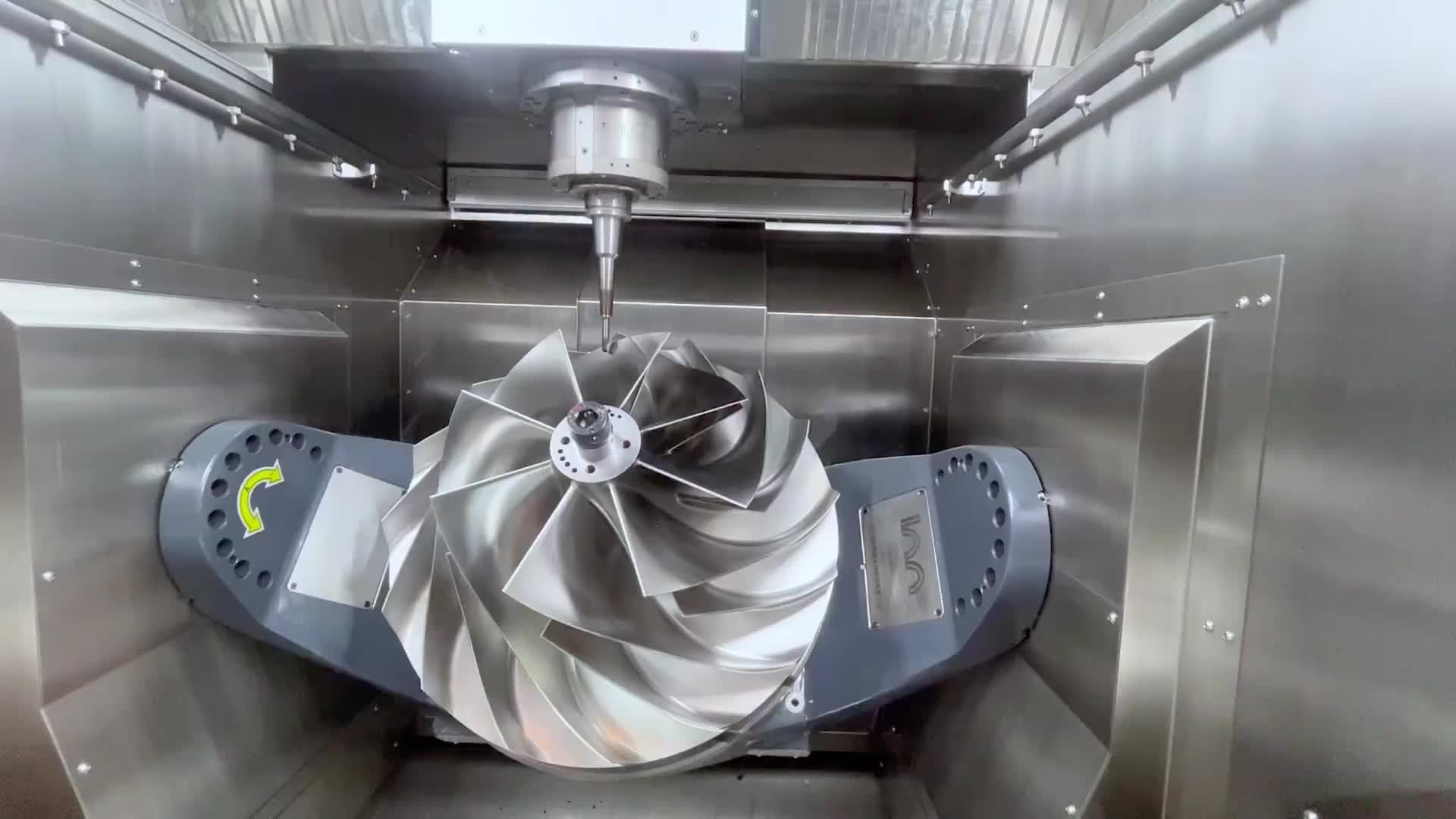
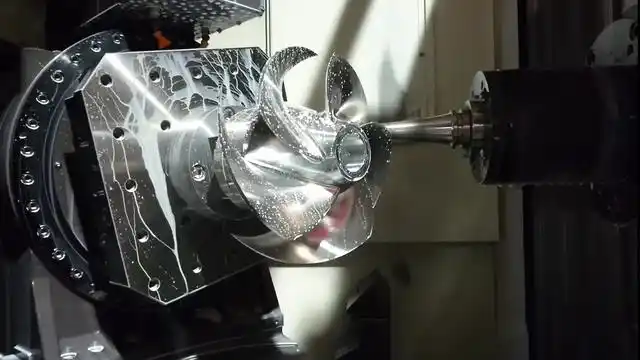
Full simultaneous 5-axis keeps the tool engaged with the surface while the part tilts and rotates. This is what makes impellers, turbine blades, and sculpted mold inserts possible: the tool stays at the correct angle to the material across a freeform surface. It requires complex CAM, careful simulation, and experienced programmers.
3+2 positioning, sometimes called positional 5-axis, tilts the part to a new angle, locks it, and machines in a standard 3-axis pass. It is much simpler to program and suits parts that simply need to be reached from several angles without re-fixturing, such as angled holes, compound-angle faces, or ports on several sides. The part is indexed rather than continuously machined.
The distinction matters for quoting. A part with four angled holes is usually a 3+2 job. A part with a continuously curved sealing surface that must be machined in one pass is a full 5-axis job. If the supplier quotes a full simultaneous program for a part that only needs positioning, you pay for programming you do not need.
What Five Axes Actually Unlock
The most valuable benefit is fewer setups. A part that needs five or six re-fixtures on a 3-axis machine can be completed in one setup on a 5-axis machine. Removing re-fixturing removes tolerance stack-up between operations and reduces handling damage on delicate geometry.
Tool engagement is the second benefit. Tilting keeps the cutting edge at the right angle to the material on contoured parts, which improves surface finish and extends tool life. Third, a tilted tool can reach deep features with a shorter, stiffer tool, which reduces deflection and chatter in deep pockets and undercuts.
The consistency argument is the one buyers often miss. When a part is finished in one setup, every feature is machined relative to the same coordinate system, so critical relationships such as a bore-to-face angle hold tighter than they would across several re-fixtures.
When 5-Axis Actually Earns Its Cost
Here is the honest version: a 5-axis machine costs more per hour than a 3-axis machine, and the toolpaths take longer to program. A simple part on a 5-axis machine is usually slower and more expensive than the same part on a 3-axis machine. Geometry must earn the capability.
A practical test: count how many setups the part needs on a 3-axis machine. Three or fewer setups, and 5-axis rarely pays. Five or more setups, or a feature that a fixed tool physically cannot reach, and 5-axis is worth quoting. The table below is a guideline, not a rule.
| Part situation | Setups on 3-axis | Best process | Why |
|---|---|---|---|
| Simple bracket, one or two machined faces | 1-2 | 3-axis | Lower hourly rate, shorter programming |
| Housing with ports on 4-6 faces | 4-6 | 3+2 five-axis | One setup, no re-fixture stack-up |
| Impeller, turbine blade, sculpted mold | Not producible | Full simultaneous 5-axis | Continuous surface engagement required |
The Cost Model: Machine Time vs. Setup Time
Machining cost is roughly machine time plus setup plus programming. A 5-axis machine has a higher hourly rate, but it can reduce total time by cutting setups and inspection points. The comparison to make is not per hour, it is per delivered part.
Programming is the cost that gets underestimated. Complex 5-axis toolpaths take longer to generate and simulate, and CAM expertise matters more than the machine list. Ask the supplier about their programming experience with your type of geometry, not just their equipment.
At low volumes, setup savings matter most because programming is amortized over few parts. At higher volumes, cycle time dominates, and the process that cuts faster per part wins even if setup is slightly longer. Fixture design is part of the cost too: a 5-axis setup often uses custom fixturing to expose five faces, and the fixture must hold the part rigidly while leaving tool access.
Simulation is the hidden step. Complex 5-axis toolpaths should be simulated to check collisions between tool, holder, and fixture before the machine runs. Suppliers who include this in their programming process are not adding overhead; they are preventing a scrapped first article.
Design Rules That Keep a 5-Axis Job Profitable
Plan for tool access before quoting. Deep pockets need clearance for the tool and its holder, and sharp internal corners may still need a radius because five axes cannot eliminate tool geometry limits. Confirm the minimum reachable feature size relative to part size: small features in a large part can force long tools even with five axes.
Two common misconceptions deserve correction. First, 5-axis does not automatically mean tighter tolerances; tolerance still depends on material, fixturing, temperature, and inspection. Second, 5-axis is not faster on simple geometry, so do not let a machine capability drive the process decision. The process decision should be driven by the part.
Questions to Ask Before Quoting a 5-Axis Part
- Is the geometry full simultaneous 5-axis or 3+2 positioning? Ask the supplier to name which one they recommend and why.
- How many setups would this part need on a 3-axis machine? Use the answer to sanity-check the recommendation.
- What CAM experience do you have with this class of geometry? Ask for the nearest comparable project, not a machine list.
- Is toolpath simulation part of the quote, or an extra? Confirm collision checking is included.
- What fixture will hold the part, and who designs it? Fixture cost and lead time belong in the quote.
The Practical Bottom Line
Use 5-axis when the setup count or the geometry demands it. Use 3+2 for multi-face positioning. Use 3-axis for simple parts and stop paying for capability you do not need. A good quote will explain the process choice, not just the price.
Note: tolerance, surface finish, and lead-time figures depend on material, geometry, and inspection method; confirm critical dimensions during DFM and quotation rather than assuming a headline number applies to every part.