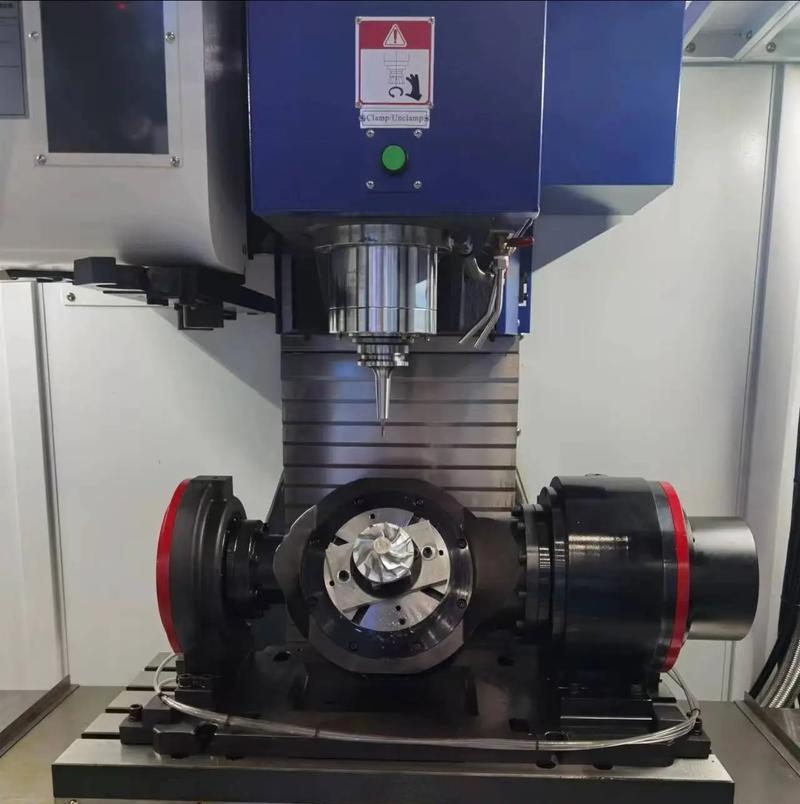
Five-axis machines offer two different capabilities, and the difference matters for cost and quality. 3+2 machining positions the tool at fixed angles using two rotary axes, then cuts with the three linear axes; simultaneous 5-axis moves all five axes at once. Both use the same machine, but they serve different parts: 3+2 for angled features and multiple faces, simultaneous for contoured surfaces that need continuous tool orientation. This guide compares the strategies and the features that choose between them.
Two Strategies, Five Axes
A 5-axis machine is two machines in one: an indexing machine that rotates the part to fixed angles, and a continuous machine that moves all axes together. The distinction is not about the hardware; it is about the tool path and the part geometry.
The practical consequence is that "five-axis" on a quote does not tell you the strategy. A part machined with 3+2 indexing is stiffer and often faster; a part machined with simultaneous motion achieves surfaces that indexing cannot. Asking which strategy the quote assumes is the first step to comparing it fairly.
The strategy is a cost line in the quote. Indexed work runs at the stiffness and the speed of a 3-axis cut with the capability to reach multiple faces; simultaneous work runs slower and harder, with the machine moving all axes continuously to hold the tool orientation. The price difference between the strategies is real, and the buyer who does not ask which one was quoted cannot compare the price. The strategy question is the first question, not the last.
The strategy also sets the programming effort. A 3+2 program positions the part and cuts with linear moves, which is a natural extension of 3-axis programming; a simultaneous program choreographs five axes together, which is a different skill and a longer development time. The programming cost follows the strategy, and it appears in the setup line of the quote. The buyer should know which programming the part needs, because it is part of the price and the lead time.
How 3+2 Indexing Works
3+2 machining positions the part at a fixed angle using the two rotary axes, locks them, and cuts with the three linear axes as if on a 3-axis machine. The process repeats for each needed orientation.
The strengths follow from the fixed position: the setup is rigid, the tool path is simple, and the cutting conditions are stable. The limitation is that the tool cannot change orientation during the cut, so contoured surfaces that require continuous tilting are beyond it. 3+2 is the strategy for angled holes, angled faces, and multi-face parts.
The 3+2 strength shows in the results: the fixed angle gives a stiff setup, so the finish on the angled faces is clean and the tool life is good. The strategy is the workhorse for housings and brackets with features on several faces, where the part is indexed to reach each face and machined with the stability of a 3-axis cut. The buyer should recognize the part type—multi-face, angled features, no continuous contours—as the 3+2 case.
The 3+2 limit is the surface. A contoured surface that curves continuously needs the tool to tilt as it cuts, and a fixed angle cannot follow the curve. The part that mixes both—angled features and a contour—needs the hybrid: 3+2 for the angled work and a simultaneous pass for the contour. The buyer should not assume the part is one strategy or the other; the feature mix decides.
What Simultaneous 5-Axis Adds
Simultaneous 5-axis moves all five axes continuously, keeping the tool perpendicular to a contoured surface or maintaining a short, rigid tool in deep cavities. The motion is complex and the programming harder, but the result is surface quality and reach that indexing cannot produce.
The cost is speed and stiffness: continuous motion runs slower, and the machine is working harder to hold position. The strategy earns its cost only where the geometry demands the continuous orientation.
The simultaneous motion also carries a finish risk. Five axes moving together can leave tool-path marks if the motion is not smooth, and the programming must manage the transition between passes. The benefit is the surface that indexing cannot produce: a sculpted blade, a mold flank, or a duct surface that needs the perpendicular tool. The buyer should match the strategy to the surface requirement, because the continuous surface is the only case that justifies the continuous motion.
The hybrid is the common reality. Many five-axis parts use 3+2 for the bulk of the work and a short simultaneous pass for the contour, balancing the stiffness of the indexed work with the reach of the continuous motion. The quote should reflect the hybrid: the setup count, the simultaneous pass time, and the finish requirement. The buyer should ask for the strategy breakdown, because the hybrid is where the cost is controlled.
A Side-by-Side Comparison Table
| Factor | 3+2 indexing | Simultaneous 5-axis |
|---|---|---|
| Motion | Fixed angles, linear cutting | Continuous five-axis motion |
| Stiffness | High | Lower (more axes moving) |
| Surface finish on flat/angled faces | Excellent | Good |
| Contoured surfaces | Not possible | Required |
| Programming | Simpler | More complex |
| Typical parts | Angled holes, multi-face housings | Impellers, sculpted molds, complex surfaces |
The table is the decision tool: match the strategy to the features, not to the machine badge.
The table is used with the drawing. The buyer lists the features—the angled holes, the faces, the contours, the depths—and marks each one against the strategies: 3+2 for the fixed-angle work, simultaneous for the continuous surfaces. The marked drawing is the basis for the supplier's recommendation, and it prevents the strategy from being chosen by the machine list. The buyer who brings the marked drawing gets the strategy that fits the part.
The strategy decision is reviewed when the design changes. A contour added to a 3+2 part moves it toward the simultaneous route; a redesigned surface that becomes flat segments moves it back. The buyer should re-check the strategy after each revision, because the geometry is the driver. The strategy that is confirmed on the final design is the strategy that is quoted correctly.
Choosing by Feature, Not by Hype
The choice is made feature by feature. If the part has angled features reachable at fixed orientations, 3+2 is the efficient answer. If it has contoured surfaces or deep cavities requiring continuous tool orientation, simultaneous five-axis is required. Many parts combine both: 3+2 for the angled features, a short simultaneous pass for the contour.
The rule is to ask the supplier which strategy the part needs and why. A recommendation tied to the drawing's features is engineering; one tied to the machine's capability list is sales.
The "why" is the test. A supplier that answers with the features—the angled ports, the contour, the depth that forces the reach—is planning the part; one that answers with the machine list is selling capacity. The buyer should listen for the features in the recommendation, because the features are the evidence behind the process. The recommendation that names the geometry is the recommendation that can be trusted.
The strategy recommendation should also name the risk. A contour that is difficult, a deep feature that challenges the reach, or a finish that is hard to hold is part of the engineering picture, and the supplier should say so. The buyer should treat the risk as information, not as sales resistance, because the honest recommendation is the one that includes the risk. The strategy that is chosen with the risk visible is the strategy that delivers.
The feature test is the reliable way to choose between the two strategies. If the part's critical surfaces can be reached from a fixed set of tilt angles, 3+2 indexing serves them with the stiffness of a 3-axis cut; if the surface continuity or the approach angle changes continuously across the feature, simultaneous motion earns its cost.
The part's feature mix often points to a hybrid. A housing with flat mounting faces and one sculpted profile may run most of its operations indexed and switch to simultaneous motion only for the complex zone; the buyer should ask the supplier which strategy serves each feature group rather than buying the whole machine behavior for one surface.
The comparison should also include the inspection story. The indexed features are verified like 3-axis features, while the continuous surfaces need the scanning or the multi-axis verification the simultaneous cut produces; the inspection plan is part of the strategy decision, because the report must prove what the machine did.
The setup count is the final check in the feature test. The indexed strategy wins when the features can be grouped into a few fixed orientations, and the simultaneous strategy wins when the part must be cut and measured as one continuous shape; the buyer who counts the setups and the critical surfaces together gets a decision that survives the quoting conversation.
Questions to Ask Before Quoting
- Which features require 3+2 and which require simultaneous motion?
- How many fixed orientations does the 3+2 route need?
- Does the part have contoured surfaces that prevent 3+2 alone?
- What is the price difference between the two strategies for this drawing?
- How does the strategy affect the surface finish and the inspection plan?
The answers turn the quote into a strategy discussion, which is where the cost difference lives.
The strategy discussion belongs before the price comparison. The buyer should confirm the strategy, the setup count, and the finish plan before comparing quotes, because two quotes for the same part can assume different strategies and different results. The comparison that aligns the strategies is the comparison that is fair. The buyer who discusses the strategy first is the buyer who compares the quotes correctly.
The final confirmation is the first article. The first part produced with the strategy is measured against the finish and the tolerance, and the result confirms the strategy works. The buyer should review the first article before the batch, because the strategy is proven on the first part. The part that meets the spec on the first article is the part whose strategy was right.
Get a Machining Strategy Recommendation
3+2 and simultaneous five-axis serve different geometry, and the strategy is the cost decision. Fixed-angle indexing handles angled features efficiently; continuous motion produces the surfaces indexing cannot.
6CProto's 5-axis machining service and CNC milling service cover both strategies. When you request a quote, include the feature list—angled features, contoured surfaces, cavity depths—and the engineering team can recommend the strategy and price it accordingly.
Conclusion
The five-axis decision is really a strategy decision. 3+2 indexing is stiff, simple, and efficient for angled features; simultaneous motion is the only way to produce contoured surfaces. Matching the strategy to the features—and asking the supplier to justify it—is what keeps the cost proportional to the geometry.
The next step is to list the part's features, ask for the strategy recommendation, and compare the quote with the finish and inspection plan.
FAQs
What is the difference between 3+2 and simultaneous 5-axis?
3+2 positions the tool at fixed angles and cuts with linear axes; simultaneous 5-axis moves all axes continuously. One is for angled features, the other for contoured surfaces.
Which strategy is more accurate?
For flat and angled faces, 3+2 is often stiffer and more accurate; for contoured surfaces, simultaneous motion is required. Accuracy follows the geometry and the process plan.
Can a part use both strategies?
Yes. Many parts use 3+2 for angled features and a simultaneous pass for contours, which balances cost and surface quality.
What should I ask before quoting a five-axis part?
Which features need which strategy, how many orientations 3+2 needs, whether contours prevent 3+2 alone, and the price and finish difference between the strategies.