

Process Overview: First Understand What Each Manufacturing Method Does
From a manufacturing strategy perspective, understanding these processes is the foundation for making informed decisions about cost and production scale.
Last updated:
In plastic part manufacturing, process selection often has a direct impact on a project’s cost structure, delivery timeline, and overall commercial viability. From a manufacturing strategy perspective, this guide explores two well-established processes—Vacuum Casting and Injection Molding—to help engineering and procurement teams achieve a more balanced decision across cost, production volume, and product maturity.
When planning your next plastic parts manufacturing project, are you evaluating whether to use Vacuum Casting or Injection Molding? For engineers, product managers, and sourcing professionals, this is rarely a purely technical choice. Instead, it is a comprehensive decision involving budget constraints, lead time expectations, and long-term mass production planning.
When planning your next plastic parts manufacturing project, are you evaluating whether to use Vacuum Casting or Injection Molding? For engineers, product managers, and sourcing professionals, this is rarely a purely technical choice. Instead, it is a comprehensive decision involving budget constraints, lead time expectations, and long-term mass production planning.
In low-volume plastic part production scenarios, companies often weigh these two processes carefully. Injection molding achieves highly consistent and repeatable large-scale production by injecting molten plastic into precision-machined metal molds. Vacuum casting, on the other hand, relies on lower-cost silicone molds with significantly shorter tooling lead times, making it better suited for low to medium volumes of functional parts, cosmetic components, or validation samples. This is why, during the New Product Introduction (NPI) phase, engineering teams frequently prioritize vacuum casting solutions.
In practice, 6CProto often recommends that customers adopt a flexible, hybrid manufacturing strategy aligned with the product lifecycle, rather than locking into injection molding too early. This approach helps mitigate unnecessary upfront tooling investment and associated risks.
The reasons behind this hesitation are straightforward: cost, lead time, and production volume remain the core decision drivers. In real-world manufacturing environments, no single process can simultaneously optimize for low cost, fast delivery, and high-volume output.
Therefore, when choosing between Vacuum Casting and Injection Molding, there is no universally “correct” answer. The most effective decision depends on your specific application requirements, budget planning, product maturity, and market timing.
From a process perspective, we should first understand what the two manufacturing methods are actually doing. From a manufacturing strategy standpoint, understanding these processes is the foundation for making cost and scale decisions.
What is injection molding?
Injection molding is a mature manufacturing process specifically designed for mass production, and it is particularly well suited for long-term manufacturing projects that require extremely high dimensional consistency and repeatability. In a typical injection molding process, molten thermoplastics are injected into a closed mold cavity under high pressure, then rapidly cooled and solidified to form the final part.
This process typically relies on high-strength steel molds or aluminum molds. Such molds require relatively high upfront investment during the initial development phase, and therefore injection molding is commonly characterized by a cost structure of high tooling cost, low unit cost. Although mold fabrication is expensive, the durability and stability of these molds allow them to support tens of thousands or even millions of production cycles, significantly amortizing the per-unit cost at high volumes.
For this reason, injection molding is highly suitable for long-term manufacturing scenarios, especially when the product design has been finalized and demand forecasts are stable. At the same time, the process supports a wide range of engineering-grade thermoplastic materials, enabling it to meet explicit requirements for strength, durability, and chemical resistance in industrial, consumer, and medical product applications.
What is vacuum casting?
Vacuum casting is a highly flexible manufacturing solution, particularly well suited for low-volume production and prototype development. The vacuum casting process typically begins with the creation of a high-precision master model, which can be produced through 3D printing or CNC machining to ensure geometric accuracy.
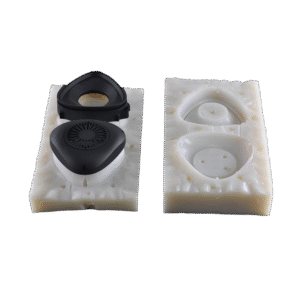
Once the master model is completed, it is encapsulated in liquid silicone to form a reusable silicone mold. Compared with metal molds, these molds have much shorter fabrication cycles, significantly improving tooling speed and allowing projects to enter the production phase more quickly.
During part production, liquid polyurethane resin is injected into the mold cavity under vacuum conditions. The vacuum environment effectively eliminates trapped air and reduces bubble defects, resulting in parts with clear details and excellent surface quality. This characteristic makes vacuum casting particularly strong in the production of cosmetic parts and functional validation components.
Vacuum casting is typically used for small to medium batch production, with common output volumes ranging from 10 to 100 units. It can faithfully replicate complex geometries and deliver appearance and tactile qualities close to final mass-production parts, which is why it is widely used for design validation, market testing, and pre-production simulation of final products.
Key Differences at a Glance: What Really Sets These Two Processes Apart?
When evaluating Vacuum Casting and Injection Molding, it is essential to understand the fundamental differences in their manufacturing logic and operational efficiency. Each process is designed for distinct production scenarios, and the final choice typically depends on multiple factors, including production volume, tooling investment, lead time, material performance, and required part precision.
| Factor | Vacuum Casting | Injection Molding |
|---|---|---|
| Tooling Cost | Low | High |
| Lead Time | Short | Long |
| Production Volume | Low (10–500 units) | High (1,000+ units) |
| Material Options | Polyurethane resins | Thermoplastics |
| Unit Cost | Higher | Lower at scale |
| Design Flexibility | High | Limited after tooling |
These differences explain why each process is better suited to specific production scenarios, which we will explore in the sections below.
Hidden Costs of Choosing the Wrong Manufacturing Process
High upfront investment (Injection Molding)
Injection molding requires custom metal tooling, and the costs associated with mold design, machining, and validation are significantly higher than those of the silicone molds used in vacuum casting. For projects with low production volumes or uncertain demand, these high upfront investments are difficult to amortize through unit cost reduction, resulting in poor overall cost efficiency.
Longer preparation and lead time (Injection Molding)
The development of injection molds typically takes considerable time. From design reviews and mold fabrication to trial runs and optimization, the entire process can span several weeks or even longer. For projects that prioritize rapid iteration or need to capture a narrow market window, this extended preparation time can be a clear disadvantage.
Limited suitability for prototyping and low-volume production (Injection Molding)
Due to high tooling costs and long lead times, injection molding offers limited flexibility during prototyping and low-volume production stages. In contrast, vacuum casting can support design validation, functional testing, and small pilot runs more quickly and at lower cost, making it a more favorable option in the early phases of product development.
Limited mold lifespan (Vacuum Casting)
Silicone molds used in vacuum casting have relatively low durability, with a typical effective production range of around 20–30 parts per mold. As the mold degrades over time, dimensional stability and surface quality may deteriorate, reducing its cost and consistency advantages as production volumes increase.
Limits in precision and repeatability (Vacuum Casting)
While vacuum casting meets the requirements of most cosmetic parts and functional validation components, it cannot match injection molding—supported by metal tooling—in terms of tight tolerance control and long-term repeatability. As a result, it is better suited for geometrically simpler parts or applications without extreme dimensional accuracy requirements.
Lower mechanical strength of finished parts (Vacuum Casting)
Due to the material characteristics of polyurethane resins, vacuum-cast parts generally exhibit lower mechanical performance than injection-molded components. This difference is especially critical for load-bearing parts or products intended for long-term use and should be carefully considered during process selection.
Manufacturing Decisions Across the Product Lifecycle
From a product lifecycle perspective, manufacturing process selection is not a one-time decision, but an evolving strategy that changes as the product matures. At different stages, teams prioritize cost, lead time, flexibility, and risk differently—factors that determine when vacuum casting or injection molding delivers the greatest value.
Below, we break down manufacturing decision logic by lifecycle stage.
Prototype Stage
Vacuum casting demonstrates exceptional flexibility in low-volume production. With short tooling lead times and low initial investment, it is well suited for functional validation, design testing, and customized prototype development. When a project is still in an exploratory or iterative phase, vacuum casting is often the more economical choice.
Vacuum casting is typically used for small to medium production runs, commonly ranging from 10 to 100 units. It can accurately replicate complex geometries while delivering appearance and tactile quality close to final production parts. As a result, it is widely used for design verification, market testing, and pre-production simulation of end products.
EVT / DVT Stage
During part fabrication, liquid polyurethane resin is poured into the mold cavity under vacuum conditions. The vacuum environment effectively eliminates trapped air and reduces bubble-related defects, resulting in parts with crisp details and excellent surface quality. This makes vacuum casting particularly effective for cosmetic components and functional validation parts.
At this stage, teams must validate functionality while preserving room for design changes. Transitioning to injection molding too early can introduce risk: long tooling lead times and complex mold tuning make design changes costly and disruptive. In contrast, vacuum casting better supports rapid iteration and low-volume validation with significantly lower risk.
Bridge Production Stage
In the bridge phase, demand may begin to increase but has not yet fully stabilized. Vacuum casting offers advantages in this stage due to its low tooling cost and short lead times, enabling pre-production simulation, market validation, and small-batch deliveries without locking in large upfront investments.
However, limitations must be carefully considered. Silicone molds typically have a limited lifespan—often around 20–30 parts per mold. As molds degrade, dimensional stability and surface quality may decline. Relying on vacuum casting for higher volumes can introduce hidden costs, including repeated mold fabrication, quality variation, and delivery delays.
Case Study: Vacuum Casting for Rapid Market Validation in Consumer Electronics
An early-stage consumer electronics company was evaluating the market viability of a new smart hardware product. Both the functionality and exterior design were still evolving, and the team wanted to gather real user feedback on appearance, tactile feel, and overall experience before committing to mass production.
At this stage, delivery speed, upfront cost control, and design flexibility were higher priorities than long-term manufacturing efficiency. After evaluating multiple manufacturing options, the team selected vacuum casting for the initial production run based on the following considerations:
- Production volume aligned with validation needs: Approximately 60 units were planned for internal reviews, channel demonstrations, and limited user testing.
- Significantly lower upfront manufacturing cost: Unit costs were kept within the USD 30–40 range, far below the USD 15,000+ typically required for injection mold tooling.
- Support for rapid design iteration and aesthetic exploration: Colors, surface finishes, and fine details could be adjusted without incurring additional tooling costs.
The first batch of samples was delivered in approximately two weeks. These physical samples were quickly deployed for market showcases and user experience testing. Feedback directly informed subsequent design refinements and provided a solid basis for deciding whether and when to transition to injection molding.
Mass Production Stage
In contrast, injection molding offers unmatched advantages in large-scale production. While initial tooling costs are higher, metal molds provide exceptional durability and support a wide range of engineering-grade thermoplastics. Once production volumes reach thousands or tens of thousands of units, unit costs drop significantly—making injection molding the preferred solution for mass production.
Injection molding also excels in dimensional accuracy and consistency. Precision-machined metal tooling ensures tight tolerances and uniformity across long production runs, making it the ideal choice for complex, high-precision, and functional components.
Case Study: Injection Molding for Large-Scale Consumer Electronics Production
A global consumer electronics manufacturer planned to produce critical structural components for its next-generation smartphone, targeting global distribution with shipment volumes in the millions. The project imposed stringent requirements on part consistency, reliability, and long-term supply stability.
During the evaluation phase, the company focused on three core criteria: stable high-volume capacity, strict dimensional tolerance control, and material performance compliant with consumer electronics standards. After comparing multiple manufacturing approaches, injection molding was selected as the primary production process.
Based on this strategy, the company partnered with 6CProto Injection Molding, leveraging its extensive experience in high-volume injection production, robust mold management systems, and deep expertise in engineering plastics.
Key reasons for selecting injection molding included:
- Support for ultra-high-volume production: Annual output targets of approximately 2–3 million sets of components. Automated, continuous injection molding ensured stable supply while significantly reducing unit costs.
- High precision and consistency: Thin-wall regions and intricate assembly features required tight tolerances, which precision metal tooling could reliably maintain over extended production cycles.
- Material performance and cosmetic requirements: Components were manufactured using PC/ABS engineering thermoplastic blends, balancing impact resistance, heat resistance, and surface finish quality.
During implementation, the company invested approximately USD 300,000–400,000 in multi-cavity, high-precision steel tooling and supporting automation equipment. As production scaled, average unit costs were reduced to approximately USD 0.06–0.08 per part. The durable tooling system supported long-term continuous production throughout the project lifecycle without noticeable quality degradation.
Breaking Down the Differences Between Injection Molding and Vacuum Casting
A Quick Alignment Guide for Process Selection
Tooling Cost
Tooling investment is often the primary factor that differentiates these two processes. Injection molding relies on high-strength metal molds—typically steel or aluminum—which involve high upfront tooling costs as well as longer design and fabrication cycles. However, these molds offer exceptional durability, supporting tens of thousands to millions of molding cycles. This results in a classic high tooling cost, low unit cost structure.
In contrast, vacuum casting uses silicone molds, which are significantly less expensive to produce and do not require complex machining processes. This cost advantage makes vacuum casting particularly attractive during budget-constrained phases or when the project design has not yet been finalized. That said, silicone molds have a limited lifespan and typically need to be remade after approximately 20–30 parts.
Production Lead Time
As product development cycles continue to accelerate, lead time has become a critical decision factor. Vacuum casting offers clear advantages in mold preparation and process setup. Once the master pattern is complete, molds can be produced and put into use quickly. This makes vacuum casting ideal for rapid prototyping, functional testing, and low-volume validation, significantly shortening the time from design to market.
Injection molding, on the other hand, requires longer upfront preparation—particularly during mold design, trial runs, and process optimization. However, once the mold is completed and stable production begins, injection molding benefits from high automation and fast cycle times, delivering unmatched efficiency in continuous high-volume production.
Production Volume
From a volume perspective, the applicable ranges of the two processes are clearly defined. Injection molding is most cost-effective for large-scale production, with unit costs decreasing continuously as volume increases. It is well suited for projects with long-term, stable demand.
Vacuum casting is better suited for low to medium production volumes, typically in the range of 10–100 units. For projects with uncertain demand, multiple design iterations, or a high degree of customization, vacuum casting is often the more flexible and economical choice.
Material Options
Material compatibility directly affects product performance and application scope. Injection molding supports a wide range of thermoplastics and elastomers, allowing engineers to precisely match requirements for strength, heat resistance, chemical resistance, and long-term stability. This versatility is especially critical in industries such as automotive, electronics, medical devices, and industrial equipment.
Vacuum casting primarily uses polyurethane resins. While their mechanical properties generally do not match those of engineering-grade thermoplastics, polyurethanes excel in appearance, flexibility, and tactile simulation. They can closely replicate the look and feel of many mass-production materials, making them ideal for aesthetic prototypes and validation parts.
Surface Finish and Precision
Injection molding continues to lead in dimensional accuracy and consistency. Precision-machined metal molds can be produced to tight tolerances, ensuring high uniformity in geometry and fine details across all parts. This makes injection molding the preferred process for complex, high-precision, and functional components.
While vacuum casting offers slightly lower absolute dimensional accuracy, it performs exceptionally well in surface finish quality. Finished parts typically achieve smooth, refined surfaces without additional post-processing, making vacuum casting particularly suitable for display models, cosmetic components, and products with high visual requirements.
From an Engineering and Procurement Coordination Perspective:
Key Advantages and Limitations of Injection Molding
In plastic part manufacturing, injection molding and vacuum casting are often regarded as two representative solutions, each serving different production objectives and project stages. For engineers and procurement decision-makers, selecting the appropriate process depends not only on part appearance or structural complexity, but also on production scale, long-term cost structure, delivery timelines, and material performance requirements.
Injection molding is typically used for projects with stable demand and high production volumes. Its strengths lie in achieving highly consistent mass production and long-term manufacturing efficiency. However, these advantages are usually accompanied by higher upfront investment and longer preparation cycles. In contrast, vacuum casting is more attractive in terms of flexibility and speed, but it has clear limitations when scaling up production.
Therefore, before determining whether injection molding is suitable for a given project, it is essential to evaluate it in comparison with vacuum casting and to systematically understand its core strengths in precision, capacity, mold durability, and material compatibility.
Key Advantages of Injection Molding
Higher dimensional accuracy and consistency
Injection molding offers clear advantages in forming complex structures and fine details. Supported by high-precision metal tooling, it enables tight dimensional tolerance control and maintains excellent consistency across thousands or even millions of parts. This is particularly critical for technically demanding applications with strict assembly requirements—an area where vacuum casting typically struggles to achieve long-term consistency.
Superior efficiency for high-volume production
Once tooling is completed and production stabilizes, injection molding enables high-speed, automated, and continuous manufacturing. Compared with vacuum casting, its shorter cycle times significantly reduce unit costs at scale, making it a classic high-volume, low-unit-cost manufacturing solution.
Greater mold durability
Injection molds are usually made from high-strength materials such as steel or aluminum, allowing them to withstand high-pressure injection and hundreds of thousands of cycles while maintaining stable performance. In contrast, the silicone molds used in vacuum casting have limited durability and require frequent replacement, increasing maintenance costs and uncertainty in large-scale production.
Broader range of material options
Injection molding supports a wide variety of engineering-grade thermoplastics and elastomers, enabling precise alignment with requirements for strength, heat resistance, flexibility, damping, and more. This material versatility gives injection molding greater applicability in industries such as automotive, electronics, medical devices, and industrial equipment, whereas vacuum casting is generally more limited in material performance.
Limitations of Injection Molding
High upfront investment
Injection molding requires custom metal tooling, with design, machining, and validation costs far exceeding those of silicone molds used in vacuum casting. For low-volume projects or those with uncertain demand, these high upfront costs are difficult to amortize, resulting in limited economic viability.
Longer preparation time
Injection mold development typically takes longer, encompassing design reviews, mold fabrication, trial runs, and process optimization. This process can span several weeks or more, making injection molding less favorable for projects that emphasize rapid iteration or time-to-market.
Poor suitability for prototyping and low-volume production
Due to high tooling costs and long lead times, injection molding lacks flexibility during prototyping and early-stage production. In contrast, vacuum casting can support design validation, functional testing, and small pilot runs more quickly and at lower cost, making it more advantageous in early product stages.
Key Advantages and Limitations of Vacuum Casting
At different stages of plastic part manufacturing, vacuum casting is often viewed as a solution that bridges the gap between prototyping and large-scale mass production. Compared with injection molding—a highly standardized mass-production process—vacuum casting emphasizes flexibility, speed, and low upfront investment, giving it unique value in early-stage validation and low-volume delivery.
When evaluating whether vacuum casting is suitable for a specific project, it is important to assess its advantages and limitations in terms of cost structure, lead time, design freedom, and performance boundaries, particularly in comparison with injection molding.
Key Advantages of Vacuum Casting
Cost efficiency for low-volume production
Vacuum casting uses silicone molds with significantly lower tooling costs than metal molds. This low-investment characteristic provides a clear economic advantage for small-batch or limited production runs, especially for projects where tooling costs cannot be amortized through high volumes.
Shorter lead times
Vacuum casting offers substantial time advantages in mold preparation and process setup. Silicone mold fabrication is relatively simple, allowing projects to move more quickly from design to actual production. This fast turnaround is especially valuable for products requiring rapid design validation or quick market entry.
Greater design flexibility
Vacuum casting excels in design freedom, accurately replicating complex geometries, thin-wall features, and fine cosmetic details. This flexibility is particularly important during the prototyping stage, where designs often require multiple iterations without incurring high tooling costs for each change.
No reliance on high production volumes
Unlike injection molding, vacuum casting does not depend on large production volumes to achieve cost efficiency. Even at low quantities, it remains economically viable, making it well suited for prototyping, low-volume delivery, or projects with clearly defined customization requirements.
Limitations of Vacuum Casting
Limited material options
Vacuum casting primarily uses polyurethane resins. While these materials perform well in appearance and tactile simulation, they generally fall short of engineering-grade thermoplastics in terms of strength, heat resistance, and long-term stability.
Limited mold lifespan
Silicone molds have relatively low durability, with a typical effective output of around 20–30 parts per mold. As molds age, dimensional stability and surface quality may deteriorate, reducing both cost efficiency and consistency in larger production runs.
Upper limits in precision and repeatability
Although vacuum casting meets the requirements of most cosmetic and functional validation parts, it cannot match injection molding—supported by metal tooling—in terms of tight tolerance control and long-term repeatability. As a result, it is better suited for simpler structures or applications without extreme dimensional accuracy requirements.
Lower mechanical strength of finished parts
Due to the inherent material properties of polyurethane resins, vacuum-cast parts generally exhibit lower mechanical performance than injection-molded components. This difference becomes particularly significant for load-bearing parts or products intended for long-term use and should be carefully considered during process selection.
When Is Injection Molding the Best Choice?
This decision depends more on product maturity than on the inherent superiority of a process. In plastic part manufacturing, once a project enters a stable phase and places higher demands on performance consistency, production scale, and material reliability, injection molding typically becomes the more suitable manufacturing solution. Compared with vacuum casting, it is better suited for applications with clearly defined standards for long-term manufacturability and product performance.
Injection molding is generally the better choice in the following scenarios:
- Medium- to high-volume production requirements:
When projected volumes reach thousands of units or more, the cost-structure advantages of injection molding begin to emerge. Although upfront tooling costs are higher, unit costs decrease significantly as production scales, making injection molding economically viable for large-volume manufacturing. - Clear requirements for part strength and service life:
Engineering-grade thermoplastics typically outperform the resins used in vacuum casting in terms of mechanical strength, fatigue resistance, and long-term stability. This makes injection molding more reliable for load-bearing structural components or functional parts intended for extended use. - Strict requirements for complex geometries and dimensional tolerances:
Metal tooling in injection molding enables higher dimensional accuracy and repeatable consistency, making it well suited for complex structures with tight tolerance requirements. - Need for broader material performance options:
Injection molding allows selection from a wide range of materials with properties such as high heat resistance, flexibility, and chemical resistance, enabling precise alignment with specific application needs.
When Is Vacuum Casting the Best Choice?
This decision depends more on product maturity than on the inherent superiority of the process. At different stages of product development and manufacturing, vacuum casting demonstrates clear advantages in certain applications due to its low entry barrier and highly flexible process characteristics. Compared with injection molding, it is better suited for projects that prioritize speed, cost control, and low-volume delivery.
Vacuum casting is typically the better choice in the following scenarios:
- Small-batch or pilot production needs:
When the required part quantity is relatively low (typically under 100 units), vacuum casting offers a more favorable overall cost structure. - Reducing upfront investment risk:
Silicone mold tooling costs are significantly lower than those of metal molds, making vacuum casting well suited for projects with limited budgets or those in the market validation phase. - Rapid prototype validation or frequent design changes:
The process supports low-cost iteration without the need for expensive and time-consuming mold rework. - Moderate structural complexity with an emphasis on appearance:
Vacuum casting delivers excellent surface quality, making it ideal for display models and cosmetic components.
The Crossover Point: Where Casting Stops Paying
The two processes are usually compared on unit price, and unit price is the wrong axis, because casting and moulding price volume differently. Casting carries a small, repeatable mould cost and a high per-part price; moulding carries a large one-time tool and a low per-part price. Somewhere between them the curves cross, and that point — not the sample price — is the decision.
The shop’s own worked example puts a housing at $22 per cast part with $600 of silicone moulds, against $4 per moulded part with a $28,000 steel tool. Setting the two landed costs equal gives 600 + 22Q = 28,000 + 4Q, and the crossover falls at about 1,520 parts. Below that volume casting is cheaper on total spend; above it the tool has paid for itself and every further part is priced at the moulded rate.
| Order quantity | Urethane casting landed cost | Injection molding landed cost | Cheaper process |
|---|---|---|---|
| 200 parts | $5,000 | $28,800 | Casting |
| 1,000 parts | $22,600 | $32,000 | Casting |
| 1,520 parts | $34,040 | $34,080 | Break-even |
| 10,000 parts | $220,600 | $68,000 | Moulding |
The model and its inputs come from the shop’s comparison of urethane casting versus injection molding. Substitute your own quotes before treating any of it as a decision: the crossover moves with the part size, the resin grade, the cavity count and the tool construction, and the table above ignores quality and lead time entirely.
Silicone Mould Life Is the Variable the Unit Price Hides
The crossover above assumes the casting route can produce the whole order, and that assumption breaks on larger runs. A silicone mould reproduces the master for a working life of around 20 casts, so the moulds are a consumable rather than a fixture.
Run the arithmetic on a 1,000-part order: 1,000 parts divided by 20 casts per mould is 50 moulds, each one poured from the same master, checked, and broken in at its own setup. The per-part resin price does not change, but the casting tooling block scales with volume in a way the moulding tool does not — a steel tool has a fixed price and keeps working for hundreds of thousands of cycles. That is the mechanism behind the general rule that casting fits quantities in the tens to low hundreds and injection molding takes over in the thousands, and it is why a 1,000-part casting quote needs to be read as “50 moulds plus 1,000 parts” rather than as a recurring unit rate. The mould life figure comes from the shop’s notes on vacuum casting cost drivers.
Two further conditions belong in the same decision. Casting gives you a production-looking part in days and tolerates a design that is still changing, while molding needs the design frozen before the tool is cut and charges a new tool for every change after that. And casting does not deliver a production thermoplastic: two-part polyurethane resins are formulated to behave like one, which is enough for fit and appearance checks and not the same thing as moulding the specified grade.
Conclusion
Choosing between vacuum casting and injection molding is fundamentally a matter of aligning the manufacturing process with the project stage and production objectives.
When a product is still in the validation or iteration phase, with limited volumes and a need for rapid design changes, vacuum casting offers greater flexibility with lower upfront investment.
As demand becomes more stable, production volumes increase, and higher requirements are placed on material performance and consistency, injection molding shows clear advantages. Supported by a mature manufacturing ecosystem and engineering-grade materials, injection molding is better suited for long-term, large-scale production. For projects entering mass production, partnering with an experienced manufacturer such as 6CProto Injection Molding can help achieve an optimal balance between quality, cost, and delivery capability.
From a product lifecycle perspective, these two processes are not substitutes but complementary solutions serving different stages. Applying the right manufacturing method at the right time is key to efficiently and successfully bringing products to market.
Why Choose 6CProto?
At every stage of a product’s journey—from concept validation to large-scale production—the choice of a manufacturing partner directly impacts cost, timelines, and final quality. 6CProto goes beyond providing manufacturing services; we are committed to helping customers select the most appropriate process at the right stage, reducing risk and improving overall efficiency.
Engineering-Driven Manufacturing Support
6CProto’s engineering team engages early in the project lifecycle, conducting systematic evaluations covering design for manufacturability (DFM), material selection, and volume planning. Through this early involvement, 6CProto Injection Molding helps customers identify and mitigate potential risks before mass production, ensuring that process decisions align with commercial objectives.
Capabilities Spanning Prototyping to High-Volume Production
Whether supporting low-volume validation runs or long-term production of hundreds of thousands to millions of parts, 6CProto offers mature manufacturing processes and robust quality control systems. For products that have entered stable mass production, 6CProto Injection Molding leverages automation and durable tooling systems to deliver consistent, efficient, and predictable output.
Stable and Reliable Quality Management
At 6CProto, quality is not an after-the-fact inspection—it is embedded throughout the entire manufacturing process. From raw material selection and mold fabrication to molding and post-processing, every critical stage is tightly controlled to ensure that each batch of parts meets design specifications and performance requirements.
Flexible Response to Different Project Timelines
We understand that different companies and project stages have varying sensitivities to speed and cost. With flexible production planning and transparent communication, 6CProto supports rapid response to design changes, delivery schedule adjustments, and volume fluctuations—helping customers avoid unnecessary time and financial waste.
FAQ
Vacuum casting vs injection molding: which is better?
Neither process is universally better, and the honest answer is a quantity. In a model with $22 per cast part and $600 of silicone moulds against $4 per moulded part and a $28,000 steel tool, the two routes cost the same at roughly 1,520 parts. Below that, casting is cheaper and far faster to first part; above it, moulding wins on total spend and on unit price.
What is vacuum casting and how does it work?
Vacuum casting, also called urethane casting, reproduces a master pattern in a silicone mould under vacuum. The master is finished to the quality the batch needs, the silicone is cast around it to form the tool, and the tool is filled with a two-part polyurethane resin. Because the tool is soft and cheap, the process reaches a production-looking part in days, and because it is a mould, it can reproduce detail that machining an individual part would cost far more to produce.
How many parts can vacuum casting produce?
Practical casting volumes run from tens of parts to the low hundreds. The limit is the mould: a silicone tool has a working life of around 20 casts, so a 1,000-part order needs on the order of 50 moulds cast from the same master. That is still workable at those quantities, but the casting tooling block grows with the volume, which is what eventually pushes the decision to a steel tool.
Can vacuum casting use the production plastic for my part?
No. Casting uses two-part polyurethane resins, which are formulated to mimic the properties of production plastics. That is usually enough for fit, form and appearance validation, and for functional testing at a prototype level. If the part must be moulded in a specific thermoplastic grade to meet its specification, that grade belongs in an injection mould rather than in a silicone tool.
At what quantity does injection molding become cheaper than casting?
It depends on the tool and the part, but the arithmetic is easy to run once you have two quotes. Take the moulding tool price plus the unit price times the quantity, and compare it with the casting mould cost plus the cast unit price times the quantity. In the shop’s own example — $22 per cast part against $4 per moulded part with a $28,000 tool — the crossover is around 1,520 parts.
Latest Post
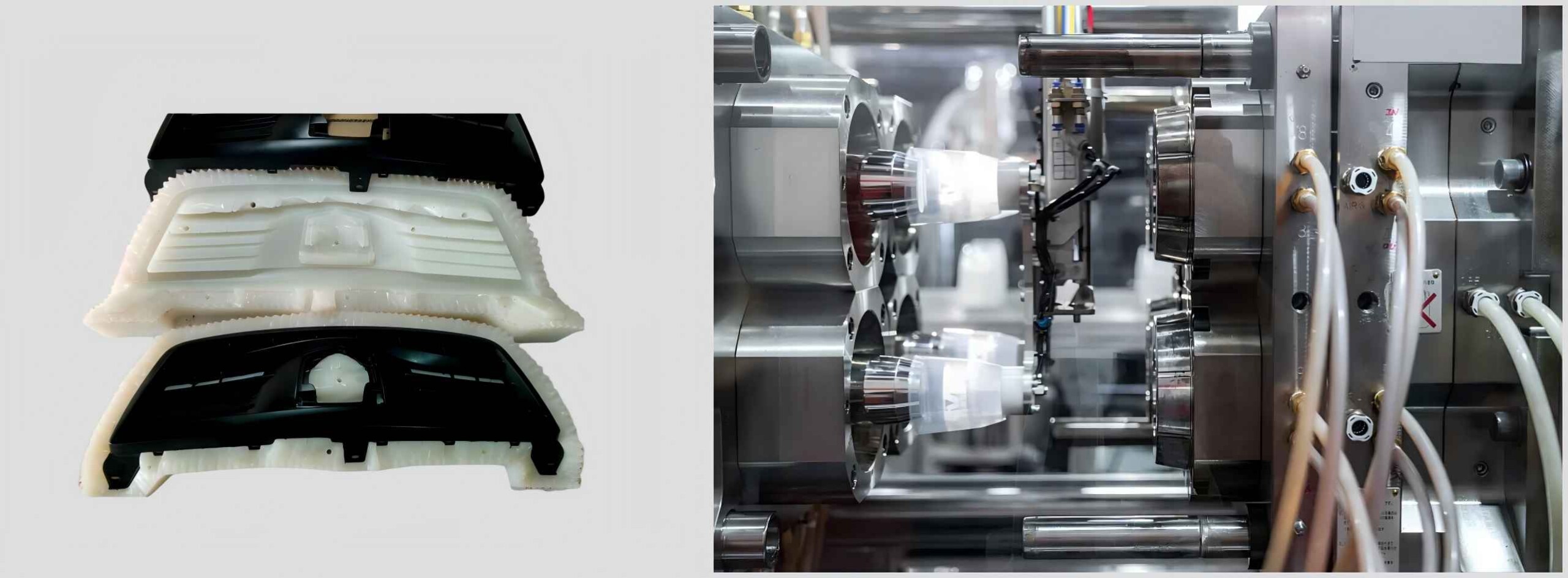
Vacuum Casting VS Injection Molding: How to Choose the Right Manufacturing Process from Prototype to Production
History of CNC Machining: The Origins and Development of Computer Numerical Control
The Ultimate Guide to Injection Molding: Process, Types, Advantages & Applications
How to Choose the Right 3D Printing Process: An Analysis of Pros and Cons
What is CNC Machining?A Complete Guide to Processes,Advantages,and Applications
Sheet Metal Enclosure Design: Corners, Sealing and Service Access
K Factor Sheet Metal Bending: Why the Same Model Gives Two Different Blanks
Custom Metal Fabricated Assemblies: Buying the Finished Item, Not the Parts
Laser Cut Prototypes: Flat Part Design and What the Cut Edge Gives You