

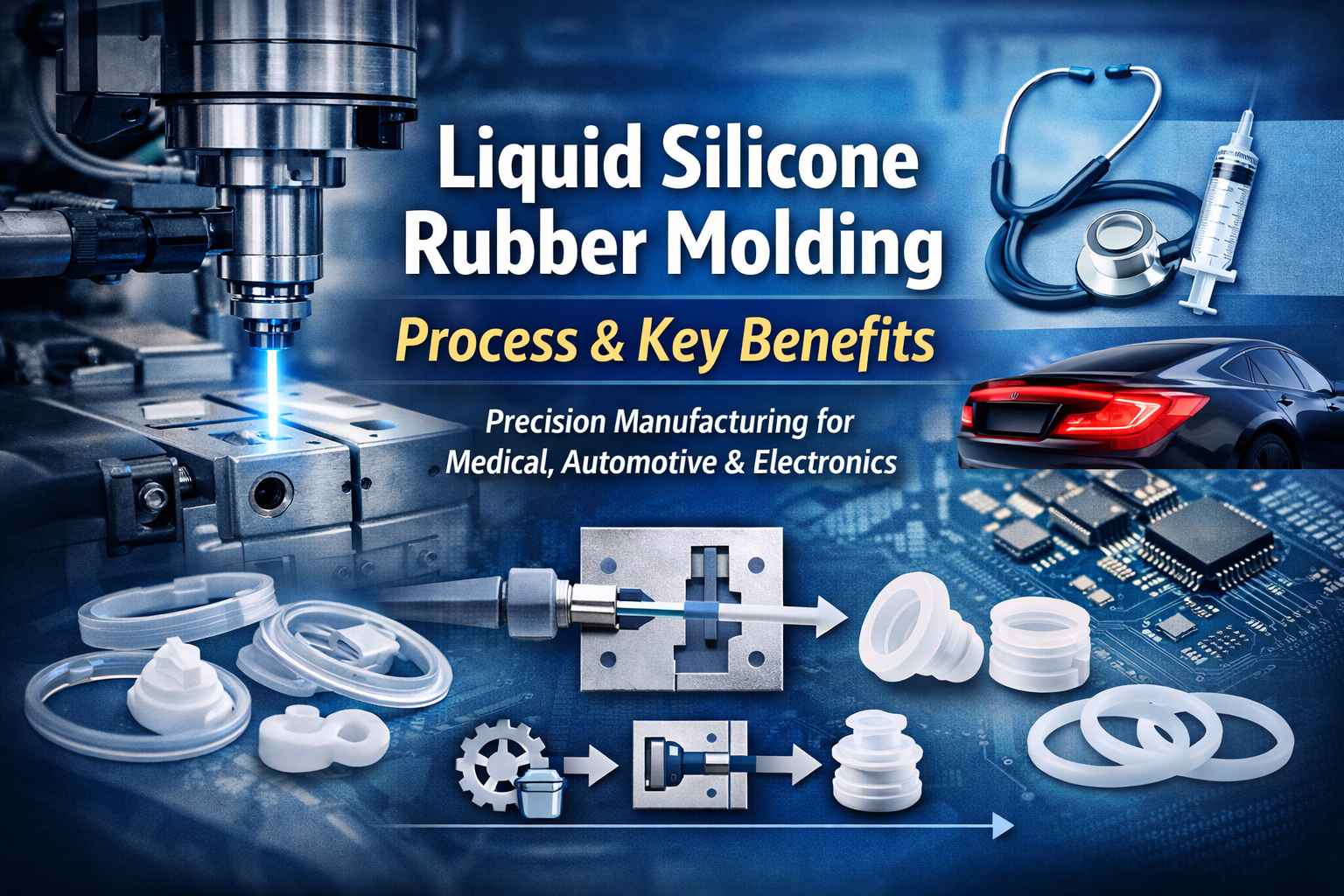
Liquid Silicone Rubber (LSR) molding is a high-precision thermoset injection process that manufactures flexible, durable, and chemically inert components with exceptional geometric repeatability. This clean manufacturing technique yields essential seals, gaskets, medical valves, and consumer interfaces capable of enduring extreme thermal thresholds, maintaining structural elasticity, and satisfying stringent biocompatibility regulations across global medical, food-grade, automotive, and electronic supply chains.
Last updated:
(Edited on June 15, 2026)
What Is Liquid Silicone Rubber Molding?
Liquid Silicone Rubber molding is a specialized injection process that pumps a two-part liquid platinum-catalyzed formulation into a heated mold cavity to chemically cross-link into a stable, solid elastomer. Unlike traditional high-consistency rubber (HCR) compression methods that rely on dense gum stocks, LSR begins as a low-viscosity liquid. This fluid characteristic allows the raw material to flow effortlessly under moderate injection pressures into extremely thin walls, intricate micro-channels, and complex geometries that would otherwise fail to fill or induce severe material shearing.
The chemical transformation of LSR is driven by an irreversible thermal curing reaction. The material consists of a base silicone chain with a platinum catalyst (Component A) and a cross-linker (Component B), which are kept separate until the immediate injection phase. Once mixed and exposed to mold temperatures ranging from 170°C to 210°C, the liquid undergoes a rapid vulcanization process. The resulting material exhibits a backbone of alternating silicon and oxygen atoms, which provides superior ozone, UV, and thermal aging resistance compared to organic hydrocarbon rubbers.
How Does LSR Molding Work?
The industrial workflow of LSR injection molding relies on specialized automated equipment engineered to maintain a strict volumetric ratio and prevent premature thermal vulcanization before the material reaches the mold cavities. The process executes through a highly controlled, synchronized material progression:
-
Primary Fluid Metering: Heavy hydraulic or electric follower plates pump Component A (base silicone and catalyst) and Component B (cross-linker) from separate industrial drums via a strict 1:1 weight ratio directly into a high-pressure manifold.
-
Homogeneous Static Mixing: From the manifold, the two distinct liquid streams force their way through an array of helical static mixing elements to ensure uniform catalyst dispersion and initiate chemical stabilization.
-
Cooled Barrel Stabilizing: The blended liquid enters a water-cooled injection barrel, which rigidly maintains a cold temperature zone between 20°C and 30°C to prevent the platinum cross-linking reaction from initiating prematurely inside the machine.
-
Heated Cavity Vulcanization: A reciprocating screw drives the cold liquid through a specialized shut-off nozzle into the securely clamped, high-temperature mold (170°C to 210°C), where the material undergoes rapid exothermic cross-linking to solidify within seconds before mechanical ejector pins remove the part.
From the manifold, the two liquid streams pass through an array of static mixing elements to ensure uniform catalyst dispersion. The blended liquid then enters a water-cooled injection barrel, which maintains a cold temperature zone between 20°C and 30°C to prevent the platinum cross-linking reaction from initiating prematurely. A reciprocating screw drives the cold liquid through a specialized shut-off nozzle into the securely clamped, high-temperature mold. As the liquid silicone contacts the heated steel walls, it undergoes rapid exothermic cross-linking, solidifying within seconds before mechanical ejector pins remove the finished elastomeric parts for final inspection.
Which Parts Are Best for LSR?
Liquid Silicone Rubber is uniquely qualified for elastomeric components that demand high compression set resistance, dynamic sealing stability, long-term flexibility, and precise tactile actuation across broad temperature fluctuations. Because the material remains elastic at temperatures as low as -50°C and as high as 250°C, it is heavily specified for critical automotive powertrain seals, aerospace sensor gaskets, and high-voltage electrical connector boots.
| Component Category | Primary Engineering Requirement | Core Structural Benefit | Standard Component Applications |
| Seals and Gaskets | High compression recovery | Long-term leak prevention under pressure | Automotive engine seals, outdoor enclosure gaskets |
| Medical Devices | Certified biocompatibility | Non-reactive, pyrogen-free interaction | Respiratory masks, surgical valves, fluid septums |
| Food-Contact Ware | Pure chemical composition | Odorless, taste-free, FDA-compliant | Infant bottle nipples, kitchen appliance seals |
| Dynamic Membranes | Fatigue flex resistance | Zero structural tearing under cycled loads | Diagnostic pump diaphragms, control valve flaps |
Why Choose LSR for Medical and Food-Grade Products?
Medical device designers and food processing equipment manufacturers select platinum-cured LSR because of its inherent chemical purity, hypoallergenic structure, and compliance with rigorous international regulatory frameworks. Unlike peroxide-cured silicones or standard industrial elastomers, platinum-catalyzed LSR does not generate volatile chemical byproducts or acid residues during the vulcanization process, eliminating the risk of toxic extractables leaching into sensitive organic fluids or pharmaceuticals.
The material easily complies with global standards including FDA 21 CFR 177.2600, ISO 10993 biocompatibility protocols, and USP Class VI medical qualifications. This makes LSR ideal for skin-contact wearables, infant care products, and implantable medical interfaces. Furthermore, the robust cross-linked matrix allows LSR components to undergo repeated sterilization cycles—including autoclaving, ethylene oxide gas exposure, and gamma radiation—without experiencing physical hardening, tearing, or structural degradation.
How Does LSR Compare With Other Elastomers?
When evaluating flexible materials for precision custom manufacturing, engineers frequently compare LSR against High-Consistency Rubber (HCR) silicone and Thermoplastic Elastomers (TPE). While HCR remains economical for large, simple profiles, it requires manual milling and labor-intensive compression molding, which increases contamination risks and restricts geometric complexity. TPE provides rapid cycle times and recyclability, but it softens prematurely under elevated thermal loads and exhibits inferior long-term compression recovery.
| Engineering Property | Liquid Silicone Rubber (LSR) | High-Consistency Rubber (HCR) | Thermoplastic Elastomer (TPE) |
| Raw Material State | Low-viscosity liquid twin-pack | Solid, heavy gum stock | Solid granulated pellets |
| Primary Molding Method | Automated liquid injection | Manual compression molding | Thermoplastic injection molding |
| Thermal Operating Range | Extensive (-50°C to 250°C) | Extensive (-50°C to 260°C) | Limited (-40°C to 120°C) |
| Compression Set Recovery | Outstanding (Retains seal form) | Good to Very Good | Poor to Fair (Prone to deformation) |
| Flash Elimination Potential | High (Requires precise tooling) | Low (Heavy secondary trimming) | Excellent (Natural material control) |
What Design Rules Improve LSR Parts?
Implementing precise Design for Manufacturability rules for liquid silicone rubber is essential because the material behaves inversely to traditional thermoplastics. Because LSR exhibits an extremely low viscosity at injection temperatures, it can easily flow into mating steel clearances as tiny as 0.005 mm, making the process highly vulnerable to part flash if the tooling faces are not perfectly sealed.
To mitigate manufacturing defects, engineers must target uniform wall thicknesses to prevent uneven curing rates and localized shrinkage voids. Unlike thermoplastics which require thick walls to accommodate material flow, LSR can easily fill wall sections as thin as 0.25 mm. Draft angles can be kept minimal or near-zero because the highly flexible nature of the rubber allows it to stretch and release from deep core cavities without tearing. However, sharp inside corners must be avoided; incorporating a minimum fillet radius of 0.5 mm ensures uniform material velocity during injection and prevents stress concentration points during dynamic cycling.
How Is LSR Used in Rapid Prototyping?
Liquid Silicone Rubber is a vital resource for rapid prototyping initiatives because it allows development teams to validate sealing compression, fluid dynamics, and tactile response using the identical material chemistry intended for final production. By utilizing specialized aluminum or soft steel prototype tooling, manufacturers can bypass the long lead times and high capital expenses associated with multi-cavity production molds, delivering functional molded components for field testing in minimal time.
This rapid validation phase is crucial for medical, consumer, and industrial hardware programs where virtual software simulations cannot accurately replicate the physical tactile feel or sealing limits of a flexible elastomer. Prototyping with actual LSR ensures that any unforeseen geometric changes, material durometer adjustments, or gate location re-engineering can be identified and corrected early in the development lifecycle, preventing costly tool modifications after final production tooling has been commissioned.
Why Does Tooling Matter So Much for Silicone Molding?
The development of the injection mold represents the single most critical factor in determining the success of an LSR molding program. Because liquid silicone easily escapes through microscopic tool splits, the tool paths, slide actions, and parting lines must be machined to demanding tolerances on high-end CNC equipment. Additionally, because the material expands as it transforms from a cold liquid to a hot solid, the tool cavities must be calculated with highly precise shrinkage variables tailored to the specific durometer of the selected silicone grade.
Effective mold design must also incorporate robust thermal isolation strategies. The tool must balance a cold runner manifold zone—which keeps the liquid silicone un-vulcanized—with a hot cavity plate zone that instantly cures the material. Evacuating trapped air from the cavities is another critical tooling requirement; because LSR injects rapidly, molds must integrate automated vacuum venting channels to draw out atmospheric gases from the sealed cavities before the liquid silicone blocks the vents, entirely eliminating burn marks or incomplete short-shot defects.
What Are the Main Production Benefits?
Automated LSR injection molding delivers substantial operational efficiencies and quality consistency advantages that make it highly competitive for scalable commercial production. The rapid cross-linking kinetics of premium platinum silicones enable remarkably short cycle times, frequently ranging from 15 to 60 seconds depending on the maximum wall thickness of the component.
The high level of process automation significantly minimizes manual operator handling, reducing human error and preventing contamination risks within medical manufacturing workflows. Furthermore, because LSR is injected through flashless cold-runner valve gate systems, the process minimizes material waste by ensuring that the material inside the delivery channels remains liquid and can be used for the subsequent injection cycle. This scrap reduction maximizes material yield and lowers the overall per-piece cost across high-volume, continuous production runs.
What to Specify, and What to Verify, on an LSR Part
Liquid silicone rubber is supplied as two components mixed at the machine, usually 1:1, and the part cures in a heated cavity rather than being formed by pressure alone. That changes what belongs on the drawing: the grade does not just name a material, it fixes the hardness the part will have, and the softness range is where most LSR projects are won or lost.
The grades divide into recognisable bands. Very soft compounds run about 10–30 Shore A and suit light seals, membranes and products that touch skin; medium grades run about 30–60 Shore A and cover gaskets, keypads and general seals; firmer grades run about 60–80 Shore A for valves, buttons and structural sealing lips; and specialty grades are specified for food contact, medical service or high temperature. Naming the Shore A band on the drawing, rather than the word “silicone”, is what lets a moulder quote the right compound.
Three process limits follow the material. The mould runs at cure temperature, commonly 120–180 °C depending on grade, with cure times measured in minutes; walls from about 0.5 mm are practical in a well-designed part because the material is liquid and fills thin sections; and draft of roughly 0.5–2 degrees is used, with more on textured or deep features. Those figures, and the grade bands, come from the shop’s note on LSR process design and validation.
Because LSR is a thermoset, a bad batch cannot be remelted, so the records are the quality control. Ask for Shore A hardness measured against the specification, the cure temperature and time recorded per batch, the post-cure schedule, and batch traceability back to the two components. Where the part goes into a regulated product, ask what the moulder keeps for its own process validation, because the documentation set a supplier delivers by default is agreed per order rather than assumed — the point the shop makes in its note on what an LSR manufacturer should deliver.
One boundary condition decides the process before the drawing is finalised. A soft silicone tool used for casting is a tool — it makes tens of parts, varies more, and is built for design validation and appearance samples. LSR injection runs a steel tool for thousands of parts and repeats over a long run. If the volume forecast is in the hundreds, casting may still be the right answer; if the part has to seal, flex or insulate in production, it belongs in a steel mould.
How Do You Select the Right LSR Supplier?
Choosing an experienced LSR manufacturing partner requires verifying comprehensive technical capabilities across precision toolmaking, automated process control, and regulatory compliance. Because silicone molding is a highly sensitive thermal process, the chosen supplier must demonstrate stable material lot traceability and cleanroom production environments when producing components for regulated medical or food-safe applications.
A qualified manufacturer should provide upfront interactive DFM analysis to optimize gate layouts and identify potential air-trapping zones before steel machining begins. The shop should also maintain multi-axis CNC equipment and Coordinate Measuring Machines (CMM) to ensure that mold seals and part geometries match the source digital engineering drawings. Partnering with an agile provider that bridges rapid prototyping flexibility with high-volume injection infrastructure ensures a seamless workflow transition with minimal supply chain handoff risks.
6CProto Expert Views
“Mastering liquid silicone rubber injection molding demands a complete shift away from traditional thermoplastic engineering principles. Thermoplastics require hot liquids flowing into cold steel, whereas LSR forces a cold liquid to enter a high-temperature mold where it undergoes a rapid cross-linking reaction. This requires absolute control over thermal isolation zones within the tooling. At 6CProto, we approach every silicone project by optimizing the tool layout and venting strategy during the initial CAD review stage. Because LSR can easily flash into a five-micron gap, our team applies advanced machining tolerances to all parting lines and inserts. Engaging in interactive DFM analysis before cutting steel allows our customers to minimize the risk of part flash, secure low cycle times, and achieve an efficient, predictable transition from rapid prototype validation to stable, high-volume production.”
— Michael Wang, Founder & Mechanical Engineer at 6CProto
What Are the Main Applications of LSR?
The unique physical resilience, electrical insulation properties, and biocompatible structure of Liquid Silicone Rubber make it the preferred material choice across diverse industrial sectors. In consumer electronics, it is widely used to manufacture waterproof seals for smartphones, soft-touch buttons, smart wearable bands, and shock-absorbing gaskets.
-
Consumer Electronics Applications: Engineered for high-integrity waterproof seals, ergonomic smart bands, and precise tactile buttons.
-
Medical Engineering Solutions: Specified for life-critical respiratory valves, high-flex peristaltic pump tubes, and sterile catheter hubs.
-
Automotive Systems Engineering: Deployed for high-voltage ignition wire boots, durable single-wire seals, and multi-pin connector mats.
In medical engineering, LSR is critical for components like fluid management valves, dialysis machine septums, respiratory seals, and neonatal bottle nipples. Automotive assembly lines utilize high-volume LSR components to produce weather-resistant electrical connector mats, single-wire seals, and high-temperature ignition wire boots. Additionally, the material serves the industrial automation sector through heavy-duty pneumatic diaphragms, chemical-resistant flow valves, and specialized vacuum suction cups that must survive millions of continuous mechanical cycles without experiencing fatigue tearing.
Can LSR Scale to High-Volume Production?
Liquid Silicone Rubber molding scales exceptionally well from low-volume pilot testing to million-unit mass production runs. Because the manufacturing workflow is completely driven by digital CNC automation and computerized closed-loop injection presses, the processing parameters remain highly stable across consecutive production lots.
During the high-volume phase, multi-cavity cold runner molds are deployed to maximize production output per machine hour while completely eliminating runner scrap. Automated end-of-arm robotic grippers or air-blast ejection systems are integrated to remove the flexible components from the cavities instantly, maintaining a constant thermal cycle on the mold. This scalable processing stability ensures that critical component dimensions, material shore hardness, and surface finish characteristics remain perfectly identical, allowing global brands to secure consistent component quality as they scale production volume.
Could Your Next Project Benefit From LSR?
Specifying custom LSR molding is a highly advantageous engineering decision if your product requires exceptional flexibility, continuous chemical inertness, and stable mechanical performance under extreme environmental stress. The process provides immense design freedom, permitting dense overmolding configurations where liquid silicone is directly bonded onto rigid thermoplastic or metal substrates to create seamless, leak-proof multi-material assemblies.
To capture the full economic and functional benefits of liquid silicone rubber, design engineering teams should collaborate with their selected manufacturing technician early in the development loop. Setting clear requirements for material durometer, defining critical sealing zones, and optimizing part wall consistency will streamline production. Utilizing the advanced engineering support and precision molding capabilities provided by 6CProto allows hardware developers to eliminate manufacturing risks, maximize product field life, and move efficiently from prototype concept to validated market release.
Conclusion
Liquid Silicone Rubber injection molding represents one of the most reliable and technologically advanced production methods for manufacturing precision, high-performance elastomeric components. It delivers exceptional thermal endurance, outstanding compression set recovery, and unmatched chemical purity, making it irreplaceable for critical sealing, medical device, and consumer product interfaces. Securing optimal component quality requires implementing uniform wall guidelines, managing tight tooling parting lines, and choosing an experienced manufacturing partner with a robust quality control infrastructure. Partnering with a comprehensive supplier like 6CProto gives engineering teams direct access to responsive DFM insights, rapid functional prototyping, and high-volume injection capability, ensuring reliable part execution across the entire product lifecycle.
FAQ
What is liquid silicone rubber used for?
Parts that have to seal, flex or insulate and stay stable afterwards: gaskets and sealing lips, keypads and buttons, membranes, and medical or food-contact components. The material is chosen because it keeps its properties across a wide temperature range and can be sterilised, which is why it dominates applications where a thermoplastic would harden, crack or degrade.
What Shore A hardness should I specify for an LSR part?
Specify the band rather than a single number. Very soft compounds run about 10–30 Shore A for light seals, membranes and skin-contact parts; medium grades about 30–60 Shore A for gaskets and general seals; and firmer grades about 60–80 Shore A for valves, buttons and structural sealing lips. Specialty grades cover food contact, medical and high-temperature service.
How thin can an LSR part be molded?
Walls from about 0.5 mm are practical in a well-designed part because the material arrives as a liquid and fills thin sections readily. The limit is set by the grade, the flow length and the mould design rather than by a single number, and thin walls still need draft — roughly 0.5–2 degrees, with more on textured or deep features.
Why does LSR need a steel mold instead of a silicone one?
They are different products. A cured silicone tool is a casting mould: it reproduces a master for tens of parts with wider variation, which suits design validation and appearance samples. LSR injection moulding uses a steel tool, runs thousands of parts and holds tolerances repeatably over a long run. The choice follows the volume and whether the part has to perform, not the material name.
What quality records should I ask for on an LSR order?
Shore A hardness measured against the specification, the cure temperature and time recorded for each batch, the post-cure schedule, and traceability back to the two liquid components. LSR is a thermoset, so a non-conforming batch cannot be reprocessed — the records are the control, and a supplier who keeps them is the one who can explain a deviation.
Technical References
-
Review advanced historical datasets on elastomeric flow kinetics and thermal curing profiles via the ScienceDirect Metal Machinability Database.
-
Investigate industrial injection process parameters and flash elimination techniques through the Taylor & Francis Online Engineering Journal.
-
Verify official biocompatibility criteria, medical sterilization standards, and dimensional tolerances on the ISO International Organization for Standardization Official Website.
-
Check accurate chemical properties, tear strengths, and thermal expansion coefficients for premium silicone grades on the MatWeb Material Property Verification Database.