
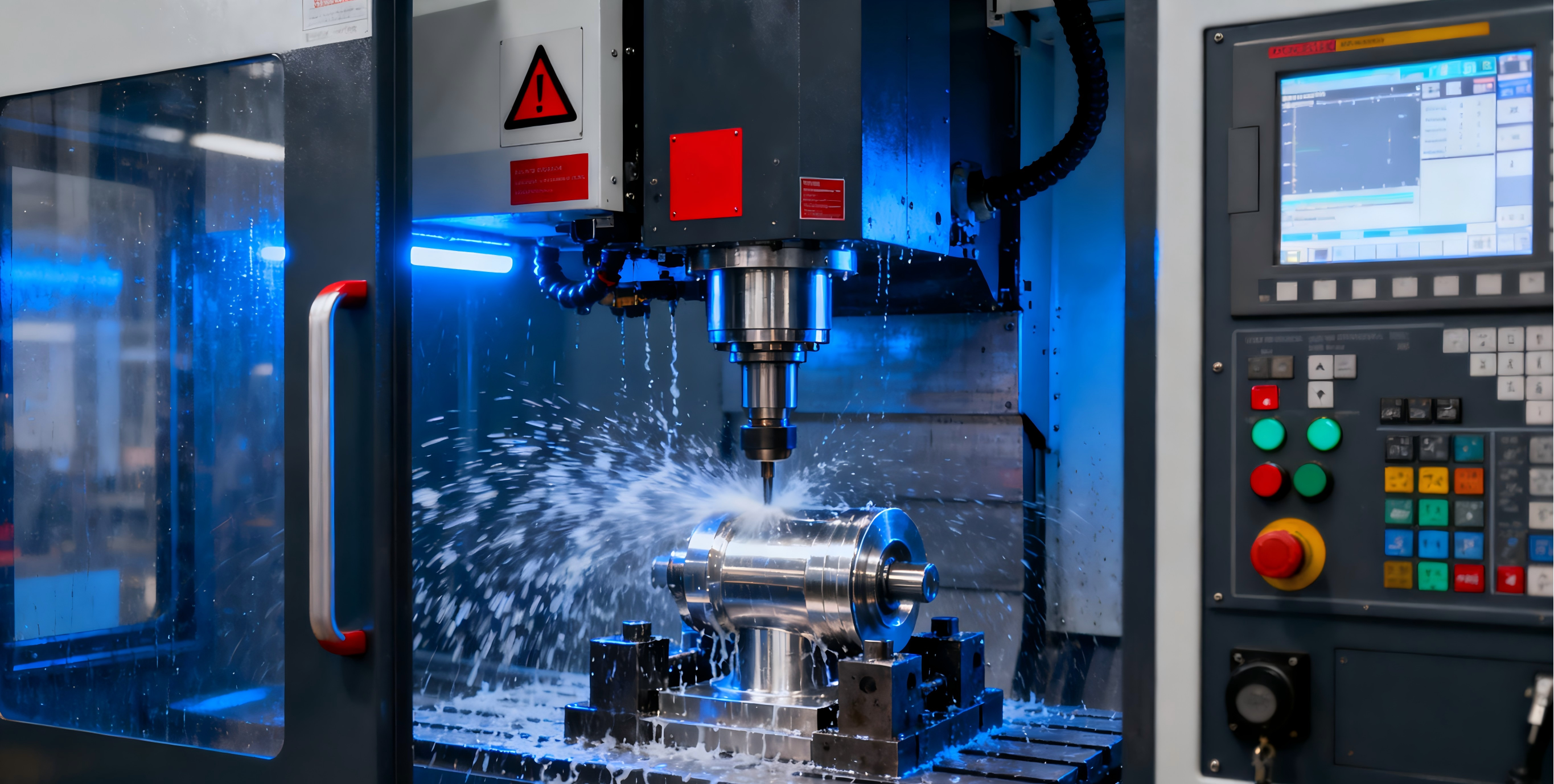
When you pick up your phone and your fingertips touch that precisely polished metal frame; when you sit in a car and feel the engine’s smooth, powerful rhythm; when you look up at the sky and see an airplane soaring freely among the clouds—behind all of this lies a critical technology: CNC machining.
You may be familiar with the term “CNC,” but you might not fully understand how it works or its core value. So, what is computer numerical control (CNC) machining, and how does it operate? This article will break down CNC machining step by step, from basic principles to practical applications, helping you understand everything about CNC machining—including how it is performed, the different types of CNC processes, its advantages, and its areas of application.
What Is CNC Machining?
CNC machining, short for Computer Numerical Control machining, is a technology that uses computer programs to control machine tools, enabling automated and highly precise part manufacturing. You can think of it as the “intelligent magician” of the manufacturing world.
Traditional machining is like “hand-cut paper,” entirely dependent on a craftsman’s experience and skill, with each cut testing their expertise. CNC machining, on the other hand, is like an “intelligent engraving machine.” You simply design the part on a computer, set the tool’s movement path, and the machine executes cutting, drilling, and polishing precisely according to the program, transforming raw materials such as metal, plastic, or wood into parts that meet the design specifications.
The core principle is converting the design into a “digital language” that the computer can understand—such as G-code and M-code. These codes act like an instruction manual for the machine, telling the tool where to move, how many degrees to rotate, and how deep to cut. It’s like telling a robot: “Cut along this line, turn 90 degrees, then make another cut”—and it executes perfectly, without any deviation.
CNC machining is not only efficient but also capable of handling complex shapes. To meet different manufacturing needs, there is a wide variety of CNC machines, including CNC milling machines, CNC lathes, and CNC grinders. These machines can perform cutting, drilling, milling, grinding, and more, making CNC machining an indispensable core technology in modern manufacturing.
The “Past and Present” of CNC Machining: From “Manual” to “Intelligent”
You might wonder—was CNC machining always this intelligent? In fact, its development reflects the manufacturing industry’s journey toward “liberating human hands.”
The Art of Craftsmanship
Before the advent of CNC machines, machining relied entirely on manual operation. Operators had to turn handwheels and control tool feeds, making decisions based on experience alone. Skilled craftsmen could produce exquisite parts, but the process was inefficient, inconsistent, and increasingly unable to meet the demands of complex industrial production.
The 1952 Breakthrough
The world’s first CNC machine was developed at the Massachusetts Institute of Technology (MIT), marking the beginning of the digital era in manufacturing. This breakthrough stemmed from engineer John T. Parsons’ idea: using data to control machine movements to tackle the challenges of machining aircraft propellers and turbine blades. With funding from the U.S. Air Force, MIT’s Servomechanisms Laboratory developed a prototype—a modified Cincinnati milling machine that used punched cards to input data and servo motors to drive the cutting tool, achieving linear cutting—the only capability at the time. Though limited in functionality, it replaced manual operation with “digital instructions” for the first time, laying the foundation for modern CNC and intelligent manufacturing.
From Numerical Control to Computer Numerical Control
In the 1970s, the emergence of microprocessors allowed CNC systems to integrate fully with computers, significantly reducing costs and machine size. CNC machines were no longer limited to aerospace; they rapidly expanded into automotive, mold-making, and general mechanical machining. By the 1980s, the integration of CAD/CAM software with CNC made “design-to-manufacturing” workflows possible. Multi-axis machining, high-speed processing, and flexible production lines gradually entered industrial settings.
Intelligent Manufacturing
Entering the 21st century, CNC machining has achieved a new leap. High-speed, high-precision technologies, real-time monitoring, and networked capabilities have made machines more efficient and reliable. Today, under the Industry 4.0 framework, CNC has deeply integrated with the Internet of Things (IoT), big data, and artificial intelligence:
Digital twins enable seamless integration between virtual simulation and real production. AI algorithms optimize tool paths and predict maintenance, reducing downtime. Hybrid manufacturing combines traditional cutting with 3D printing, expanding the boundaries of fabrication.
How Does CNC Machining Work?
The working principle of CNC (Computer Numerical Control) machines centers on using digital instructions to drive the machine. First, engineers design the part in CAD/CAM software and generate the machining program, usually in the form of G-code. These codes are then transmitted to the CNC control system, which converts the instructions into electrical signals that precisely control the servo motors and lead screws. This drives the cutting tool along the predetermined path, removing material from the workpiece to produce the part as designed in the CAD/CAM software.
The entire process does not rely on manual handwheels; instead, it is precisely controlled by the computer, achieving high-efficiency, high-precision automated machining.
Next, we will break down the various processes involved in the CNC machining workflow.
Typical Steps in CNC Machining
1.Design and Modeling
Before starting CNC machining, a final design must be prepared, either as a 2D drawing or a 3D model. These models are created by engineers using CAD software. Common design software includes AutoCAD, SolidWorks, CATIA, Creo, Siemens NX, and others.
2.Programming (CAM / NC Programming)
CNC machines cannot directly interpret CAD models; they must be converted into G-code, which the machine can understand. Engineers import the designed part model into CAM software, write the machining program, generate tool paths, select cutting tools, and set cutting parameters (spindle speed, feed rate, cutting depth, etc.), ultimately outputting the CNC-readable G-code. If the computer is networked with the CNC machine, the G-code can be directly uploaded to the machine to start machining. Before this, the CNC machine must be properly configured with the correct post-processor. Different CNC systems require different post-processor configurations, such as Siemens, Mitsubishi, or FANUC systems.
3. Program Verification
Program verification is an essential step. The machining process is simulated in the software to check whether the tool paths are correct. The purpose of verifying tool paths is to prevent collisions, overcuts, or machining errors, ensuring safety. Simulation also allows engineers to estimate machining time and calculate theoretical daily production capacity, enabling precise control of production schedules and efficient workflow planning.
4. Machine Preparation
Operators mount the raw material on the worktable or fixture and calibrate the workpiece position (set the zero point). Before calibration, appropriate cutting tools must be selected according to the material characteristics and machining stage, considering tool type, diameter, and length. It is crucial that the tool coordinates entered into the CNC machine are completely accurate. Errors in coordinate input can lead to severe collisions between the tool and the workpiece or fixture, or cause the tool to cut outside the target area, resulting in undercuts or incomplete machining. This not only affects part quality but can also damage the tool, the workpiece, or the machine itself.
5.Machining Execution
Once the computer is connected to the CNC machine, the operator locates the corresponding program on the machine’s display panel and starts the process. The machine will automatically cut the workpiece according to the instructions. If the computer is not connected to the CNC machine, the program must be uploaded to the machine system manually, then started via the display panel. Once the CNC program is executed, the machine runs until the program ends. It will only stop if the operator intervenes, an unexpected error occurs, or there is a power interruption.
Terminology in CNC Machining
In the field of CNC machining, mastering the professional terminology is particularly important. Here are some common CNC terms:
Computer-Aided Design (CAD)
Computer-Aided Design (CAD) refers to software tools used to create 2D or 3D digital models of parts. CAD software allows engineers to accurately draw the geometric shapes of parts. Through digital modeling, CAD helps designers optimize structure, materials, and dimensions more intuitively. It also enables engineers to make modifications, perform assembly simulations, and conduct interference checks. When designing complex parts, the overall design is often broken down into several subcomponents, each modeled independently and then integrated within an assembly environment. Common CAD software includes AutoCAD, SolidWorks, CATIA, Creo, Siemens NX, FreeCAD, and others.
Computer-Aided Manufacturing (CAM)
Computer-Aided Manufacturing (CAM) is the process of converting CAD models into executable CNC programs (G-code/M-code). CAM software generates tool paths and sends them to the machine control system. It can also simulate the machining process, allowing engineers to detect tool collisions or path errors in advance.
CAM is usually used in close conjunction with CAD. Engineers first complete the digital modeling of parts in CAD software, then use CAM software to convert the model into tool paths and generate machining programs recognizable by CNC machines (such as G-code and M-code). These programs are then transmitted to the machine, where the CNC control system drives the tools to perform the actual machining operations.
It’s important to note that most CNC machines do not come with full CAM software; they are equipped with the corresponding CNC control system. Engineers typically complete programming on a standalone CAM platform (such as Mastercam, Fusion 360, or NX CAM) and then import the generated machining program into the machine for execution.
Some modern software now integrates both CAD and CAM functions, seamlessly connecting the design and manufacturing stages.
What Are G-Code and M-Code?
In CNC machining, G-code and M-code are the two core types of instructions in a CNC program. They tell the machine “what to do” and “how to do it.”
G-Code
G-code primarily controls the motion of the machine. It defines the tool’s movement path, interpolation method, machining coordinate system, feed rate, and more.
In simple terms, G-code handles the “motion instructions,” telling the machine where and how the tool should move.
M-Code
M-code primarily controls the machine’s non-motion functions, such as spindle on/off, coolant, tool changes, etc.
In other words, M-code handles the “control actions,” telling the machine what to turn on or off, or when to start or stop certain functions.
Relationship Between G-Code and M-Code
In actual CNC programs, G-code and M-code are usually used together: G-code controls the tool’s movement path (e.g., moving in a straight line to a specific position), while M-code controls auxiliary machine actions (e.g., turning on the spindle or starting coolant when the tool reaches its position).
What Are the Different Types of CNC Machining Processes?
CNC machines are not a single piece of equipment, but a category encompassing various types of machines, each suited for different machining processes. Here are some of the most common CNC machining processes:
CNC Milling
CNC milling is one of the most widely used CNC machining processes. In many machine shops, the terms “CNC machining” and “CNC milling” are often used almost interchangeably.
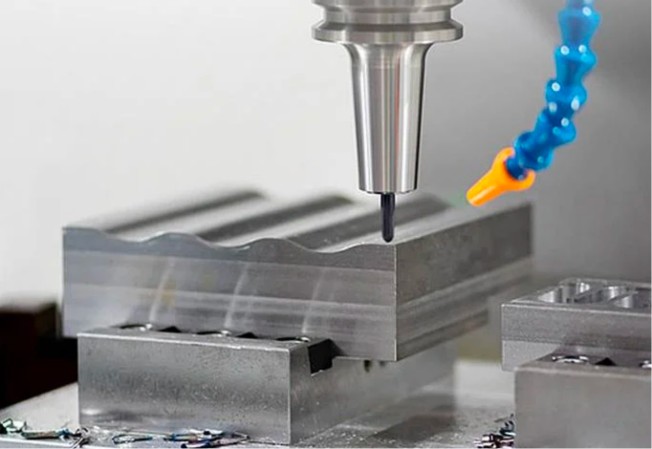
During milling, a rotating cutter moves relative to the workpiece along multiple axes, removing material layer by layer to achieve the desired shape and dimensions. The cutting tool (end mill) is mounted on the spindle, and the spindle’s high-speed rotation combined with multi-directional movement enables precise three-axis or multi-axis milling operations.
Common milling methods include: Face milling: used to machine flat surfaces on a workpiece. Peripheral milling: used to machine the outer contour or profile of a workpiece.
CNC Turning
CNC turning is another common CNC process, especially suitable for cylindrical or rotational parts. You can think of it like sharpening a pencil: the workpiece rotates on the spindle while the cutting tool, like a pencil sharpener, gradually removes excess material along the surface to achieve the desired shape and dimensions.
During the process, the tool moves according to the program, removing material layer by layer. CNC lathes precisely control tool movement to achieve high-precision, efficient turning operations.
Common turning methods include: External turning: machining the outer cylindrical surface of a workpiece. Facing: machining the end surface of a workpiece.
CNC Drilling
Compared with CNC milling and turning, CNC drilling is relatively simple. During CNC drilling, the workpiece usually remains stationary while the cutting tool (drill bit) is mounted on the spindle and moves vertically to gradually cut material and form holes. CNC drilling is particularly suitable for parts with multiple holes.
The primary purpose of drilling is to create precise holes for assembly, fastening, or functional requirements. Holes serve various roles in mechanical machining and part design, including: Installing bolts, screws, or pins to connect components. Acting as reference points for accurate assembly. Guiding moving parts or supporting bearings. Serving as channels for liquids, gases, or cooling. Reducing weight by removing excess material. Installing sensors, fittings, or achieving specific functions. Providing base holes for subsequent operations like tapping, reaming, or enlarging.
CNC Grinding
CNC grinding is a high-precision machining process that removes material from the workpiece surface using a high-speed rotating grinding wheel, achieving the desired dimensions, shapes, and surface finish. It is an important step in precision machining, typically used for parts with high hardness or stringent accuracy requirements.
CNC Routing
CNC routers are quite similar to CNC milling machines, but the main difference lies in their operation: in a CNC router, the workpiece remains stationary while the cutting tool moves along the X, Y, and Z axes. This design allows CNC routers to achieve faster cuts than milling machines without sacrificing accuracy or design complexity.
Other Types of CNC Machines and Operations
Beyond the common CNC processes such as milling, turning, drilling, and grinding, there are a variety of other CNC machines and operations designed for specialized tasks. These machines use computer control for precise and automated movement. Key types include:
1.Material Cutting and Shaping
Sawing: Uses a toothed blade to create straight, linear cuts. When controlled by CNC, sawing allows automated, precise cutting of materials. Plasma Cutters: Employ a high-temperature plasma jet generated by an electrical arc to cut conductive materials quickly and accurately. Laser Cutters: Use a focused laser beam to cut or engrave materials. Unlike plasma cutting, laser cutting is not limited to conductive materials and can process a wide range of materials with adjustable precision. Flame Cutters: Utilize an oxy-acetylene (Oxy-fuel) flame to cut metals. The flame reaches extremely high temperatures, allowing efficient metal cutting. Water Jet Cutters: Employ ultra-high-pressure water streams to cut materials, including metal, wood, stone, and glass. CNC control ensures precise movement and complex shapes.
2.Finishing and Surface Treatment
Honing: Similar to grinding, honing uses an abrasive stone or wheel for secondary finishing, achieving precise dimensions and improved surface quality. Lapping: Uses an abrasive paste, powder, or mixture between two surfaces to create a smooth, flat finish. Lapping is ideal for achieving extremely fine surface quality.
3. Forming and bending
Press Brakes: Designed to bend metal plates and sheets. The material is placed between V-shaped or U-shaped dies, and pressing creates precise bends according to specifications.
4.Specialized Material Removal
Broaching: Uses a toothed cutting head to remove material and create specific niche shapes. Broaching can be linear or rotary and provides highly consistent, accurate cuts. Electrical Discharge Machines (EDM): Use electrical pulses to generate arcs that melt and remove material from conductive workpieces, enabling precise cutting of complex shapes.
Selecting the Right CNC Machine for the Job
Choosing the most suitable CNC machine is essential for producing high-quality parts efficiently. Each type of machine has its own strengths and limitations, and it is rare to find every type of CNC machine in a single workshop—exceptions being specialized trade shows . If the ideal machine is not available, it is necessary to adapt and make the parts using the equipment at hand. Understanding the differences between vertical and horizontal milling machines, as well as turning machines, can help guide this decision and optimize the machining process.
Optimizing Workpiece Setup
Once the appropriate CNC machine has been selected, the next critical step—before programming—is determining the optimal way to secure the workpieces. Proper workholding is essential to achieve high-quality machining results. In fact, in many cases, this stage is even more crucial than defining the tool paths. However, based on experience, many machinists struggle with this step, which can slow down the entire process. As a prototype machining company, we prioritize hiring individuals who are resourceful and able to devise effective workholding solutions, since we encounter a wide variety of CNC parts every day.
Selecting the Right Cutting Tools
After establishing the machine and workholding setup, choosing the appropriate cutting tools is key to achieving tight tolerances and superior surface finishes. The right tool can dramatically reduce machining time. For example, milling ribs with a draft angle using a standard ball-end cutter might take several hours, whereas a taper cutter can complete the same task in just a few minutes. Imagine the time savings when milling ten or more parts. Understanding the differences between CNC cutting tools and their applications is therefore essential for both efficiency and quality.
What are the Advantages of CNC Machining?
CNC machining has transformed the manufacturing industry by minimizing manual labor while delivering unparalleled consistency and precision. For product designers, understanding whether CNC machining is suitable for a particular part is essential in the early stages of design.
1. Increased Production Speed
CNC machining significantly accelerates production by removing the limitations of human labor. Automated processes allow manufacturers to produce parts at much higher rates compared to traditional manual methods.
2. Consistency and Accuracy
CNC machines ensure that every part is identical and functions as intended. Micro-level accuracy is achievable, and precision can be further enhanced with appropriate tooling. This consistency is difficult, if not impossible, to achieve with manual operations.
3. Reduction of Rejected Parts
Automation reduces human error, leading to fewer defects and rejections during quality control. This not only saves time but also minimizes material waste and associated costs.
4. Cost Efficiency
By reducing labor hours, production time, and human error, CNC machining lowers manufacturing costs. While factors such as material choice, part geometry, and production volume can influence costs, the overall efficiency provides a competitive advantage and allows for potential reinvestment.
5. Material Versatility
CNC machining is compatible with a wide range of materials, provided they have sufficient hardness, allowing for greater flexibility in product design.
6. Manufacturing Data Tracking
CNC machines generate detailed process data for every part, enabling manufacturers to track each operation and identify the exact source of any fault. This traceability improves quality control and process optimization.
CNC machining’s combination of speed, precision, and versatility makes it a preferred choice for modern manufacturing. For a more comprehensive exploration of its benefits, see our detailed article on CNC machining advantages.
What Materials Can Be Processed By CNC Machines?
CNC (Computer Numerical Control) machining can handle a wide range of materials, eliminating the need for different machines for different materials. Most CNC machines support multiple materials and can switch between producing different parts with minor tooling changes.
1. Metal Materials
Metals are commonly processed using CNC machining because their hardness makes manual machining slow and less precise. CNC allows fast and accurate fabrication of metal parts. Common metals include:
Aluminum: Lightweight and strong, ideal for parts that require high strength-to-weight ratio. It is the most commonly used metal in CNC machining.
Magnesium: About 33% lighter than aluminum, commonly used for electronic casings to reduce weight.
Titanium: Extremely strong, used in aerospace, military, and high-end industrial applications.
Cast Iron: Can be machined quickly with less tool wear, often used for durable parts.
Metal alloys are also widely processed with CNC:
Stainless Steel: Hard and corrosion-resistant, commonly used for industrial components.
Brass: Soft and corrosion-resistant; its properties can be adjusted by varying copper-zinc ratios, suitable for many parts.
Carbon Steel: Affordable and strong, suitable for high-precision machining.
2. Non-Metal Materials
CNC machining is not limited to metals—it can also handle a variety of non-metal materials, including plastics and wood:
Plastics
Nylon: Strong, flexible, fire-resistant, and lubricative; sometimes replaces metal parts.
ABS: Thermoplastic, suitable for prototype and small-batch parts.
PMMA (Acrylic): Strong and transparent, used as a glass replacement in optical devices or containers.
PEEK: High-temperature resistant and strong, used in aerospace and medical applications.
Wood: Easy to machine and commonly used for furniture, decorative parts, and models.
3. Other Materials
CNC can also process specialized materials, such as:
Ceramics: High hardness and heat resistance, used for precision parts and electronic components.
Carbon Fiber Composites: Lightweight and strong, used in aerospace and racing applications.
Glass: CNC can create precision optical components or decorative items.
What Are the Main Applications of CNC Machining in Modern Manufacturing?
CNC machining plays a vital role across industries, from producing essential tools to delivering finished end products. Its precision, versatility, and ability to handle both prototyping and mass production make it indispensable. Key application areas include:
1.Automotive
Used in the production of engines, transmissions, chassis, and body structures. Essential for prototyping, mass production, and custom part manufacturing.
2.Aerospace
Applied in the manufacturing of turbine blades, engine parts, and airframe structures.
Ensures exceptional accuracy and material performance to meet strict safety and reliability standards.
3.Electronics
Rapidly creates prototypes from 2D or 3D digital models.
Enables designers and engineers to test, validate, and iterate quickly.
4.Research & Development
Rapidly creates prototypes from 2D or 3D digital models.
Enables designers and engineers to test, validate, and iterate quickly.
5.Defense & Military
Manufactures weapon components, aircraft parts, and specialized equipment.
Meets stringent demands for durability and high performance.
6.Medical & Healthcare
Produces surgical instruments, implants, prosthetics, and components for diagnostic equipment.
Supports both rapid prototyping and high-quality end-use part manufacturing.
7.Architecture & Design
Creates decorative elements and intricate stonework.
For example, CNC-controlled waterjet cutting is commonly used for detailed kitchen countertop designs.
8.Robotics & Automation
Produces sophisticated robotic components with flexibility for rapid design modifications.
Drives innovation in the fast-growing robotics and automation sector.
What are the advantages of CNC machining over conventional manual machining methods?
Within the scope of traditional machining methods (such as turning, milling, planing, and grinding), manual machining is almost the only direct alternative to CNC machining. However, the advantages of CNC far surpass any conventional manual approach. The key points of comparison are as follows:
1.Production Efficiency
Modern industries demand large-scale manufacturing capabilities. CNC machining delivers high speed and precision, while manual methods cannot achieve the required output.
2. Workforce Optimization
CNC machines reduce the need for heavy physical labor, allowing human resources to focus on more creative and intellectual tasks.
3. Quality and Consistency
By eliminating human error inherent in manual operations, CNC machining minimizes defective products and ensures efficient use of resources.
4. Processing Capability
Due to human physiological limitations, manual machining struggles with extremely hard or complex materials. CNC machines, on the other hand, can handle these tasks with ease.
5. Continuous Production
CNC machining is not constrained by breaks or shift changes. It can operate 24/7, significantly enhancing productivity.
In summary, CNC machining not only surpasses manual machining in efficiency and quality, but also breaks through the limitations of traditional methods, making it an indispensable core process in modern manufacturing.
Overview of the CNC Machining Industry: The Core Engine of Modern Manufacturing
According to Fortune magazine, the CNC machining market is expected to grow rapidly in the coming years. Market research company MarketsandMarkets reports that the global CNC market is projected to increase from approximately $6.7 billion in 2023 to around $8 billion by 2028. This growth is primarily driven by rising demand from the semiconductor, medical device manufacturing, and electric vehicle industries.
Challenges in the CNC Industry
Although CNC machining dominates the industry, it still faces several challenges:
Customization Difficulty
CNC can produce customized parts, but every modification requires redesigning the CAD file and repeating the entire machining process. Even minor adjustments cannot be made directly on the finished product.
Limitations in Complex Part Machining
High-end CNC machines can handle complex parts, but many manufacturers still use equipment with limited capabilities. Upgrading old machines and introducing more advanced equipment remains a significant challenge.
Industry Development Trends
CNC machining is rapidly evolving toward higher precision and greater intelligence. Key trends include:
Increasing the number of machine axes to handle more complex geometries.
Introducing robotics to achieve fully automated machining processes.
Continuous upgrades in CAD and CAM programming languages.
Enhancing nanometer-level machining capabilities to meet the needs of high-precision fields such as semiconductors.
Why CNC Machining Is So Important?
CNC machining is a pillar of modern manufacturing. Starting from raw materials, it can turn ideas into reality:
- Metal sheets can be machined into airplane fuselages and car bodies.
- Metal rods can be turned into critical components like automotive axles.
Whether for prototype design, small-batch production, or large-scale mass production, CNC is a reliable choice. Moreover, you don’t need to own the equipment to benefit from the efficiency and precision that CNC machining provides through machining services—Horizon offers end-to-end prototype and small-batch CNC machining solutions, from design optimization to finished parts, helping clients turn their ideas into tangible products quickly and cost-effectively.
Latest Post

Liquid Silicone Rubber Molding: Process, Benefits, Applications, and Design Considerations
What is a 5-axis machine? The differences from 3-axis machines and their applications.
What Is a Tack Weld? Definition, Purpose, and Applications
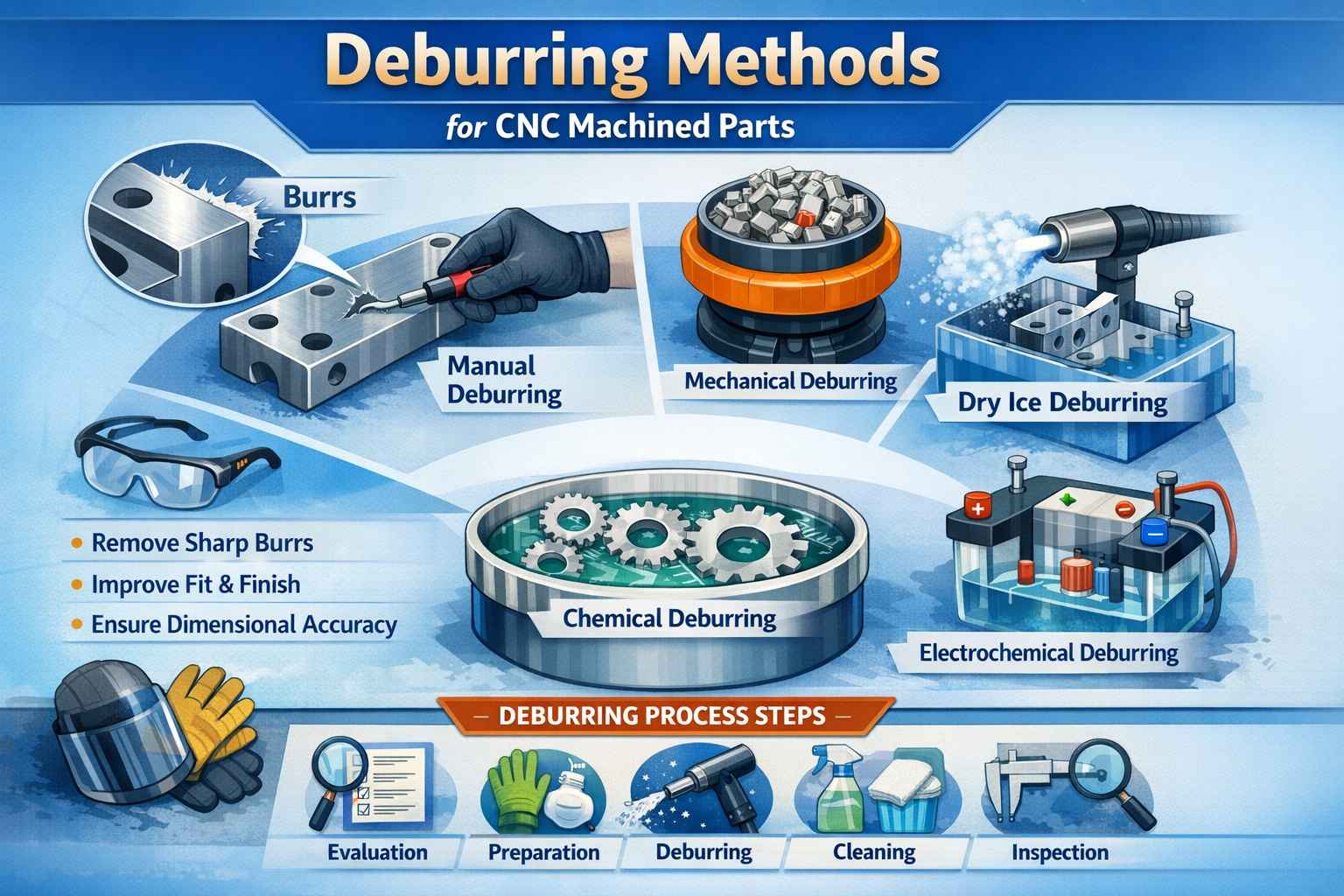
How to Remove Burrs from CNC Machined Parts: Common Deburring Methods Explained