

Last updated:
What is Injection Molding?
Injection molding is one of the most widely used manufacturing processes in modern industry. By heating raw materials until they melt and injecting them into a precisely engineered mold cavity, manufacturers can produce parts with complex shapes, high precision, and consistent quality. This process is highly versatile, accommodating a wide range of materials including thermoplastics, thermosets, silicone, and even metal powders through Metal Injection Molding (MIM).
This process is the backbone of mass production in industries ranging from consumer electronics to automotive, medical devices, and packaging. Its ability to create consistent, durable, and intricate parts makes it indispensable in today’s manufacturing landscape. Even everyday objects like smartphone cases, bottle caps, or kitchen utensils often owe their existence to this technology.
How Does Injection Molding Work?
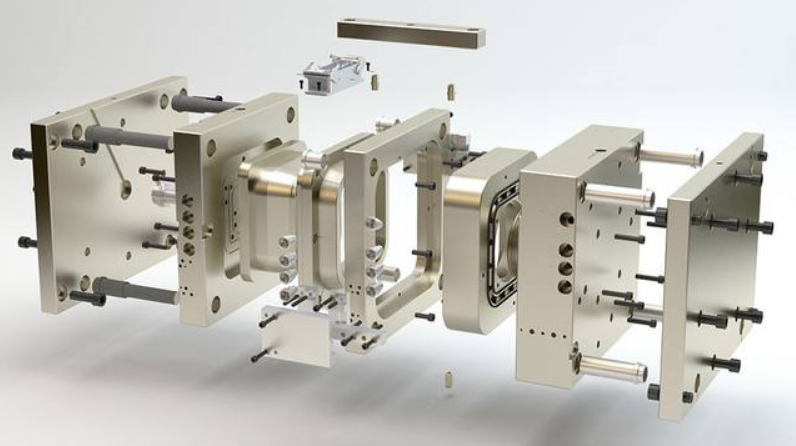
At its core, injection molding requires two key elements: the injection molding machine and the mold.
Injection Molding Machine: This is the heart of the process, providing the pressure, temperature control, and mechanical movement required to melt and inject the material into the mold. Modern injection molding machines are equipped with advanced controls that allow precise adjustments of temperature, injection speed, holding pressure, and cooling cycles.
Injection Molding Process Steps
1. Material Preparation –Drying, coloring, or mixing with additives for specific properties like UV resistance, flame retardancy, or mechanical strength.
3. Cooling – Material solidifies. Advanced molds use complex cooling channels to reduce cycle time and maintain dimensional accuracy.
4. Cooling – The part solidifies inside the mold. Cooling time depends on material properties, part thickness, and mold design. Advanced molds often incorporate complex cooling channels to reduce cycle times and improve dimensional accuracy.
5. Ejection – Once solidified, the part is ejected from the mold using pins, plates, or air blasts. Proper ejection prevents damage to the part and the mold.
6. Post-processing – After ejection, parts may require trimming, surface finishing, or assembly. Some products may undergo secondary processes like painting, overmolding to achieve desired functionality and aesthetics.
Types of Injection Molding
There isn’t just one way to perform injection molding. Depending on the material, design complexity, and intended application, manufacturers rely on different molding techniques to achieve the desired results. The most common types include:
Thermoplastic Injection Molding
This is the most widely used method. Thermoplastic resins are melted, injected into a mold, and solidify upon cooling. Since the material can be reheated and reprocessed, it is ideal for mass production of consumer goods, automotive parts, and electronic housings.
Applications: smartphone cases, dashboards, appliance components.
Thermoset Injection Molding
Unlike thermoplastics, thermoset materials undergo a chemical change during molding. Once hardened, they cannot be melted again. This makes them suitable for high-heat and electrical insulation applications.
Applications: circuit breakers, electrical switches, kitchenware handles.
Insert Molding
In this process, pre-formed components such as metal screws, pins, or threaded inserts are placed into the mold before injection. The plastic encapsulates the insert, creating a single, durable part.
Applications: automotive fasteners, surgical instruments, threaded housings.
Overmolding
Overmolding involves molding one material over another, usually a softer material over a rigid substrate. This enhances grip, comfort, and product aesthetics.
Applications: toothbrush handles, power tool grips, medical devices.
Liquid Silicone Rubber (LSR) Injection Molding
Metal Injection Molding (MIM)
MIM combines metal powders with binders to form a feedstock that is injected into molds. After injection, the binder is removed and the part is sintered to achieve high density and strength, similar to wrought metals.
Applications: gears, surgical instruments, aerospace components.
Rapid Injection Molding
Advantages and Disadvantages of Injection Molding
- High efficiency and fast production cycles for large quantities.
- Capable of producing intricate designs and tight tolerances.
- Consistent quality with low defect rates.
- Wide range of materials and surface finish options.
- Automation reduces labor costs and ensures repeatability.
- High initial mold cost, especially for complex or multi-cavity molds.
- Longer lead times for mold design and manufacturing.
- Not cost-effective for very low-volume production.
- Sensitive to process parameters; small variations can cause warping, sink marks, or voids.
- Limited flexibility once molds are made; design changes require expensive mold modifications.
Factors Affecting Injection Molding Quality
Factors Affecting Injection Molding Quality: Several key factors influence the quality and consistency of injection-molded parts.
1.Material Properties – Different polymers have varying melt flow, shrinkage rates, and thermal stability. Choosing the right material is essential for dimensional accuracy and mechanical performance.
3.Process Parameters – Temperature, injection speed, holding pressure, and cooling time must be carefully controlled. Automated machines often include sensors to monitor these variables in real-time.
4.Machine Condition – Precision, maintenance, and calibration of the injection molding machine affect consistency and part quality.
5.Operator Expertise – Skilled operators ensure proper setup, monitor production, and make adjustments to reduce defects and improve yield.

Applications of Injection Molding
- Consumer Electronics – Smartphone and laptop housings, headphones, chargers, and other accessories.
- Automotive – Dashboard panels, bumpers, interior trims, air vents, and functional engine components.
- Medical Devices – Syringes, surgical tools, implantable devices, and silicone seals.
- Packaging – Bottle caps, food containers, cosmetic jars, and industrial packaging.
- Household Items – Toys, kitchen utensils, furniture components, and storage solutions.
- Aerospace and Precision Engineering – Lightweight, high-strength, and heat-resistant components for aircraft and satellites.
- Renewable Energy & Electronics – Parts for solar panels, battery enclosures, and electronic housings.
Everyday life is full of objects shaped by injection molding, from the obvious (phone cases) to the subtle (coffee machine parts, water taps, remote controls). Its versatility makes it an essential technology across nearly every industry.
The Road Ahead for Injection Molding
- Sustainability: Adoption of biodegradable plastics, recycled materials, and energy-efficient production.
- Smart Manufacturing: AI-driven process optimization, predictive maintenance, and IoT monitoring reduce defects and improve efficiency.
- Rapid Manufacturing: 3D printing combined with injection molding accelerates prototyping and reduces mold costs.
- Precision & Micro-Molding: Growing demand in medical devices, wearables, and microfluidic systems.
- Customization & Small-Batch Production: Flexible production meets niche, high-value product demands.
Cavity Count and Tooling: What Your Volume Forecast Buys
Two numbers decide most of a tooling price: how many cavities the mould carries and how many shots it has to survive. Everything else on the quote — steel grade, side actions, polish level, texture, tolerance — is a consequence of those two, which is why a quote is only comparable against a stated annual volume.
Cavity count scales with the run. Engineering teams typically evaluate 2–8 cavities for mid-volume work and 16–128 for mass production, and the annual volume is the input that decides which side of that line a project sits on: around 100,000 parts a year is usually a 4–8 cavity tool, while 5–10 million parts a year is where 32–128 cavities start to justify themselves. The mechanism is simple arithmetic — a 32-cavity mould produces 32 parts per cycle instead of one — and at high volume the spread of machine time, labour and energy across many parts often cuts unit cost by 50–90% against a single-cavity run.
| Volume forecast | Typical cavities | Tool class | What it buys |
|---|---|---|---|
| About 5,000 shots | 1 | Bridge tool in a softer steel | The fastest, cheapest route to real production-material parts |
| About 100,000 parts a year | 4–8 | Production tool, hardened steel | A balance between cycle time, quality stability and tool life |
| 5–10 million parts a year | 32–128 | High-cavity production tool | Throughput, and the lowest unit cost the process can reach |
The cavity and volume figures follow the shop’s guides to how many cavities an injection mould should have and to what drives injection mould tooling cost, which name the same cost drivers: cavities, steel, actions, tolerances and surface texture.
Bridge Tool or Production Tool: a Model
Whether the bigger tool pays depends on how many parts you actually take. Model the two positions with stated assumptions: a single-cavity bridge tool quoted at $7,000 running a 20-second cycle, against a two-cavity hardened tool at $28,000 running 12 seconds; a machine rate of $45 per hour; and an 18 g part in resin at $3.20 per kilogram.
| Bridge tool, 1 cavity | Production tool, 2 cavities | |
|---|---|---|
| Parts per hour | 180 | 600 |
| Machine cost per part | $0.25 | $0.08 |
| Resin cost per part | $0.06 | $0.06 |
| Variable cost per part | $0.31 | $0.14 |
| Tooling | $7,000 | $28,000 |
| Landed cost at 5,000 parts | $8,550 — $1.71 each | $28,700 — $5.74 each |
| Landed cost at 100,000 parts | $38,000 — $0.38 each | $42,000 — $0.42 each |
The crossover in this model sits near 120,000 parts: below it the bridge tool wins on total spend, above it the two-cavity tool absorbs its extra $21,000 and then keeps going. Substitute your own quotes, cycle times and resin price before treating any of it as a decision — and note that the model ignores quality, which is often the real argument for the harder tool once a cosmetic surface or a tight tolerance has to repeat for a year.
How to Choose the Right Injection Molding Partner?
Experience that Counts
Every project comes with its own challenges. An experienced injection molding team knows how to navigate design complexities, optimize mold structures, and ensure smooth production from start to finish.
Modern Technology
Precision and speed depend heavily on equipment. A provider with advanced molding machines can deliver tighter tolerances, faster turnaround times, and consistent quality across every batch.
Ability to Scale
FAQ
What are the downsides of injection molding?
The tool has to be bought before the first saleable part exists, so the upfront cost and lead time land early; a design change after the tool is cut is expensive; and at low volume the tooling dominates the unit price. That last point is the reason prototype and low-volume work is usually routed to CNC machining or 3D printing first.
How many cavities should an injection mold have?
One cavity for a pilot or bridge tool, 2–8 for mid-volume runs, and 16–128 for mass production. As a rule of thumb, about 100,000 parts a year suits a 4–8 cavity tool, while 5–10 million parts a year is where 32–128 cavities begin to pay for themselves.
Is injection molding worth it for 500 parts?
Usually not with a production tool, but a bridge tool or a low-volume moulding route can still make sense when the parts must be in the production material and a machined or printed substitute would not behave the same way. Model the tooling, the cycle time and the material, then compare it with the per-part price of machining the same quantity.
What drives the price of an injection mold?
Cavity count, the steel grade and its hardness, side actions and other mechanisms, the tolerances the part demands, and the surface texture or polish level. A cosmetic part with a side action in hardened steel costs a multiple of a simple single-cavity bridge tool for the same geometry.
What are the steps of the injection molding process?
The mould closes and clamps, the screw injects molten polymer into the cavity, the pack and hold phase replaces the shrinkage as the part cools, the part cools to a stable enough state to be ejected, and the mould opens and ejects it. The cooling phase usually dominates the cycle time, which is why cooling-channel design changes the part price as much as it changes quality.
Latest Post
Vacuum Casting VS Injection Molding: How to Choose the Right Manufacturing Process from Prototype to Production
History of CNC Machining: The Origins and Development of Computer Numerical Control
The Ultimate Guide to Injection Molding: Process, Types, Advantages & Applications
How to Choose the Right 3D Printing Process: An Analysis of Pros and Cons
What is CNC Machining?A Complete Guide to Processes,Advantages,and Applications
Sheet Metal Enclosure Design: Corners, Sealing and Service Access
K Factor Sheet Metal Bending: Why the Same Model Gives Two Different Blanks
Custom Metal Fabricated Assemblies: Buying the Finished Item, Not the Parts
Laser Cut Prototypes: Flat Part Design and What the Cut Edge Gives You