

Explore Injection Molding Design & Tooling
Live tooling improves CNC turn-mill by letting a single machine perform turning, milling, drilling, and tapping in one clamping. That means fewer setups, less handling, tighter feature-to-feature accuracy, and shorter lead times. For complex parts, it also reduces fixture risk and secondary operations, which makes production faster, more repeatable, and easier to quote with confidence.
Last updated:
What Is Live Tooling in CNC Turn-Mill?
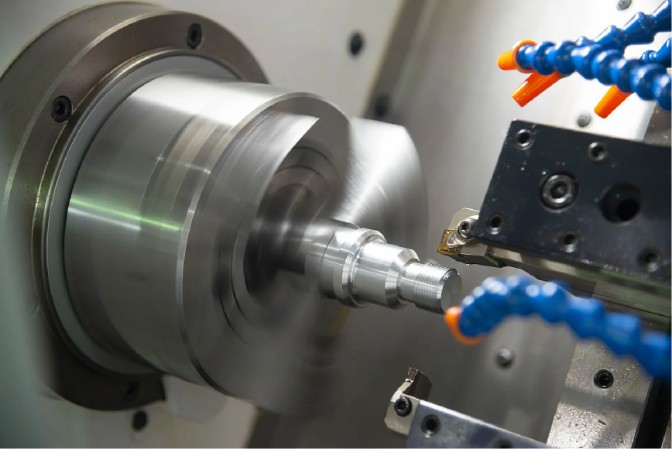
Live tooling is a powered tool system on a CNC turning center that rotates the cutting tool instead of relying only on the workpiece. In practice, it turns a lathe into a multitasking platform that can machine flats, slots, holes, and profiles without moving the part to another machine.
For a factory team, the real value is not just capability. It is process consolidation. When a job stays in one setup, the machine removes transfer errors, alignment drift, and the hidden labor cost of moving parts between departments.
At 6CProto, we often see live tooling become the difference between a part that is “machinable” and a part that is truly production-efficient. That is especially true for prototypes that need both turned diameters and milled features on the same component.
Why Does One Setup Matter So Much?
One setup matters because every unclamp-and-reclamp cycle adds variation. Even a small error in part orientation can create a mismatch between drilled holes, milled pockets, and turned reference surfaces.
In high-precision work, the issue is cumulative error. If the part is moved across machines, each transfer introduces new tolerance stack-up, new inspection points, and more opportunities for scrap. A single clamped workflow keeps critical datums consistent from start to finish.
This is why live tooling is so valuable for aerospace, medical, and automotive parts where hole location and concentricity must remain stable. It also supports faster turnaround because the job spends more time cutting and less time waiting for the next operation.
How Does Live Tooling Work?
Live tooling works by mounting driven tools on the turret or tool head of a CNC turn-mill machine. Those tools are motorized, so they can spin while the spindle holds the workpiece, allowing milling and drilling to happen on a lathe platform.
The machine often combines C-axis control for angular positioning with Y-axis motion for off-center features. That combination is what makes complex geometry practical, including cross holes, keyways, flats, and angled faces.
A useful rule from the shop floor: if the feature can be made relative to the same datum without sacrificing rigidity, live tooling is usually the cleaner path. If the feature demands heavy side cutting, deep slotting, or long tool reach, you may still need to balance speed against tool deflection and cycle stability.
Live Tooling vs Secondary Ops
The choice is not always about what is possible. It is about what is efficient at scale. 6CProto uses this same logic when reviewing whether a part should stay on a turn-mill platform or be split into separate operations for cost control.
Which Parts Benefit Most From It?
Parts with both rotational and off-axis geometry benefit most from live tooling. That includes shafts with cross holes, bushings with flats, connector bodies, valve components, medical housings, and many custom prototypes.
Non-cylindrical features are where the payoff becomes obvious. If a component needs turning for the main body and milling for interfaces, live tooling can eliminate a second machine visit entirely.
It is also strong for low- to medium-volume production because setup cost is spread across fewer operations. For one-off prototypes, the value is even clearer: fewer fixtures, fewer handoffs, and faster engineering iteration.
How Does It Reduce Lead Time?
Live tooling reduces lead time by eliminating secondary operations and machine queue time. When the part stays in one machine, there is no waiting for another department to pick it up, set it, and verify orientation.
It also shortens programming and inspection flow when the part is designed around one datum strategy. That means fewer inspection checkpoints, fewer deburr passes, and fewer chances to discover an issue after the part has already moved downstream.
For rapid prototyping, this matters a lot. 6CProto often uses integrated machining strategies to accelerate first articles, because speed only helps if the dimensions still land correctly the first time.
What Should Engineers Design For?
Engineers should design for tool access, rigidity, and datum consistency. If live tooling is expected, avoid burying features where the cutter cannot reach without long stick-out or awkward tool angles.
A good design should also reduce unnecessary reorientation. Align holes, flats, and slots around one primary datum whenever possible, because that improves repeatability and makes the program more stable.
The best DFM mindset is simple: ask whether a feature can be created in the same chucking position without making the toolpath fragile. This is exactly where a free DFM review from 6CProto can uncover cost and lead-time savings before the part is released.
Can It Improve Part Quality?
Yes, because live tooling improves part quality by controlling variation at the source. When turning and milling happen in one workflow, the part keeps the same coordinate reference, which helps preserve positional accuracy.
It also reduces cosmetic damage from repeated handling. Parts that move between operations often show clamp marks, edge nicks, or minor distortion from extra handling steps.
Quality improves further when the machine, tooling, and inspection plan are aligned. At 6CProto, we pair advanced machining with CMM inspection so the geometry produced by the turn-mill process is verified against the drawing, not just assumed to be correct.
What Trade-Offs Should You Expect?
Live tooling is not automatically the cheapest route for every part. It can increase machine cost, programming complexity, and tool investment, especially when the geometry is simple.
Tool life can also become a factor if the job mixes interrupted cuts, side milling, and hard materials. In those cases, cycle time may look efficient on paper, but tool wear could erase the savings if feeds and speeds are not tuned carefully.
Another trade-off is machine access. Some parts are better handled on a pure lathe plus a simple secondary op because the live-tool path would overcomplicate a very basic geometry. The right answer is the one that minimizes total cost, not just machine time.
6CProto Expert Views
“In custom manufacturing, the smartest part is often the one that respects the machine’s strengths. At 6CProto, we use live tooling when it removes avoidable handoffs, protects datums, and shortens the path from CAD to finished part. The real win is not just speed; it is repeatability you can build a supply chain around. For urgent prototypes and production parts alike, one clean setup usually beats three perfect apologies.”
How Do You Choose the Right Supplier?
Choose a supplier with turn-mill experience, process discipline, and inspection capability. A shop that only owns the machine is not enough; the team must also understand programming strategy, fixturing, tool load, and tolerance flow.
Look for evidence that the supplier can handle both prototype and production needs. That includes DFM feedback, documented inspection, and enough manufacturing breadth to pivot if a part needs injection molding, 3D printing, or sheet metal support later in the program.
6CProto is built around that kind of one-stop workflow. For buyers, that means one partner can often support the full lifecycle from early prototype to scaled production without rebuilding the supply chain at every stage.
When Live Tooling Pays, and When It Does Not
Live tooling is not a better lathe; it is a way of removing a second operation. The decision comes down to what the part needs off its axis and how many parts are needed, and the shop’s own process guide makes the boundary clear: a cylindrical shaft with tight roundness at volume belongs on a lathe, a bracket with pockets and flats belongs on a mill, and a body of revolution with flats is normally turned first and milled second. Live tooling is what collapses that third case into one setup.
Two conditions decide whether that is worth doing. The first is the amount of off-axis work: a handful of cross-holes and a pair of flats justify live tooling, while a part with deep pockets on several faces still belongs on a machining centre, because the tool needs reach and rigidity the lathe cannot offer. The second is the volume. Put a model on it with stated assumptions: 300 parts, each needing 3 minutes of extra handling, fixturing and load/unload as a second operation, at a shop rate of $75 an hour. That is 15 hours, or $1,125, before the fixture is built, and a simple second-operation fixture adds roughly $400 — about $5 per part to move work off the lathe. Substitute your own rate and handling time; the structure is what matters, and it is why the second operation is the cost live tooling actually removes.
The Limits Worth Designing Around
The smaller the part, the less the setup logic matters and the more the details do. Swiss-type turning holds a workpiece centimetres from its support rather than 200 mm from the end of a bar, which is what makes tight concentricity possible on long, thin parts — and it also means the live-tooled features are cut on a scale where a burr is a real edge condition rather than a cosmetic nuisance. A 0.5 mm pin and a 4 mm shaft do not hold the same diameter tolerance, and a finish that passes on a 5 mm shaft reads as rough on a sub-millimetre part. If the drawing uses one tolerance for both, the quote is being built on an assumption the shop will have to make for you. The turning and milling split, and the small-part behaviour, are set out in the shop’s guides to Swiss precision turning and to choosing between turning and milling.
Before confirming a process route, ask for the operation list rather than the machine list: what matters is whether the features can be reached in one setup, and whether the supplier measures the off-axis features that live tooling just produced.
Where Does Live Tooling Create the Most Value?
Live tooling creates the most value where geometry is mixed and deadlines are tight. That includes custom connectors, precision housings, instrument parts, shafts with cross features, and any component that must hold multiple relationships to a single reference.
It is especially useful when the part is expensive to rework. If a component has tight tolerance features and a high scrap penalty, reducing setups can save far more than the raw machining time suggests.
In rapid prototyping, it also helps teams iterate faster. Designers can test a turned-and-milled part sooner, confirm fit earlier, and avoid waiting on separate machining paths that slow development.
Conclusion
Live tooling is valuable because it changes the economics of machining, not just the motion of the machine. By combining turning, milling, and secondary features in one setup, it reduces lead time, improves accuracy, and lowers the risk created by extra handling.
For complex prototypes and production parts, the biggest advantage is process control. The fewer times a part moves, the fewer chances it has to drift from the drawing.
That is why manufacturers use turn-mill strategies when speed, precision, and consistency all matter at once. For teams that need practical engineering support, 6CProto brings together live tooling, DFM review, inspection, and rapid delivery into a single workflow that is built for real shop-floor results.
FAQ
What is live tooling in CNC?
Live tooling is a driven tool holder mounted on a lathe or turn-mill, so the tool rotates as well as the workpiece. On a conventional lathe only the part turns, which limits machining to features on the axis; with live tooling the machine can drill and mill cross-holes, flats and slots without the part leaving the spindle, which removes a second operation and the datum transfer that comes with it.
What is the difference between radial and axial live tooling?
Radial live tooling works perpendicular to the spindle axis and is what produces cross-holes, flats and slots around the circumference of a turned part. Axial live tooling works along the spindle axis and handles features on the face of the part, such as bolt-hole patterns or milled recesses. Most turn-mill work needs both, and the distinction matters when the drawing is reviewed against the machine.
When is live tooling not worth it?
When the off-axis work is deeper than the tooling can reach rigidly, or when the volume is too low for the saving to matter. A part with deep pockets on several faces still belongs on a machining centre. At very low volume, a second operation on a mill is often cheaper than the setup and programming that live tooling requires.
Does live tooling change the cost of a turned part?
It can, but not in the way it is usually presented. The saving is the second operation — in a model with 300 parts, 3 minutes of extra handling each at $75 an hour, that is about $1,525 including a simple fixture, or roughly $5 per part. What live tooling adds is a higher machine rate and a longer cycle, so the comparison has to be run per part rather than per process.
What should a drawing specify for a live-tooled part?
The off-axis features with their own tolerances and datums, the positions of cross-holes relative to the turned axis, the deburring requirement on edges that are now cut on a much smaller scale, and any feature that must be concentric with the main diameter. A single general tolerance applied to a turned shaft and a sub-millimetre pin will not describe what the part actually needs.