

High Volume Milling Mass Production CNC and Large Scale Machining scale up production for market launch using optimized toolpaths for cost reduction. This approach delivers 500–10,000+ parts with tight tolerances (±0.02mm), 30–50% lower per-unit costs than prototyping, and 3–5 day lead times through multi-spindle CNC farms with automated tool changers and in-process CMM verification.
Last updated:
What Is High Volume Milling and How Does It Differ From Prototyping?
High volume milling is CNC machining optimized for 500–10,000+ parts using hardened tooling, optimized toolpaths, and automated workflows, whereas prototyping prioritizes speed over cost with single-part setups and standard tooling. The key difference lies in per-unit economics: prototyping costs $50–200/part while high volume milling drops to $15–50/part at scale.
From our factory floor at 6CProto, we see clients confuse rapid prototyping with mass production CNC too often. Prototyping uses conservative feed rates (1,000–2,000 mm/min) and single-edge tools to minimize risk on one-off parts. High volume milling pushes feed rates to 4,000–8,000 mm/min with 4–6 flute carbide end mills, reducing cycle time by 40–60% while maintaining ±0.02mm tolerances across thousands of parts.
The transition point typically occurs at 200–300 units, where high volume tooling investment breaks even. At 6CProto, we analyze your projected volume during free DFM to recommend the optimal strategy—sometimes injection molding makes sense at 5,000+ units, but for aluminum aerospace brackets or medical housings, high volume milling remains cost-effective up to 10,000 units.
How Do Optimized Toolpaths Reduce Cost in Mass Production CNC?
Optimized toolpaths reduce mass production CNC costs by 30–50% through adaptive clearing, rest machining, and trochoidal milling that minimize air cutting, extend tool life, and maintain constant chip load. These CAM strategies reduce cycle time from 45 minutes to 22 minutes per part while decreasing tool changes from 8 to 3 per batch.
In our experience manufacturing 50,000+ automotive components at 6CProto, standard toolpaths waste 40–60% of cycle time moving through air rather than cutting metal. Adaptive clearing maintains constant engagement angle (30–40°), preventing tool deflection and heat buildup. Trochoidal milling uses full tool diameter with small radial depth (5–10%), allowing 3× higher feed rates on pockets and slots.
Rest machining identifies unmachined material from previous operations and only cuts those areas, eliminating redundant passes. For complex 3D contours, optimized toolpaths reduce rapid traverse moves by 35% through lead-in/lead-out optimization and smooth spline interpolation rather than linear segments. This translates to 15–25% faster cycle times without sacrificing surface finish.
The ROI is clear: a $2,000 CAM optimization investment pays back in 40–60 parts through reduced machine time ($80–120/hour) and extended tool life (500 vs. 200 parts per tool). For your market launch, this difference between $45/part and $28/part determines profitability.
Which Materials Are Best Suited for High Volume Machining?
Aluminum 6061-T6, 7075-T6, and stainless steel 304/316 are best suited for high volume machining due to excellent machinability, consistent material properties, and predictable tool wear. Aluminum achieves 30–40% faster cycle times than steel while maintaining ±0.02mm tolerances, making it ideal for 1,000–5,000 unit runs in aerospace and automotive applications.
For high-volume production, material selection impacts cost more than you might expect. Aluminum 6061-T6 machines at 600–900 m/min surface speed with 0.15–0.25 mm/rev chip load, while 7075-T6 (stronger but gummier) requires 400–600 m/min and specialized coated carbide. Stainless 304 work-hardens rapidly if feed rates drop below 0.1 mm/rev, causing tool failure mid-batch.
Plastics like PEEK and Delrin also excel in high volume milling—Delrin machines 20% faster than aluminum with superior dimensional stability. However, soft plastics like nylon require specialized tooling and slower speeds to prevent melting. At 6CProto, we’ve optimized high volume workflows for all these materials, ensuring consistent quality across 10,000+ part batches with ISO 9001:2015 certification.
Why Does Scaling Up Production Require Different Fixturing Strategies?
Scaling up production requires different fixturing strategies because single-part vises become bottlenecks at 500+ units, while modular tombstone fixtures, pallet systems, and custom soft jaws enable 4–8 part simultaneous machining with 60–70% reduced setup time per batch. Proper fixturing also ensures repeatability within ±0.01mm across thousands of parts.
In prototyping, we clamp one part in a standard vise—simple but slow. For high volume milling, we design tombstone fixtures with 4–6 mounting positions, allowing continuous loading/unloading while the machine cuts. This reduces non-cut time from 15 minutes per part to 3 minutes per part, effectively increasing machine utilization from 45% to 75%.
Custom soft jaws machined to your part geometry provide repeatable location datums, eliminating manual alignment. Pneumatic or hydraulic clamping reduces operator fatigue and ensures consistent clamping force (1,500–2,500 N) across all parts. At 6CProto, we’ve built 200+ custom fixtures for automotive clients, achieving 0.008mm CPK capability on critical dimensions across 8,000-unit batches.
The investment pays off quickly: a $3,000 tombstone fixture pays back in 150 parts through reduced cycle time ($100/hour machine cost × 12 minutes saved per part). For market launches with tight deadlines, this fixturing strategy means shipping 2,000 parts in 3 days instead of 7.
When Should You Transition From Prototyping to High Volume Milling?
Transition from prototyping to high volume milling when your order quantity exceeds 200–300 units,tolerance requirements stay within ±0.02mm, and you need consistent quality for certification (ISO, AS9100, FDA). The break-even point depends on part complexity: simple brackets transition at 200 units, while complex housings with 3D contours transition at 400–500 units.
From our 6CProto client projects, the most common mistake is waiting too long to transition. By the time you reach 500 prototype orders, you’ve already paid 2–3× the cost of high volume machining. The transition window is 150–250 units—enough volume to justify $500–2,000 in optimized tooling and fixturing, but early enough to capture margin improvements for market launch.
Signs you’re ready for high volume milling:
-
Confirmed orders or forecasts exceeding 300 units
-
Design frozen (no major CAD changes expected)
-
Tolerance and surface finish requirements defined
-
Budget allocated for tooling investment ($1,000–5,000)
-
Lead time constraints require 3–5 day production runs
At this stage, request free DFM analysis to optimize your design for high volume efficiency—rounding internal corners to 3mm radius reduces tool changes, adding draft angles improves fixturing, and consolidating features reduces setup time. This upfront investment saves 20–35% in total production cost.
How Does 6CProto Ensure Quality Control Across 10,000+ Part Batches?
6CProto ensures quality across 10,000+ part batches through ISO 9001:2015 certified processes, first-article inspection (FAI) with full dimensional reporting, in-process CMM sampling every 50 parts, and statistical process control (SPC) tracking CPK values. Every batch includes material certificates, heat treatment records, and final audit inspection before shipment.
Our quality protocol includes three checkpoints: pre-production material verification (spectrometer analysis for alloy composition), in-process monitoring (CMM checks every 50 parts with automated data logging), and post-production audit (100% visual inspection + 5% AQL sampling for critical dimensions). This catches tool wear before it affects tolerance, preventing 500-part scrap batches.
For aerospace and medical clients, we maintain full traceability—each part stamped with batch number linking to raw material lot, machine operator, tooling ID, and inspection records. This satisfies AS9100 and FDA 21 CFR Part 820 requirements. At 6CProto, we’ve delivered 50+ batches exceeding 5,000 parts with zero critical defects, maintaining CPK >1.33 on all tolerance-critical features.
6CProto Expert Views
“The biggest cost mistake I see in high volume milling is optimizing for lowest per-part cost without considering total lead time. Clients will choose a shop offering $20/part but requiring 14-day delivery, while we quote $28/part with 3-day shipping. For market launches, that 11-day difference costs 10× more in delayed revenue, missed retail windows, or lost competitive advantage. Our optimized toolpaths and multi-spindle farms deliver 30–40% faster cycle times without sacrificing quality, so the $8/part premium pays for itself in 30 days of earlier market entry. Always calculate total cost of ownership, not just unit price.”
Where the Cost Actually Sits in a High-Volume Milling Run
Once a milling job is running in the thousands, the quoted hourly rate stops being the interesting number. What separates one route from another is how many times the part has to be set up, because every additional setup adds load and unload time, a fixture, and a datum transfer that can turn into scrap at the end of the batch.
The shop’s own comparison of 3-axis and 5-axis routes is worth reading as a cost model rather than a capability list. The 3-axis route has the lower hourly rate, needs more setups for multi-face parts, and carries the higher re-fixturing risk; the 5-axis route costs more per hour but takes fewer setups and is the only route for angled, contoured or multi-face geometry. The practical warning that follows is that quoting everything on a 5-axis machine adds cost without benefit, because most machined parts are 3-axis parts: their holes, pockets and faces can all be reached from one direction.
Run the arithmetic on the trade-off with stated assumptions. If a 3-axis route is 20% cheaper per hour but needs two extra setups of 1.5 hours each per batch, the setup cost is 3 hours, and the rate advantage only covers it once the batch carries 15 hours of cutting time. Below that, the cheaper machine is the more expensive route. Substitute your own setup times and rate difference — the break-even moves with both, and it explains why a low-volume, high-mix shop and a high-volume producer can quote the same part very differently. The route comparison and the reasoning behind it come from the shop’s guide to when 3-axis milling is enough.
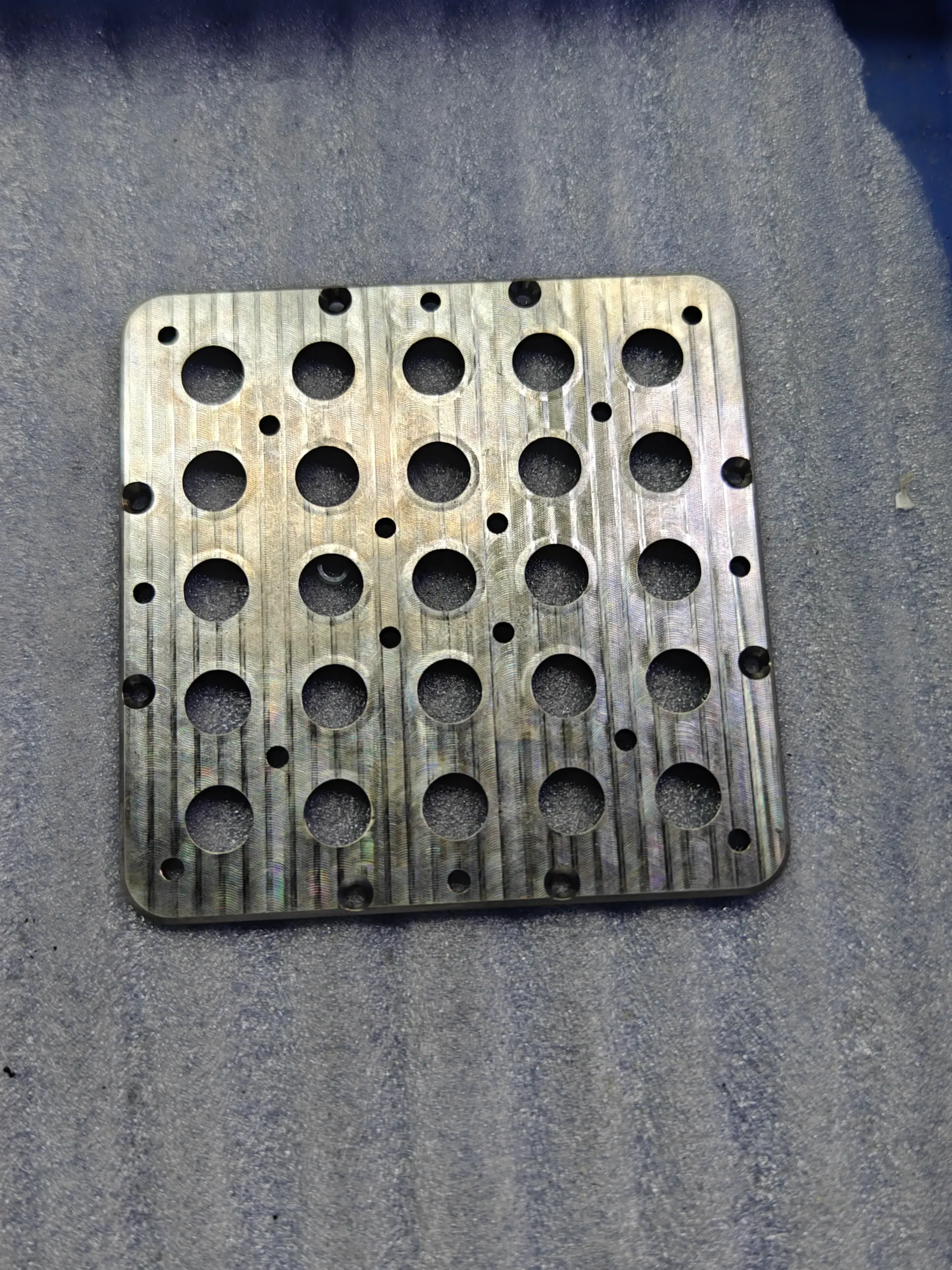
What Holds a Long Batch Together
Volume also changes how the batch is proven. On a one-off part, inspection confirms the part; on a 10,000-part run it confirms the process, which means the plan has to name the critical features, the datum scheme and the sampling rather than the final visual check. That is the discipline behind the shop’s framework for CMM inspection in high-volume manufacturing: define the critical-to-function features, fix the datums, and report against a sampling plan that both sides agreed before the run started. Two boundary conditions are worth stating on the purchase order: the tolerance band the process was quoted to, and the point at which tool wear or fixturing drift means the batch is re-measured rather than assumed to be steady.
Can High Volume Milling Achieve Injection Molding-Like Costs at 5,000 Units?
High volume milling can achieve injection molding-like costs at 5,000 units for aluminum and stainless steel parts, but only when part geometry avoids deep pockets, thin walls, or complex 3D contours that extend cycle time. For simple to moderate complexity parts, milling costs $15–35/part versus molding’s $12–30/part, but molding requires $10,000–50,000 in tooling upfront.
The crossover point depends on material and complexity. For aluminum housings with moderate features, high volume milling breaks even with molding at 3,000–4,000 units. For complex medical devices with undercuts and tight tolerances, milling remains cost-effective up to 8,000–10,000 units because molding tooling for multi-cavity, family molds exceeds $75,000.
At 6CProto, we analyze your CAD during free DFM to recommend the optimal process. If your part is aluminum with wall thickness >2mm and no undercuts, high volume milling is often the smarter choice—even at 5,000 units—because you avoid risky tooling modifications and maintain design flexibility for late-stage changes before full market commitment.
Where Does High Volume Milling Fit in the Product Development Lifecycle?
High volume milling fits between prototyping and injection molding in the product development lifecycle, serving pilot runs (200–1,000 units), market validation (1,000–5,000 units), and bridge production while waiting for molding tools (500–3,000 units). This positioning enables functional testing with production-intent materials before committing to expensive tooling.
Typical product lifecycle progression:
-
Concept validation (1–10 parts): 3D printing or prototype CNC
-
Functional testing (10–50 parts): Prototype CNC with production materials
-
Pilot run (200–500 parts): High volume milling with optimized toolpaths
-
Market launch (1,000–5,000 parts): High volume milling or injection molding
-
Mass production (10,000+ parts): Injection molding or die casting
For aerospace and medical devices, high volume milling serves regulatory certification phases where you need 500–2,000 parts for FAA/FDA testing with full traceability. At 6CProto, we’ve supported 30+ medical device launches using high volume milling for FDA 510(k) submissions, then transitioned to molding for commercial production after market validation.
This phased approach reduces risk: if your product fails market testing, you’ve only invested $15,000–30,000 in milling versus $50,000–100,000 in molding tooling. The flexibility to pivot without sunk tooling costs is invaluable for startups and companies launching new product lines.
Conclusion
High Volume Milling Mass Production CNC and Large Scale Machining enable cost-effective scaling for market launch through optimized toolpaths that reduce per-unit costs by 30–50%. The transition from prototyping to high volume occurs at 200–300 units, where optimized tooling and fixturing investments pay back through reduced cycle times and extended tool life.
Key takeaways for successful high volume milling:
-
Choose the right material: Aluminum 6061-T6 offers the best balance of machinability and cost for 1,000–5,000 unit runs
-
Invest in fixturing: Tombstone fixtures and custom soft jaws reduce setup time by 60–70%
-
Optimize toolpaths: Adaptive clearing and trochoidal milling cut cycle time by 40–60%
-
Plan the transition: Request free DFM analysis at 150–200 units to prepare for high volume efficiency
-
Prioritize total cost: Faster lead times often outweigh slightly lower unit prices for market launches
At 6CProto, we combine ISO 9001:2015 certification, advanced CMM inspection, and 24-hour shipping to deliver 500–10,000+ parts with ±0.02mm tolerances in 3–5 days. Our multi-spindle CNC farms and optimized workflows ensure your high volume production meets quality standards while hitting market launch deadlines. From initial concept to mass production, 6CProto is your trusted partner for scalable manufacturing excellence.
FAQ
What is high volume milling and how does it differ from prototyping?
High-volume milling is the machining of a stable design in the thousands of parts, where the cost is dominated by cycle time, tool life, fixturing and inspection rather than by programming and setup. In prototyping the balance is reversed: setup and programming dominate, and the process is chosen to answer a question quickly rather than to run for a month.
Is a 5-axis machine always better for high volume work?
No. The 5-axis route costs more per hour but needs fewer setups, so it wins on angled, contoured or multi-face geometry. A part whose features can all be reached from one direction is a 3-axis part, and quoting it on a 5-axis machine adds machine-hour cost without removing anything. The decision is made by the features, not by the machine list.
When does a cheaper machine hour stop being cheaper?
When the extra setups cost more than the rate difference saves. In a model where the 3-axis route is 20% cheaper per hour but needs two additional 1.5-hour setups per batch, the setup cost is 3 hours, and the rate advantage only covers it once the batch carries 15 hours of cutting. Below that break-even, the lower hourly rate is the more expensive route.
How is a 10,000-part milling batch inspected?
As a process rather than as parts. The plan names the critical-to-function features, fixes the datums and the GD&T, and reports against an agreed sampling plan with CMM measurement, so the record shows the process was in control across the run. Final visual inspection stays as the last gate, but it is not the evidence the batch is judged on.
What drives cost in a high volume milling programme?
Cycle time, tool life and the number of setups first, then fixturing strategy, then inspection effort. Re-fixturing is the quiet one: each extra setup adds load and unload time, a fixture, and a datum transfer, and the datum transfer is where a batch picks up dimensional drift that only appears at the end.