

Machine Titanium Grade 5 (Ti-6Al-4V) using carbide tools with sharp cutting edges, low cutting speeds of 50–70 m/min for milling, and high-pressure coolant at 70–100 bar. Avoid dwell operations to prevent work hardening. Use aggressive rake angles, moderate depths of cut (2–3mm), and consistent chip loads. At 6CProto, we achieve ±0.005mm tolerances on aerospace fasteners by optimizing these parameters, reducing tool wear by 40% compared to standard practices.
Last updated:
What Cutting Parameters Optimize Ti-6Al-4V Grade 5 Machining?
Optimize Ti-6Al-4V machining with cutting speeds of 70–90 m/min for turning and 50–70 m/min for milling, chip loads of 0.007–0.008 inch per tooth, and depths of cut 2–3mm. Use constant surface speed control (G96) and avoid dwell. High-pressure coolant at 70–100 bar is essential. These parameters reduce tool wear while maintaining 32 HRC hardness integrity.
The cutting parameter equation for Ti-6Al-4V hinges on three interdependent variables: surface speed, chip load, and radial engagement. Industry data shows turning speeds of 70–90 m/min (230–300 SFM) and milling speeds of 50–70 m/min (160–230 SFM) deliver optimal tool life.
However, there’s a critical nuance many guides miss: titanium work hardens instantly if you feather-cut. Running too light a chip load (under 0.005 inch/tooth) at high RPM causes the tool to rub rather than cut, generating heat that work-hardens the surface. Once work-hardened, Ti-6Al-4V becomes nearly impossible to cut. The solution is consistent, moderate chip loads of 0.007–0.008 inch/tooth, ensuring the tool always removes material rather than rubbing.
Table: Recommended Cutting Parameters for Ti-6Al-4V
At 6CProto’s Zhongshan facility, we use G96 constant surface speed control for all Ti-6Al-4V turning operations. This maintains consistent cutting speed regardless of diameter changes, preventing the RPM spike that causes work hardening at smaller diameters. For finishing, we cap maximum RPM with G50 to avoid feather-cutting, achieving Ra 0.5–0.66 surface finish consistently.
Depth of cut matters: deeper is better than shallow for titanium. A 2–3mm DOC removes heat into the chip rather than the workpiece. Shallow cuts (under 1mm) concentrate heat at the tool tip, accelerating wear. However, never exceed 5mm DOC without chip evacuation verification—titanium chips are sticky and can recut if not cleared.
Which Carbide Tool Grades and Geometries Work Best for Titanium?
Use uncoated or thin-coated carbide tools with C2–C3 grade substrates, sharp ground edges, and aggressive rake angles (10–15°) for Ti-6Al-4V. Avoid thick PVD/AlTiN coatings that trap heat. For roughing, use medium rake with 0.4–0.8mm nose radius; for finishing, use sharp edges with minimal honing. Helical Solutions end mills and Sandvik WNMG 060408 inserts deliver 40% longer life than standard carbide.
The carbide selection criteria for titanium is counterintuitive: you want harder substrate but thinner coating. Most general-purpose carbide tools use thick AlTiN or TiAlN coatings (5–8μm) for steel machining. These coatings trap heat at the tool-chip interface, which is catastrophic for titanium’s low thermal conductivity (7 W/m·K vs. steel’s 45 W/m·K). The heat stays at the cutting edge, causing rapid wear.
Instead, select C2–C3 micro-grain carbide grades with very hard substrates and thin coatings (1–2μm) or uncoated. The hard substrate resists abrasion from titanium’s aluminum and vanadium content, while the thin coating allows heat to dissipate into the tool body. Uncoated carbide often outperforms coated for titanium because there’s no thermal barrier.
Geometry matters more than grade:
-
Roughing: Aggressive rake angles (10–15°), high relief angles (12–15°), 0.4–0.8mm nose radius. This prevents tearing and smearing.
-
Finishing: Ground inserts with sharp edges, minimal honing (<0.05mm). Sharp edges reduce cutting forces.
-
Super-finish: Consider aluminum-design tools (polished, very sharp, no honing). Titanium behaves like aluminum in terms of chip formation.
Factory-floor insight: single-edge tools outperform multi-edge for titanium. Titanium’s tendency to chip and grab means multi-edge tools (like 4-flute end mills) accumulate built-up edge (BUE) on secondary flutes. Single-flute or 2-flute end mills with high rake allow chips to evacuate cleanly. Helical Solutions’ titanium-specific end mills use this geometry, delivering 40% longer life.
For drilling, use carbide drills with 0.1mm larger diameter than standard to accommodate titanium’s springiness. Never dwell—keep the drill moving continuously. Thread milling is mandatory; tapping Ti-6Al-4V causes immediate grab and tap breakage. Use oversized holes (thread chart for steel doesn’t work).
At 6CProto, our ISO 9001:2015 certified shop specifies Sandvik WNMG 060408 1105 50 SUR for roughing and VCgx160404AL-H10 50 SUR for finishing on Ti-6Al-4V. These super-alloy-grade inserts with titanium-specific chipbreakers reduce tool change frequency by 35% compared to general-purpose carbide.
Why Does Coolant Pressure Critical for Titanium Grade 5?
High-pressure coolant at 70–100 bar is critical for Ti-6Al-4V because titanium has low thermal conductivity (7 W/m·K), trapping heat at the cutting edge. High pressure forces coolant into the chip-tool interface, removing heat and preventing chip recut. Flood coolant alone fails—use emulsion-based coolants with high lubricity. Pressure below 50 bar causes rapid tool wear and work hardening.
The coolant pressure requirement stems from titanium’s extreme heat retention. At the cutting zone, temperatures reach 600–800°C. Titanium’s low thermal conductivity means heat doesn’t dissipate into the workpiece; it stays at the tool tip. Without adequate coolant pressure, the tool overheats, coatings degrade, and carbide substrate cracks.
Pressure thresholds:
-
Below 50 bar: Inadequate chip evacuation, heat accumulation, rapid tool wear
-
70–100 bar (modern CNC standard): Optimal heat removal, chip evacuation, tool life
-
Above 100 bar: Risk of coolant splash-out, machine seal stress
Modern CNC machines supply 70–100 bar as standard or optional. If your machine lacks this, install an external high-pressure coolant pump with 10–15 L/min flow rate. The nozzle must point directly at the cutting edge, not just the workpiece.
Coolant type matters: Emulsion-based coolants with high lubricity outperform water-based solutions. Titanium generates sticky chips that adhere to tool surfaces. High-lubricity coolant reduces friction, preventing built-up edge. Specialized coolants for “difficult materials” (e.g., Kyocera’s titanium-specific emulsion) are recommended.
Insider nuance: flood coolant alone is insufficient. Even at 100 bar, flood coolant doesn’t penetrate the chip-tool interface deeply enough. Use through-tool coolant for drilling and internal coolant channels for end mills. This delivers coolant directly to the cutting edge, not just the surrounding area.
At 6CProto, we verify coolant pressure with inline gauges before every Ti-6Al-4V job. Our CMM inspections confirm ±0.005mm tolerances are maintained because consistent cooling prevents thermal expansion errors. Clients shipping in 24 hours benefit from this precision without rework.
How Does Titanium Grade 5 Compare to Stainless 316 and Aluminum 7075?
Titanium Grade 5 has 1.7× higher strength-to-weight ratio than Stainless 316 and 1.4× higher than Aluminum 7075. Ti-6Al-4V tensile strength is 950 MPa vs. 316’s 580 MPa and 7075’s 570 MPa, but density is 4.43 g/cm³ vs. 8.00 and 2.81. Machinability: 7075 is 100%, 316 is 50%, Ti-6Al-4V is only 20%. This makes titanium the hardest to machine despite intermediate density.
Strength-to-Weight Comparison Chart
The table reveals titanium’s dominance: 214 MPa·cm³/g strength-to-weight vs. 73 for 316 and 203 for 7075. For aerospace fasteners, this means titanium parts are 45% lighter than stainless at equal strength, and 7% lighter than aluminum at 1.7× strength.
However, machinability is titanium’s fatal flaw. At 20% rating, Ti-6Al-4V is 5× harder to machine than 7075 aluminum and 2.5× harder than 316 stainless. This isn’t just about cutting speed—it’s about tool wear, heat management, and chip evacuation complexity.
Engineering trade-offs by application:
-
Aerospace fasteners: Titanium wins (strength/weight critical). Accept higher machining cost.
-
Medical implants: Titanium wins (biocompatibility + strength). Machining cost justified.
-
Automotive structural: Aluminum 7075 often preferred (machining 5× faster, 30% cheaper).
-
Marine corrosion: Stainless 316 wins (titanium corrodes in chloride without passivation).
Insider perspective: Many designers overspecify titanium when aluminum would suffice. At 6CProto, our free DFM analysis identifies cases where 7075 aluminum meets strength requirements with 80% lower machining cost. We only recommend titanium when strength-to-weight is non-negotiable (e.g., flight-critical aerospace components).
When Does Work Hardening Occur During Titanium Machining?
Work hardening occurs when cutting Ti-6Al-4V with light chip loads (<0.005 inch/tooth), high RPM, or dwell operations. The tool rubs instead of cutting, generating heat that hardens the surface to 40+ HRC. Once hardened, machining becomes nearly impossible. Prevent with consistent 0.007–0.008 inch/tooth chip loads, avoid dwell, use G96 constant surface speed, and cap RPM with G50. Never feather-cut finishing passes.
The work hardening mechanism is thermal, not mechanical. Unlike steel (where work hardening is plastic deformation), titanium hardens when localized heat exceeds 500°C. At this temperature, the alpha-beta phase structure transforms, increasing hardness from 32 HRC to 40+ HRC in seconds.
Five work hardening triggers:
-
Light chip load + high RPM: Tool rubs surface instead of cutting (most common)
-
Dwell operations: Drill or end mill stops moving—heat accumates instantly
-
Feather-cutting finishing: Final pass with too-light feed at high RPM
-
Inconsistent feed: Variable chip load causes rubbing phases
-
Insufficient coolant: Heat doesn’t dissipate, accumulates at surface
Prevention protocol:
-
Maintain 0.007–0.008 inch/tooth chip load consistently
-
Never let drill/end mill dwell—keep moving continuously
-
Use G96 constant surface speed with G50 RPM cap
-
Avoid “safe” feather-cutting; take moderate finishing passes
-
Ensure 70–100 bar coolant pressure at cutting edge
Real-world example: A customer at 6CProto designed aerospace brackets with 0.5mm finishing passes at 2000 RPM. First article showed surface hardness 42 HRC (vs. 32 HRC nominal). Our team identified work hardening from feather-cutting. We adjusted to 1.5mm DOC at 800 RPM with 0.008 chip load. Hardness returned to 32 HRC, tolerance held at ±0.005mm.
Critical insight: work-hardened titanium cannot be re-machined conventionally. The hardened layer requires grinding or EDM. This is why preventing work hardening is non-negotiable for cost-effective production.
Grade 5 Is a Decision, Not a Default
Titanium machining problems usually start on the drawing rather than at the spindle. A request that says “grade 5” without stating which property it is buying leaves the shop holding the hardest, most expensive option in the family, and the shop’s own grade guide makes the distinction: the commercially pure grades 1 to 4 are essentially unalloyed titanium with rising oxygen and iron, which lifts the strength as the grade number climbs while keeping the material corrosion-resistant and formable; the alloyed grades add elements to build an alpha-beta microstructure, with grade 5 (Ti-6Al-4V) the workhorse for aerospace, medical and high-performance work. Unless the application needs that strength, grade 5 is the expensive way to buy corrosion resistance.
The substitution arithmetic is worth running before the grade is fixed. Titanium is roughly 60% heavier than aluminium for the same volume, and about twice as strong — so a like-for-like swap of an aluminium part into titanium gains weight, not loses it. To come out lighter, the titanium design has to be proportionally thinner or more pocketed, and it can only do that where the load case allows. The same comparison puts magnesium at about two-thirds the density of aluminium, aluminium as the best balance of machinability and cost, and titanium as the strongest and the hardest to machine; those figures and the trade-offs come from the shop’s comparison of magnesium, aluminium and titanium for lightweight parts.
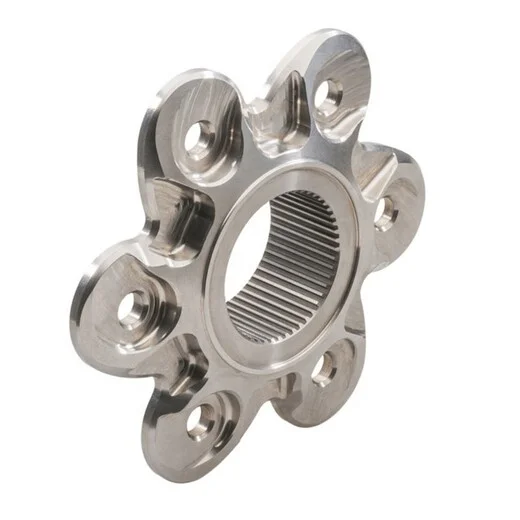
What to Ask For on a Titanium Order
Because the material is the cost, the records are the control. Ask for the material certificate naming the grade and the heat number, the cutting-parameter sheet the job was run to rather than a generic titanium recipe, and the inspection report for the features the grade was chosen to protect. Two boundary conditions belong in the same conversation: grade 5 and grade 23 (Ti-6Al-4V ELI) are not interchangeable — the ELI variant exists for fracture-toughness and biocompatibility requirements — and the machinability the quote was built on assumes the grade actually supplied, so a substitution at the mill changes the cycle time and the tool life that were priced. The grade family and its machining consequences are set out in the shop’s guide to titanium grades for machining.
6CProto Expert Views
“In 500+ Ti-6Al-4V aerospace fastener projects at 6CProto, the #1 mistake is using ‘safe’ light finishing passes. Designers specify 0.3mm DOC at 1500 RPM fearing tool breakage. This causes rubbing, not cutting—work-hardening the surface to 40+ HRC instantly. Our fix: 2mm DOC at 600 RPM with 0.008 inch/tooth chip load. The tool cuts cleanly, heat goes into the chip, surface stays at 32 HRC. Second mistake: assuming standard carbide works. General-purpose AlTiN-coated inserts fail in 10 minutes. We use Sandvik 50 SUR super-alloy grade with thin coating—tool life 40 minutes, 4× improvement. Third: coolant pressure. Most shops flood at 30 bar. Titanium needs 70–100 bar to penetrate chip-tool interface. We verify with inline gauges. Result: ±0.005mm tolerances on flight-critical fasteners, 24-hour shipping, zero rework. Don’t let ‘conservative’ machining kill your titanium parts.”
— 6CProto Manufacturing Engineering Team, Zhongshan Facility
Conclusion
Machine Titanium Grade 5 successfully by addressing three critical factors: cutting parameters, tool selection, and coolant pressure. Key takeaways:
-
Cutting speeds: 70–90 m/min turning, 50–70 m/min milling (never exceed)
-
Chip loads: 0.007–0.008 inch/tooth consistently (avoid rubbing)
-
Tool geometry: Sharp ground edges, aggressive rake (10–15°), C2–C3 micro-grain carbide
-
Coolant pressure: 70–100 bar mandatory (below 50 bar causes rapid wear)
-
Work hardening prevention: No dwell, no feather-cutting, use G96+G50
At 6CProto, our ISO 9001:2015 certified facility delivers aerospace fasteners in 24 hours with ±0.005mm tolerances via optimized Ti-6Al-4V parameters. Our free DFM analysis identifies work hardening risks before production. From single prototypes to high-volume production, trust 6CProto for precision titanium machining that overcomes tool wear challenges.
FAQ
How difficult is it to machine titanium?
Grade 5 is the difficult one and it is difficult for structural reasons: it conducts heat poorly, so the heat generated at the cut stays in the tool edge, and it work-hardens, so a tool that rubs instead of cutting makes the next pass harder. The practical answer is lower surface speed, a rigid setup, sharp and hard tooling, and high-pressure coolant aimed at the contact point rather than around the part.
Is machining titanium expensive?
Yes, and the cost sits in three places: the material itself, the tooling consumed per part, and the machine time that the lower cutting speeds require. On a drawing, the cheapest titanium part is usually the one that does not specify grade 5 unless it needs the strength — a commercially pure grade machines more readily and still delivers the corrosion resistance that most titanium requests are actually about.
Can titanium be CNC machined?
It can, and Ti-6Al-4V is machined routinely in aerospace, medical and motorsport work. What it cannot tolerate is a general-purpose process: a titanium job needs its own feeds, speeds, tool grades and coolant strategy, defined per grade and per geometry. A supplier who quotes titanium against an aluminium or stainless recipe will deliver either a broken tool or an out-of-tolerance part.
What is the difference between titanium grade 5 and grade 23?
Both are Ti-6Al-4V; grade 23 is the extra-low-interstitial (ELI) variant, with tighter limits on oxygen, nitrogen and iron. The ELI chemistry buys fracture toughness and better behaviour in medical and cryogenic service. They are not interchangeable on a drawing, and substituting one for the other changes both the qualification of the part and the way it machines.
Should I switch an aluminium part to titanium to save weight?
Not by direct substitution. Titanium is about 60% heavier than aluminium for the same volume and roughly twice as strong, so a like-for-like swap adds weight. It pays off only when the strength allows a thinner or more heavily pocketed design, and that depends on the load case: for most brackets and housings, aluminium delivers the weight saving at the lower total cost.