

Explore Injection Molding Design & Tooling
Rapid tooling services use prototype molds and fast tooling methods to quickly create cost-effective injection molds for testing and low-volume runs, bridging the gap to mass production with real materials and near-production quality parts. They reduce lead time, lower tooling costs, and provide design feedback early, helping teams de-risk full-scale production and optimize both part design and final production tooling.
Last updated:
What is rapid tooling and how does it bridge the gap to mass production?
Rapid tooling is the use of simplified, cost-optimized molds—often aluminum or soft steel—to produce real injection-molded parts quickly for testing and low-volume runs before committing to full production tooling. It bridges the gap to mass production by validating design, material, and process on real parts, allowing engineers to refine gate layout, cooling, and tolerances before investing in long-life, high-cavitation molds.
From my factory-floor experience, rapid tooling acts like a rehearsal for your production mold. I can deliberately oversize critical inserts by 0.02–0.05 mm, then shim or regrind after T1 samples instead of scrapping a six-figure steel tool. At 6CProto, we use rapid tooling data to lock in resin grade, shrink rates, and cooling strategies so the transition to mass production is controlled rather than experimental.
How do rapid tooling services work from CAD file to first shots?
Rapid tooling services convert your 3D CAD model into a simplified, fast-to-machine mold using standardized mold bases, aluminum or pre-hardened steel inserts, and streamlined cooling and ejection layouts. The typical flow is: DFM review, mold design, machining/EDM, assembly, and T0/T1 sampling, with iterations based on measured part data until you reach acceptable dimensional and cosmetic quality.
On the shop floor, the DFM phase is where I catch 80% of problems: thin ribs that will sink, zero draft on deep cores, or weld lines on structural features. At 6CProto, I insist that every rapid tool gets a cooling layout review, even if it adds a day; uneven cooling is the number one root cause of warp that customers mislabel as “bad molding.”
Which key benefits make rapid tooling, prototype molds, and fast tooling cost-effective?
Rapid tooling reduces upfront mold cost (often 50–80% lower than full production tools), compresses lead time from months to days or weeks, and allows early validation with production-like parts, cutting the risk of expensive late-stage design changes. It is especially cost-effective when you need dozens to a few thousand parts for testing, certification, or pilot runs without overbuilding the tooling.
The real economic win I see is avoiding “over-spec’d” steel molds for products that never scale. With rapid tools, we can build a two-cavity aluminum mold in 10–15 days, produce 1,000–3,000 parts, and then decide if the market justifies a hardened 8-cavity tool. At 6CProto, clients in automotive trim often recoup rapid tooling cost simply by catching one late design defect before mass production.
Typical use cases and value levers
-
Functional testing with real materials and real process conditions
-
Regulatory and certification builds where process history matters
-
Pilot runs for marketing, user trials, or investor demos
-
Bridge production while long-lead production tools are being built
In practice, I often run the same molding parameters on the rapid tool that we expect on the final tool: melt temperature, mold temperature, packing pressure, and cooling time. That way, the process window you establish with rapid tooling becomes your starting recipe for the production mold, saving weeks of ramp-up.
How does rapid tooling compare with production tooling in cost, speed, and lifespan?
Rapid tooling uses lower-cost materials and simpler designs to deliver parts in days or weeks, but with a limited mold life, usually in the 100–10,000 shot range, depending on material and pressure. Production tooling uses hardened steels, complex cooling, and more cavities to support 100,000–1,000,000+ shots, with higher upfront cost and longer lead times but a much lower cost per part at scale.
From an engineering standpoint, I treat rapid tools as learning platforms and production tools as cash machines. On a rapid tool, I will prioritize accessibility for rework, modular inserts around risk areas, and manual slides where possible. On a production tool, I invest heavily in robust cooling, automated actions, and wear-resistant steels like H13 or S136H, because a one-hour unplanned stop per week becomes extremely expensive at volume.
Rapid vs production tooling at a glance
Why is rapid tooling ideal for fast testing and design validation?
Rapid tooling is ideal for fast testing because it produces injection-molded parts in the right resin and using real processing conditions, revealing issues that 3D printing or machining can hide. It allows you to validate functional performance, assembly fit, cosmetic quality, and manufacturability on realistic parts, so any changes you make are grounded in real-world behavior, not just CAD assumptions.
On the line, I routinely see 3D printed prototypes pass bench tests but fail once we mold them due to fiber orientation, sink, and gating-induced stress. Rapid tooling exposes these phenomena early. At 6CProto, we capture CMM data on critical dimensions across T0, T1, and T2 shots, which lets us quantify shrink and warpage trends rather than rely on visual checks alone.
Typical issues rapid tooling helps uncover
-
Warp due to uneven wall thickness or cooling
-
Sink marks on thick bosses or ribs
-
Short shots from poor venting or gate placement
-
Stress cracking around living hinges or snap fits
-
Assembly stack-up problems not obvious in CAD
Because we can tweak gate size, location, or cooling channels on a rapid tool with minimal cost, you can iterate two or three times and arrive at a “tool-safe” design before commissioning a full production mold.
What materials, mold types, and processes are used in rapid tooling?
Rapid tooling commonly employs aluminum (such as 6061 or 7075) and pre-hardened steels (such as P20) for cores and cavities, sometimes combined with standardized mold bases to reduce machining time. It is typically produced using CNC machining and EDM, with occasional additive manufacturing for complex inserts, and is used with standard injection molding machines to process production-grade thermoplastics, elastomers, and sometimes metals via die casting.
From a process engineer’s view, the key is choosing a mold material that matches your volume and resin. For abrasive, glass-filled polymers, I prefer P20 or better, even at the rapid tooling stage, because an aluminum tool will degrade too quickly and give misleading process data. At 6CProto, we maintain dedicated aluminum and P20 mold base inventories so we can align tool life with your program’s realistic shot count.
Common rapid tooling mold options and use cases
How should engineers choose between aluminum, steel, and hybrid rapid tooling?
Engineers should choose aluminum rapid tooling when speed and low cost are priorities and expected volumes are modest, often in the hundreds to low thousands of shots. Steel rapid tooling, usually P20 or similar, is better when you expect higher shot counts, use abrasive or high-temperature materials, or need tighter tolerances and longer tool life. Hybrid tooling suits parts that mix cosmetic surfaces with high-wear features.
When I review a project at 6CProto, my rule-of-thumb is: if the part sees glass-filled nylon, repeated snap engagement, or overmolding, I steer away from pure aluminum, even for small runs. Instead, we might use an aluminum base and P20 inserts at the gate and critical ribs. That way, you still get fast machining but avoid early gate washout and dimensional drift.
Decision guidelines
-
Aluminum tools: consumer housings, early cosmetic trials, low-risk geometries
-
P20 tools: engineering components, automotive, connectors, clips
-
Hybrid tools: cosmetic bezels with structural clips, living-hinge covers, multi-material parts
The subtle trick is to design inserts around “failure zones”—gates, sharp corners, thin ribs—so if wear or cracking occurs, we can re-machine a small block, not the entire mold.
Where do rapid tooling services fit in the product development and manufacturing timeline?
Rapid tooling services fit after initial concept validation and prototype iterations, but before committing to full production tooling and large-scale manufacturing. They are most valuable when you have a nearly frozen design that still needs validation in real materials and processes, and when you need parts for functional testing, certification, or early customer delivery while production molds are being built.
From my experience, the most successful programs allocate a specific “rapid tooling phase” with clear objectives: validate CTQs (critical-to-quality dimensions), confirm cosmetic class, finalize resin grade, and establish an initial process window. At 6CProto, we often run rapid tooling in parallel with early production tool design, feeding back lessons on gating, venting, and cooling so the production tool starts at a higher maturity level.
Typical timeline integration
-
Early: CAD and 3D printed prototypes for form and concept
-
Mid: CNC-machined prototypes for functional checks
-
Rapid tooling: low-volume injection parts, process validation, pilot builds
-
Production tooling: high-cavitation, hardened tools for long-term volume
By inserting rapid tooling, you move from guessing how the part will behave in production to seeing real data, which dramatically reduces launch surprises.
Can rapid tooling support demanding industries like aerospace, medical, and automotive?
Rapid tooling can absolutely support demanding industries such as aerospace, medical, and automotive, provided the service provider follows strict quality systems, material traceability, and process control. It allows these sectors to build functional prototypes and low-volume parts in certified or near-certified materials, supporting tests like vibration, chemical resistance, biocompatibility, and environmental cycling before committing to full production.
On regulated projects, my role extends beyond cutting steel: I must document material batches, molding parameters, and measurement results so test reports stand up to audits. At 6CProto, for aerospace and medical programs, we align our rapid tooling runs with ISO 9001:2015 procedures, use calibrated CMM equipment, and store complete process records so customers can link test failures or successes back to a traceable process history.
Industry-specific considerations
-
Aerospace: tight tolerances, weight-critical parts, FST or high-temp materials
-
Medical: biocompatibility, clean-room molding needs, sterilization compatibility
-
Automotive: dimensional stack-ups, long-term thermal and vibration cycling
In these fields, rapid tooling is less about “cheap parts” and more about “fast, traceable learning,” which is where experienced providers like 6CProto add real value.
Does rapid tooling always save money compared with skipping straight to production tooling?
Rapid tooling generally saves money by reducing the risk of costly rework or scrap on production tooling, but it is not automatically cheaper in every scenario. It is most economical when there is meaningful uncertainty in design, material, or demand, or when the time value of earlier validation or market entry outweighs the additional cost of a separate tool.
From a cost engineer’s perspective, I sometimes advise clients to skip rapid tooling if volumes are guaranteed, design is mature from prior generations, and material is well understood. But when there are new mechanisms, new polymers, or aggressive cosmetic targets, every design issue you catch at the rapid tooling stage can eliminate tens of thousands in production-tool rework and weeks of lost schedule. At 6CProto, we’ve seen programs where a $10,000 rapid tool prevented a $150,000 change order on a hardened 16-cavity mold.
When rapid tooling is most cost-effective
-
New product categories or unproven architectures
-
High-risk features: living hinges, deep ribs, complex clips
-
Uncertain demand forecasts where oversizing production tools is risky
-
Projects where a three-month earlier launch has significant revenue impact
The nuanced decision is not just “tool cost,” but also schedule risk, design maturity, and the strategic value of early learning.
Who is 6CProto and why does its approach to rapid tooling matter?
6CProto is a Zhongshan-based one-stop custom manufacturing partner specializing in rapid prototyping, CNC machining, injection molding, 3D printing, and sheet metal, serving industries like aerospace, medical, and automotive. Its approach to rapid tooling matters because it combines fast lead times with ISO 9001:2015-certified quality, advanced CMM inspection, and free DFM analysis, helping customers move reliably from a single prototype to high-volume production.
As a manufacturing specialist at 6CProto, I focus on connecting rapid tooling decisions directly to long-term production strategy. For example, when we design a prototype mold, we already think about gate type and location that can scale to multi-cavity production tools, avoiding “prototype-only” layouts. By aligning rapid and production tooling from day one, we shorten the learning curve and make every trial shot serve your future mass production.
6CProto Expert Views
“When I review a rapid tooling project, I look for three things: where the part will likely warp, where the mold will likely wear, and where the customer will likely change their mind. I then design the tool so those zones live on replaceable inserts. That way, we can adjust geometry, gate style, or venting without restarting the entire tool. This mindset is why our rapid tools genuinely bridge to production rather than becoming expensive one-off experiments.”
What are the critical DFM and tolerance decisions that make or break a rapid tooling project?
Critical DFM decisions include maintaining uniform wall thickness, ensuring proper draft angles, designing robust gates and vents, and avoiding sharp internal corners that concentrate stress. Tolerance decisions must balance realistic process capability with functional requirements, typically tightening only truly critical dimensions while allowing others more freedom to avoid unnecessary machining and inspection costs.
On the shop floor, I routinely see designs with ±0.02 mm tolerances on non-critical cosmetic edges, which slow machining and increase scrap without improving function. At 6CProto, we push back early, proposing tolerance zoning: tight around sealing, alignment, or bearing surfaces, looser elsewhere. We also simulate gate-induced flow and shrink directions so the mold’s cavity steel is intentionally biased against expected warpage, not just a mirror of the CAD part.
Practical DFM checklist for rapid tooling
-
Draft: at least 1–2 degrees on most walls, more on textured surfaces
-
Walls: keep ratios reasonable (e.g., ribs at 40–60% of wall thickness)
-
Gates: avoid gating on cosmetic class-A surfaces when possible
-
Vents: place near flow ends to prevent burns and shorts
-
Tolerances: tiered by functional criticality, not uniformly tight
By addressing these elements up front, your rapid tool produces meaningful data that can be transferred confidently to the production design and tool.
What to Specify and Verify on a Bridge Tool
The value of rapid tooling is that it moves the first real shots forward in the schedule, and the risk is that it is asked to do a production tool’s job. The construction follows the volume forecast rather than the drawing: in the shop’s own banding, 100 to 1,000 parts is usually a single-cavity tool in aluminium, chosen because it is the lowest tool cost, the fastest to deliver and the easiest to modify; 1,000 to 5,000 parts adds a steel gate insert, which extends life at the point that wears first for very little money; 5,000 to 20,000 parts moves to a hybrid tool, an aluminium frame carrying steel inserts where the wear actually occurs; and above 20,000 parts the tool becomes steel with its cavity count matched to the volume. Those bands and the reason for each come from the shop’s note on low-volume injection molding, MOQ and cost per part.
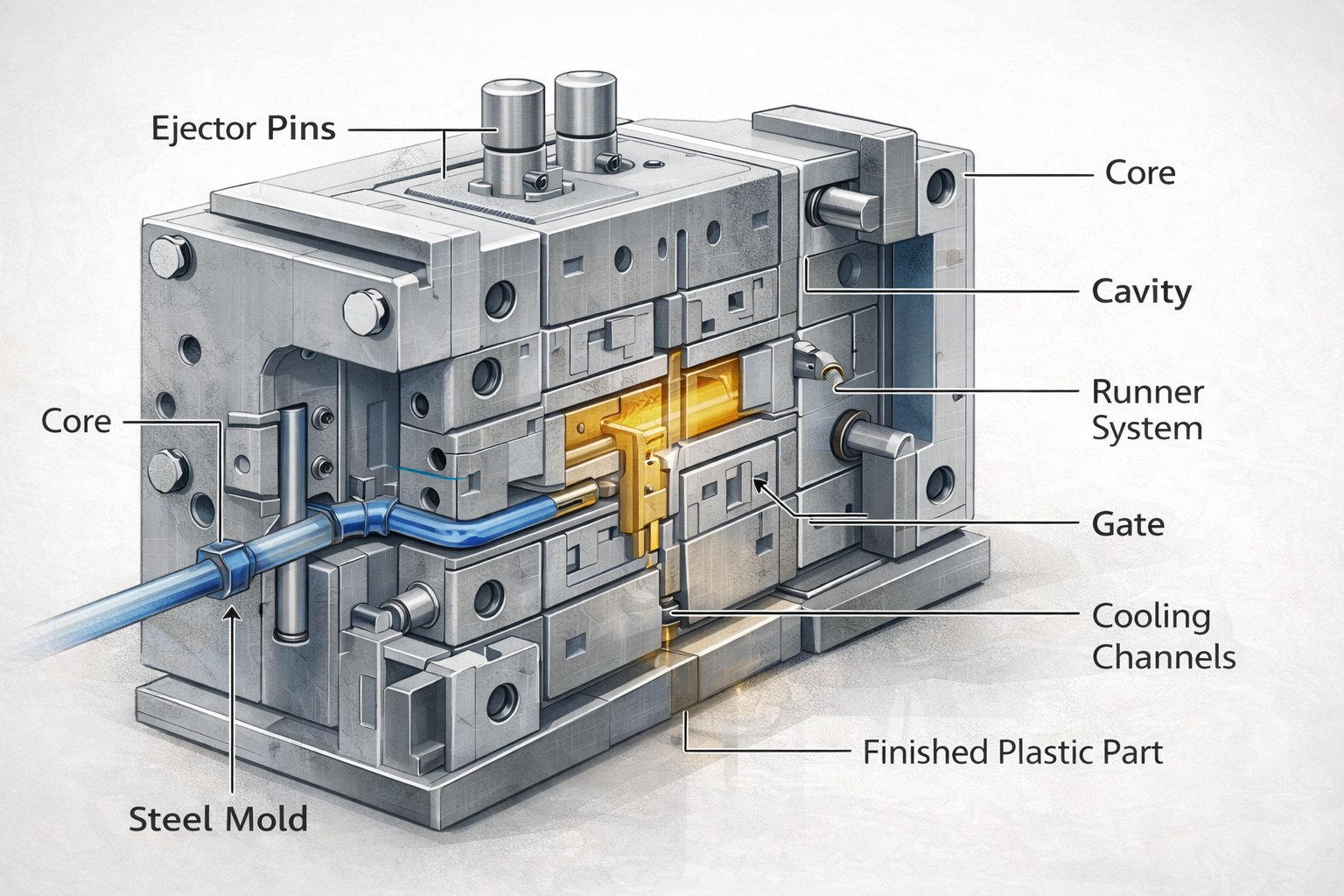
The Volume Number That Decides the Cavity Count
Cavity count is a throughput decision rather than a quality setting, and it is the other half of the bridge-tool calculation. Engineering teams typically evaluate two to eight cavities for a mid-volume run and sixteen to one hundred and twenty-eight for mass production, and at high volume the arithmetic is stark: spreading machine time, labour and energy across many parts often cuts unit cost by 50 to 90% against a single-cavity run. A bridge tool rarely needs that, which is exactly why it is cheap — it is there to answer questions about the part, not to minimise its price. The cavity and cost figures are set out in the shop’s guide to how many cavities a mould should have.
Three things are worth asking for before the bridge tool is cut. The expected shot life in writing, since that is the number the whole decision rests on; the gate insert material if the tool is aluminium, because the gate wears first; and a first-article inspection report from the bridge tool, because a bridge tool that cannot hold the drawing is not a schedule device at all — it is a delay with a purchase order attached. Two boundary conditions belong alongside them: a bridge tool is built from softer steel and thinner sections, so it tolerates fewer cycles and less abuse than the production tool it precedes, and its cavities cannot simply be copied into a hardened tool later — the production tool is a new build, and the bridge tool’s real deliverable is the process knowledge that shortens its first tryout.
How should buyers evaluate and select a rapid tooling partner?
Buyers should evaluate a rapid tooling partner based on technical capabilities, material and process expertise, quality systems, speed, and transparency. Key signals include in-house machining and molding capacity, DFM support, documented inspection methods, realistic but fast lead times, and clear communication about mold life and expected shot counts, especially for challenging materials or geometries.
In my experience, the most telling sign of a good partner is whether they push back on risky design choices or simply quote “as is.” At 6CProto, we treat every RFQ as an engineering conversation, not just a price exercise. We routinely propose alternate gate locations, different tool steels, or insert strategies to extend tool life or improve cosmetic results, even if it lowers our short-term margin, because it builds trust and leads to long-term relationships.
Key questions to ask potential partners
-
Which mold materials and machining processes do you use for my resin and volume?
-
How do you handle DFM and tolerance reviews before cutting steel?
-
What measurement and inspection tools do you use, and how is data reported?
-
How do you plan for future production tooling when designing my rapid tool?
If a partner can answer these clearly, with specific examples and trade-offs, you are more likely to get a rapid tool that truly bridges to production.
Conclusion
Rapid tooling services using prototype molds and fast tooling methods are one of the most powerful ways to de-risk new products, compress development timelines, and bridge confidently from concept to mass production. When executed correctly—with the right choice of mold materials, thoughtful DFM, realistic tolerances, and a clear link to future production tools—rapid tooling gives you production-like parts, meaningful process data, and a smoother ramp-up.
Working with a technically grounded partner like 6CProto, you can turn each rapid tooling run into a deliberate learning cycle: validate your design, refine your resin and gating strategy, and lock in CTQs before investing in high-cavitation, hardened production molds. The actionable path forward is simple: engage your tooling partner early, demand detailed DFM feedback, and treat rapid tooling not as an optional extra, but as an integral phase of your product’s journey to market.
FAQ
What is rapid tooling and how does it bridge the gap to mass production?
It is a mould built to make real, on-process parts in days or weeks rather than months, using aluminium or hybrid construction instead of a fully hardened steel tool. It bridges the gap because it produces parts from the production material and process, so the design, the gate position and the assembly can be validated before the production tool is committed.
How many shots can a bridge or prototype mould run?
It depends on the construction, which is why the figure should be quoted in writing. The practical banding runs from about 100 to 1,000 parts on a single-cavity aluminium tool, 1,000 to 5,000 with a steel gate insert, 5,000 to 20,000 on a hybrid tool with an aluminium frame and steel inserts, and beyond that a steel tool with its cavity count matched to the volume.
Does rapid tooling always save money?
Not always. It saves schedule, and schedule is only worth money if the volume, the tooling budget or the launch date is at risk. Where the design is frozen and the volume is already in the tens of thousands, going straight to a production tool is usually cheaper. Where the design still has questions to answer, the bridge tool pays for itself by answering them before the hardened tool is cut.
What should I ask for with a bridge tool quote?
The expected shot life in writing, the construction details that decide it (aluminium or hybrid, and where the steel inserts sit), the gate insert material, the first-article inspection report, and the process parameter sheet the tool was run to. That last document is the transferable asset: it tells the production tool where to start.
Can a bridge tool be upgraded into the production tool?
Usually not. A bridge tool is built from softer steel and thinner sections to be fast and cheap, and those choices set its life and its cycle time. The production tool is a separate build, and what carries over is the knowledge rather than the hardware: the gate position that worked, the cooling behaviour, the shrink allowance and the process window established on the bridge.