
In the field of precision manufacturing, if 2D drawings are considered the language of engineers, then tolerances are the “hidden language” within them. They determine whether a product can be assembled smoothly, remain stable and reliable, and whether production costs can be effectively controlled. Many designers and engineers focus primarily on dimensions at the drawing stage, often overlooking the specification of tolerances. In actual production, the reasonableness of tolerance selection can directly affect the performance and cost-effectiveness of the finished product.
For example, assembly holes used for fastening screws typically have their diameters controlled according to the ISO 2768-mK standard. If the tolerances are too tight or too loose, proper assembly may be prevented, thereby increasing production costs and delivery time.
What is Tolerance?
CNC machining is known for its high precision and efficiency, but even so, the produced parts must still follow certain tolerance standards. Tolerance refers to the allowable deviation range of a part’s dimension, that is, the acceptable difference between the actual dimension and the design dimension.
The tolerances we usually refer to are dimensional tolerances and geometric tolerances.
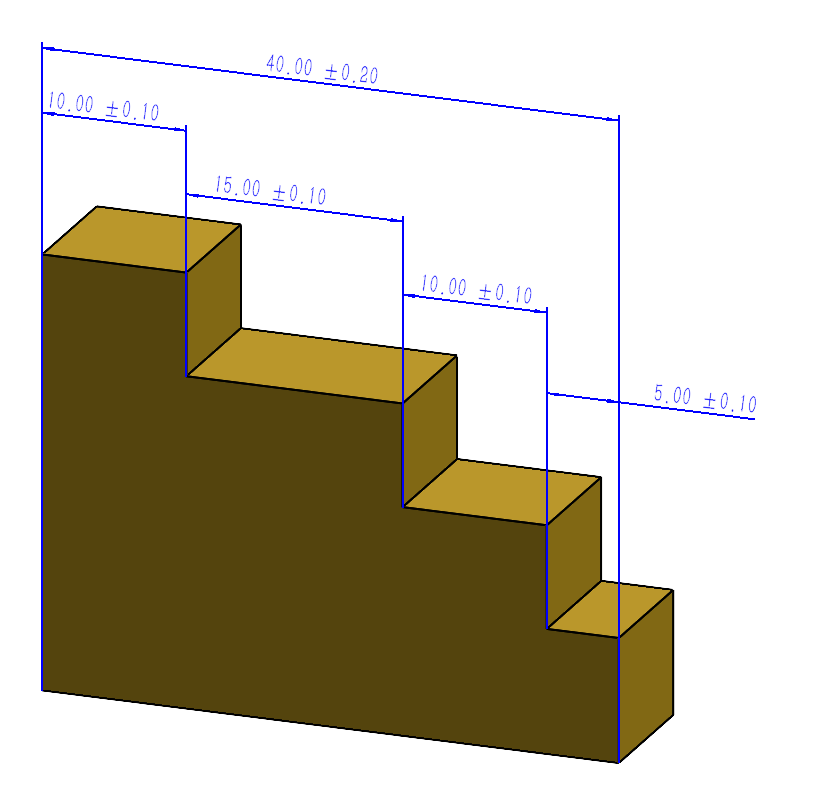
Dimensional tolerance refers to the allowable variation of a dimension, equal to the absolute difference between the maximum limit size and the minimum limit size. It can be divided into linear dimensional tolerance and angular dimensional tolerance.
Geometric tolerance includes form, orientation, location, and runout.
Form tolerance refers to the allowable variation of a single feature’s shape, including straightness, flatness, roundness, cylindricity, line profile, and surface profile.
Location tolerance refers to the allowable positional variation of related features with respect to a datum. It restricts the relative positional relationship between two or more points, lines, or surfaces, including concentricity/coaxiality, symmetry, and true position.
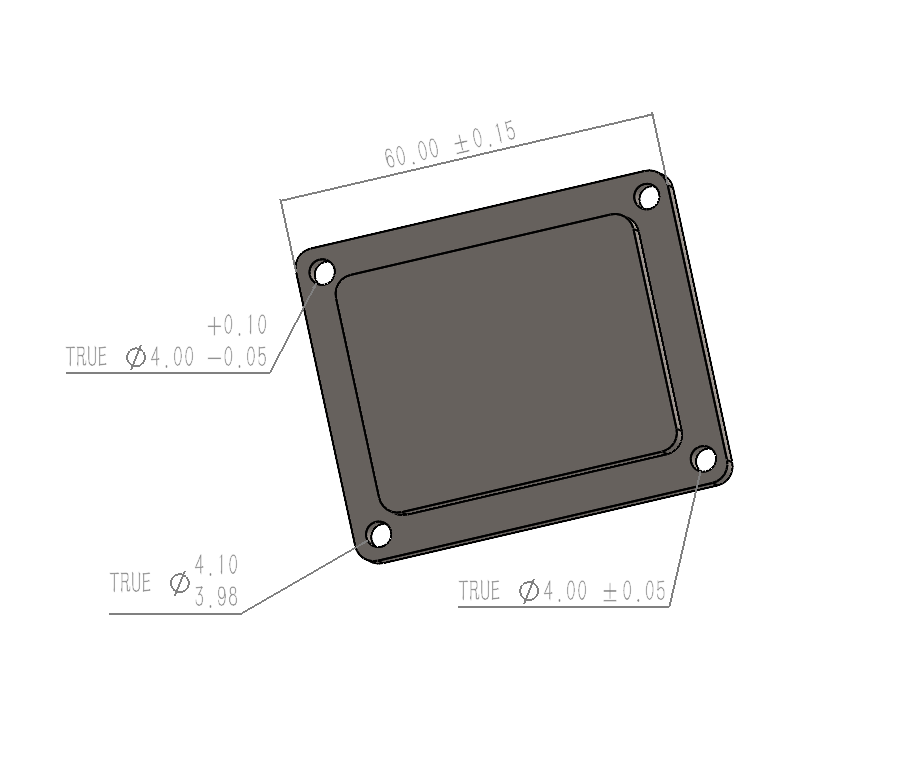
In CNC machining, holes are typically drilled with a standard tolerance of Φ4±0.1mm. If higher precision is required, reaming can be used, but this will increase both machining costs and lead time. Therefore, unless a hole requires special precision, it is generally not recommended to strictly control the tolerance for every dimension, in order to balance cost and delivery time.
Standardized Tolerances for CNC Machining
The standard prototyping and production tolerance at Horizon factories is ±0.1 mm. For metal parts, we typically follow ISO 2768-1:1989 at fine (f) grade, while for plastic parts we apply the medium (m) grade.
If higher precision is required, we can provide a standard precision machining tolerance of ±0.05 mm. For specific features, hole tolerances can be held to ±0.02 mm, and positional tolerances can be maintained within ±0.05 mm when features are located on the same side of a part.
In addition, depending on the geometry and material of the part, we can often achieve even tighter tolerances. If your design requires special tolerances, please clearly specify them on your drawings or models when uploading files for quotation.
The forms of dimensional tolerance notation
As shown in the figure above, we use three types of notation: Φ4±0.05 mm represents a bilateral symmetrical tolerance, Φ4+0.1/-0.05 mm represents a bilateral asymmetrical tolerance, and Φ4.1/Φ3.98 represents a limit tolerance.
All of the above notation methods are acceptable, but they must be clearly indicated on the design drawing. At the same time, attention should be paid to cumulative tolerance issues, and tolerances should be reasonably allocated across different stages to ensure that the final functional dimensions meet design requirements.
Surface Roughness Considerations under Machining Tolerances
In part machining, tolerances involve not only dimensions (length, width, hole diameter, etc.) but also surface roughness, which has a significant impact on a part’s functionality, assembly, and appearance. Under standard machining conditions, the surface roughness of flat and perpendicular surfaces is typically 63 µin (approximately 1.6 µm), while curved surfaces are 125 µin (approximately 3.2 µm) or better. This level is sufficient for most functional parts. Surface roughness directly affects friction, wear, sealing performance, and fatigue life. Functional surfaces usually require lower roughness to ensure reliable fit.
For aesthetic surfaces, especially on metal parts or consumer products, visual appearance and tactile quality can be improved through light bead blasting, fine shot peening, or polishing. During the design phase, roughness levels should be selected appropriately according to part function and appearance requirements, and clearly indicated on drawings (e.g., Ra, Rz, or µm). When necessary, the machining method or surface treatment process should also be specified. Additionally, the effect of surface roughness on dimensional accuracy, fit, and assembly must be considered, with cumulative tolerances allocated reasonably to ensure that the final assembly and performance meet design requirements.
From Prototype to Production
-
When you are in the prototype stage, our CNC machining can quickly deliver parts, helping you accelerate design validation and iteration.
-
When your project moves into volume production and demands tighter tolerances and higher quality, Horizon’s high-precision/large-quantity machining solutions are ready to meet those needs. We support advanced processes such as wire EDM and EDM drilling, and provide comprehensive quality inspection and complete documentation — including material certifications — to ensure consistency and reliability in every batch.
Latest Post

Liquid Silicone Rubber Molding: Process, Benefits, Applications, and Design Considerations
What is a 5-axis machine? The differences from 3-axis machines and their applications.
What Is a Tack Weld? Definition, Purpose, and Applications

How to Remove Burrs from CNC Machined Parts: Common Deburring Methods Explained