
Search Results: 116 items found
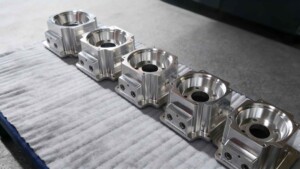
Why Rapid Manufacturing Outperforms Conventional Manufacturing?
In modern manufacturing systems, companies no longer pursue merely large-scale production; instead, they seek faster iteration, more flexible process options, and more reliable development workflows. While traditional manufacturing methods still dominate high-volume production, rapid manufacturing a...

A Comprehensive Guide to Aluminum Anodizing: Everything You Need to Know
Aluminum is widely used in industries such as mechanical manufacturing, electronic products, and architectural structures due to its low density, moderate strength, and excellent machinability. However, untreated aluminum surfaces still have certain limitations in terms of wear resistance and corros...

Vacuum Casting VS Injection Molding: How to Choose the Right Manufacturing Process from Prototype to Production
Process Overview: First Understand What Each Manufacturing Method DoesFrom a manufacturing strategy perspective, understanding these processes is the foundation for making informed decisions about cost and production scale.
In plastic part manufacturing, process selection often has a direct impact o...
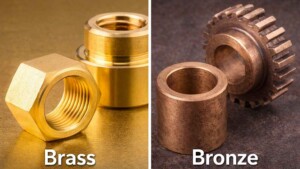
Brass VS Bronze: Which Material Is Better Suited for Your Part?
In industrial manufacturing and mechanical parts machining, the differences between brass and bronze are a key consideration during material selection. As two commonly used copper alloys, both brass and bronze are widely applied across various industries. Due to differences in their alloy compositio...
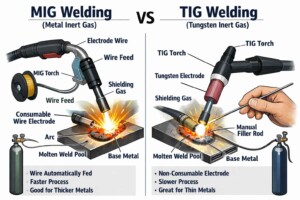
MIG Welding vs TIG Welding: Which Welding Technique Should You Choose?
MIG welding and TIG welding are two of the most commonly used arc welding processes in modern welding technology, and they are widely applied in metal fabrication, manufacturing, automotive, aerospace, and other industries. Although both belong to gas-shielded welding processes (GMAW and GTAW), they...
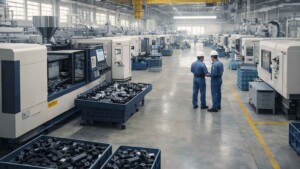
What is industrial-grade injection molding? A guide to design, materials, and mass production for engineers and OEMs.
Industrial injection molding is one of the most widely used manufacturing processes in modern industry. From automotive parts and medical devices to air conditioner housings and consumer electronics, injection molding enables the mass production of high-precision plastic parts while maintaining cons...
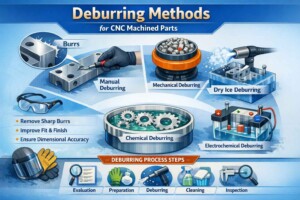
How to Remove Burrs from CNC Machined Parts: Common Deburring Methods Explained
During the CNC machining process, burrs are often formed on edges and hole openings after milling, drilling, turning, and other machining operations. These burrs not only affect the appearance and surface quality of parts, but also cause assembly difficulties. In some cases, they may even pose safet...
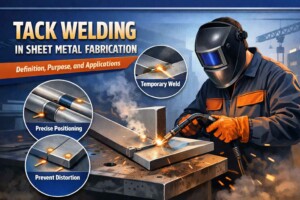
What Is a Tack Weld? Definition, Purpose, and Applications
In the field of sheet metal fabrication, when welding structural components, it is essential to ensure assembly accuracy and dimensional stability. Welding engineers often need to fix two components in position. Using fixtures for positioning not only increases cost but is also time-consuming.
As a ...
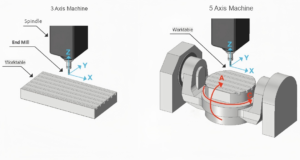
What is a 5-axis machine? The differences from 3-axis machines and their applications.
With the rapid advancement of the manufacturing industry, the structures of precision parts are becoming increasingly complex, leading to higher demands for machining accuracy and production efficiency. Relying solely on traditional 3-axis equipment has become challenging for many high-difficulty wo...
How does CNC milling deliver fast, precise parts?
CNC milling is a subtractive manufacturing process where computer-controlled cutting tools remove material from a solid block to create precise, repeatable parts for prototypes and production. It supports complex 3D geometries, tight tolerances, and a wide range of metals and plastics while offerin...