
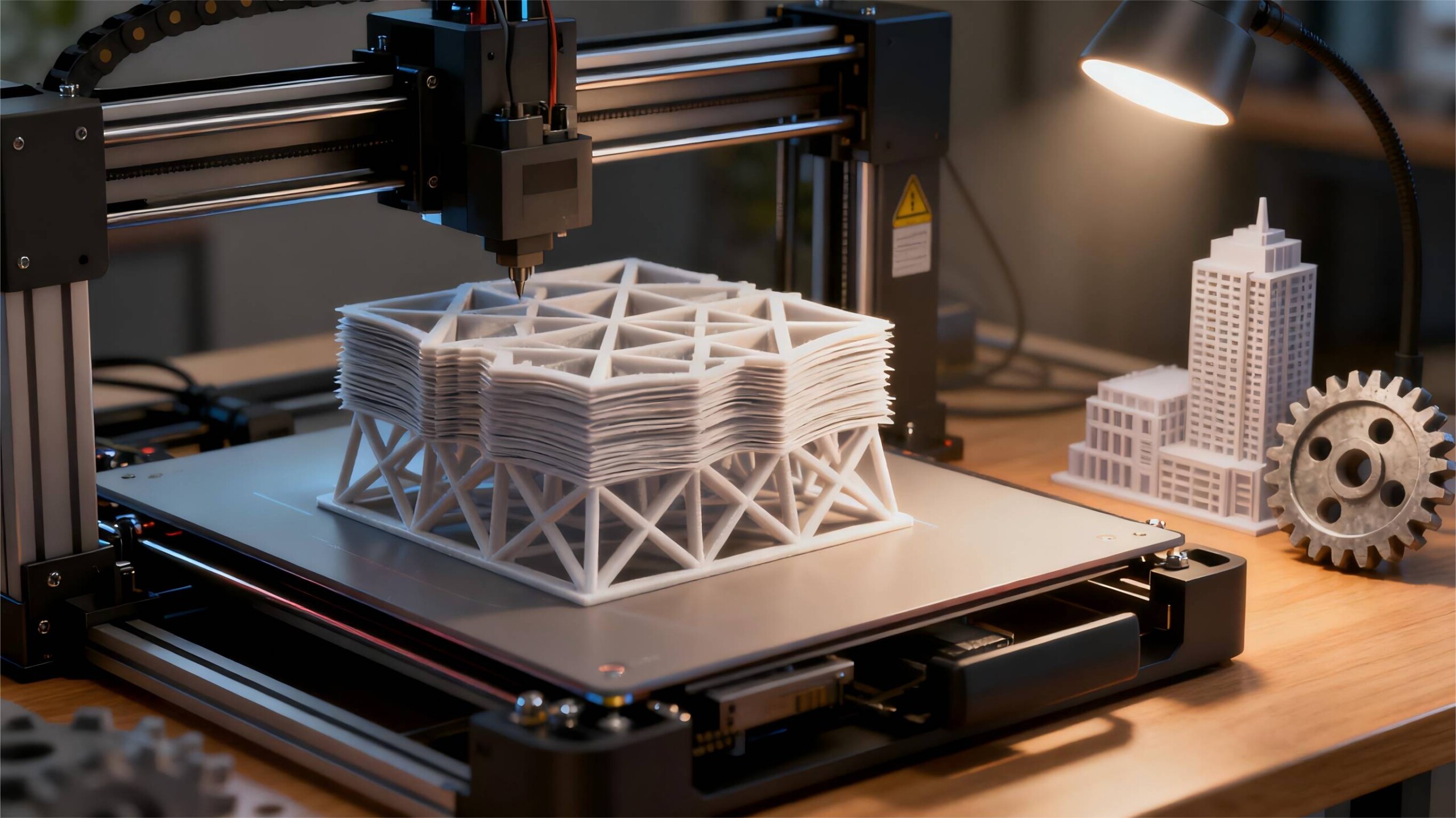
In recent years, 3D printing (Additive Manufacturing) has gradually moved from a niche maker community into the public eye: from product design and medical technology to classroom education and even home DIY, its presence can be seen everywhere. Not only are there multiple additive technologies, but a wide range of materials is also available.
So why are so many people beginning to choose 3D printing? What problems does it actually solve? And what value can it bring to you?
What is 3D printing?
3D printing is an additive manufacturing technology that builds objects layer by layer, similar to stacking building blocks. Compared with traditional subtractive methods such as milling or turning, it requires no molds or fixtures, produces very little material waste, and directly turns a digital model on a computer into a physical object.
Common additive manufacturing technologies include SLA, SLS, SLM, FDM, MJF, and others.

What are the advantages of 3D printing?
Compared with traditional CNC processes, 3D printing can complete manufacturing more efficiently and quickly. CNC machining requires multiple processes to finish a single part, including preparing fixtures and tools, as well as tuning tool paths. In contrast, 3D printing is an additive manufacturing process that builds models layer by layer. The different working methods directly result in differences in manufacturing efficiency.
The following are the main reasons why 3D printing is faster:
No need for molds or fixtures
3D printing requires no molds and no complex fixtures, whereas CNC machining often requires fixtures, tool path tuning, and even the creation of specialized jigs or clamps to hold complex parts.
No extra steps for complex structures
3D printing comes at almost “no cost” for complex shapes—the more intricate the model, the greater the advantage, and the main structure can be completed in a single print. In contrast, CNC machining of complex internal structures (such as curved surfaces or internal channels) often requires multiple processing steps and re-fixturing to complete.
Fast processing speed
3D printing requires no complicated programming, with slicing software preparing the job in minutes and the ability to print multiple parts simultaneously. In contrast, CNC machining requires material preparation, programming, and in some cases, parts must first undergo turning and then milling. 3D printing achieves higher manufacturing efficiency and takes less time.
Supports high customization
As more and more people pursue personalization, the value of 3D printing becomes particularly evident—3D printing seems tailor-made for single-piece production. You can adjust size, shape, and functionality at any time according to your needs, creating products fully customized for you. Whether it’s personalized gifts or decorations, custom automotive parts, or medical prosthetics, 3D printing can make it possible.
Cost saving
Compared with traditional injection molding, mold costs can run into tens of thousands or more, making it unsuitable for small batches. 3D printing requires no molds, allowing low-volume customization to remain relatively low-cost.
Complex structures
Traditional machining is limited by process constraints, but 3D printing offers nearly limitless freedom—hollow, chain-like, embedded structures, and bionic skeletons can all be easily realized. It can create complex structures that are difficult to achieve with traditional methods, which is why it is especially popular in professional fields such as aerospace and medical devices.
High design freedom
In the past, designers and artists, when creating exquisite artworks, also had to consider whether the shape could be manufactured. Now, you only need to think about “what you want it to look like.” 3D printing can realize it, allowing designers and artists to express their ideas more freely.

What materials are available for 3D printing?
3D printing offers a wide variety of material choices, each suitable for different applications. The most common include thermoplastics (such as PLA, ABS, PETG), ideal for rapid prototyping and desktop printing; photosensitive resin, which offers high precision and smooth surfaces, suitable for models and crafts; nylon and polycarbonate (PC), with high strength, wear resistance, and heat resistance, suitable for functional parts; metal powders (such as stainless steel, titanium alloy, aluminum alloy), used for industrial parts and high-strength applications; in addition, there are ceramics, composites, and flexible materials (TPU, TPE), meeting diverse needs from educational models and artistic creations to medical and aerospace applications. Learn more about 3D printing materials.

Can 3D printed parts be post-processed?
Absolutely. Post-processing is an important step after 3D printing to enhance the quality and functionality of the finished product, making it not only usable but also more visually appealing and professional. Common post-processing methods include:
- Sanding and polishing: Removing layer lines with sandpaper or polishing tools to achieve a smooth, glossy surface, especially suitable for PLA, ABS, or resin prints.
- Painting and coloring: Applying paint or dyes to the model to enhance visual effects and texture, making the piece more vibrant.
- Chemical smoothing: Treating ABS prints with chemicals like acetone to create a mirror-like smooth surface, ideal for display prototypes.
Through these post-processing techniques, your 3D printed creations become more durable and can achieve a professional, high-quality finish. Whether for prototype design, educational models, or creative crafts, post-processing makes your work stand out. Contact us to learn more.
Who is 3D printing suitable for?
With the continuous development of 3D printing technology, not only have industrial-grade machines emerged, but there are also an increasing number of desktop printers available, along with a wide variety of materials. It is ideal for designers to create prototypes and perform structural testing, for engineers to manufacture jigs or replacement parts; in education, it can help students understand engineering and art concepts through intuitive models; in the medical field, it can be used for customized applications such as simulated bones and prosthetics.
Why choose Horizon for 3D printing?
Choosing Horizon for 3D printing gives you access to a wide range of materials and the support of years of printing experience. Whether it’s plastics, resins, metals, or functional composite materials, we can meet a variety of needs. At the same time, Horizon offers professional structural optimization services, ensuring each printed part achieves the best performance in strength, weight, and precision, making every step from prototype design to functional components efficient and reliable.
Want to learn more or start your 3D printing project? Contact us, and Horizon’s professional team will provide full support and customized solutions.
Latest Post
Liquid Silicone Rubber Molding: Process, Benefits, Applications, and Design Considerations
What is a 5-axis machine? The differences from 3-axis machines and their applications.
What Is a Tack Weld? Definition, Purpose, and Applications
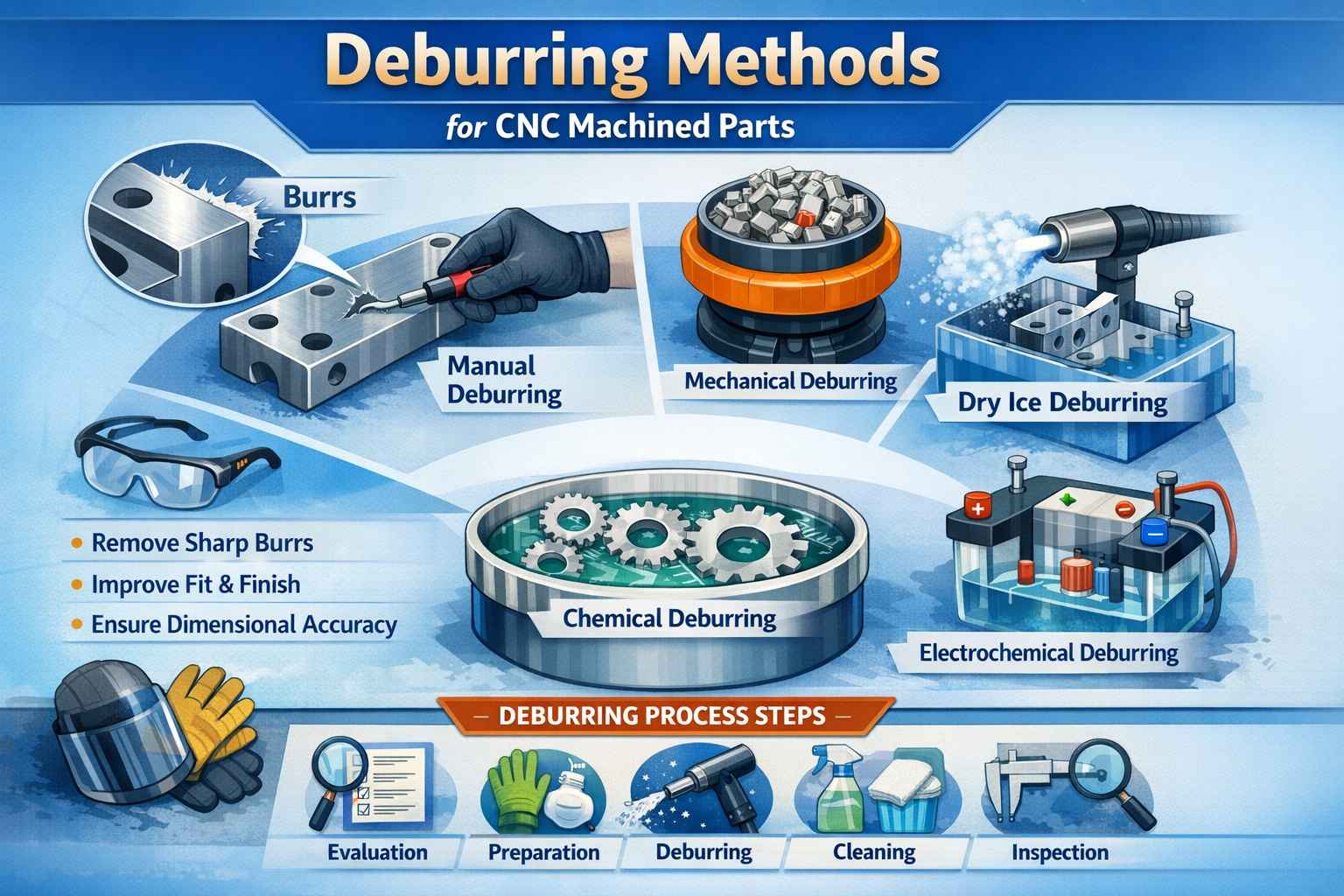
How to Remove Burrs from CNC Machined Parts: Common Deburring Methods Explained