
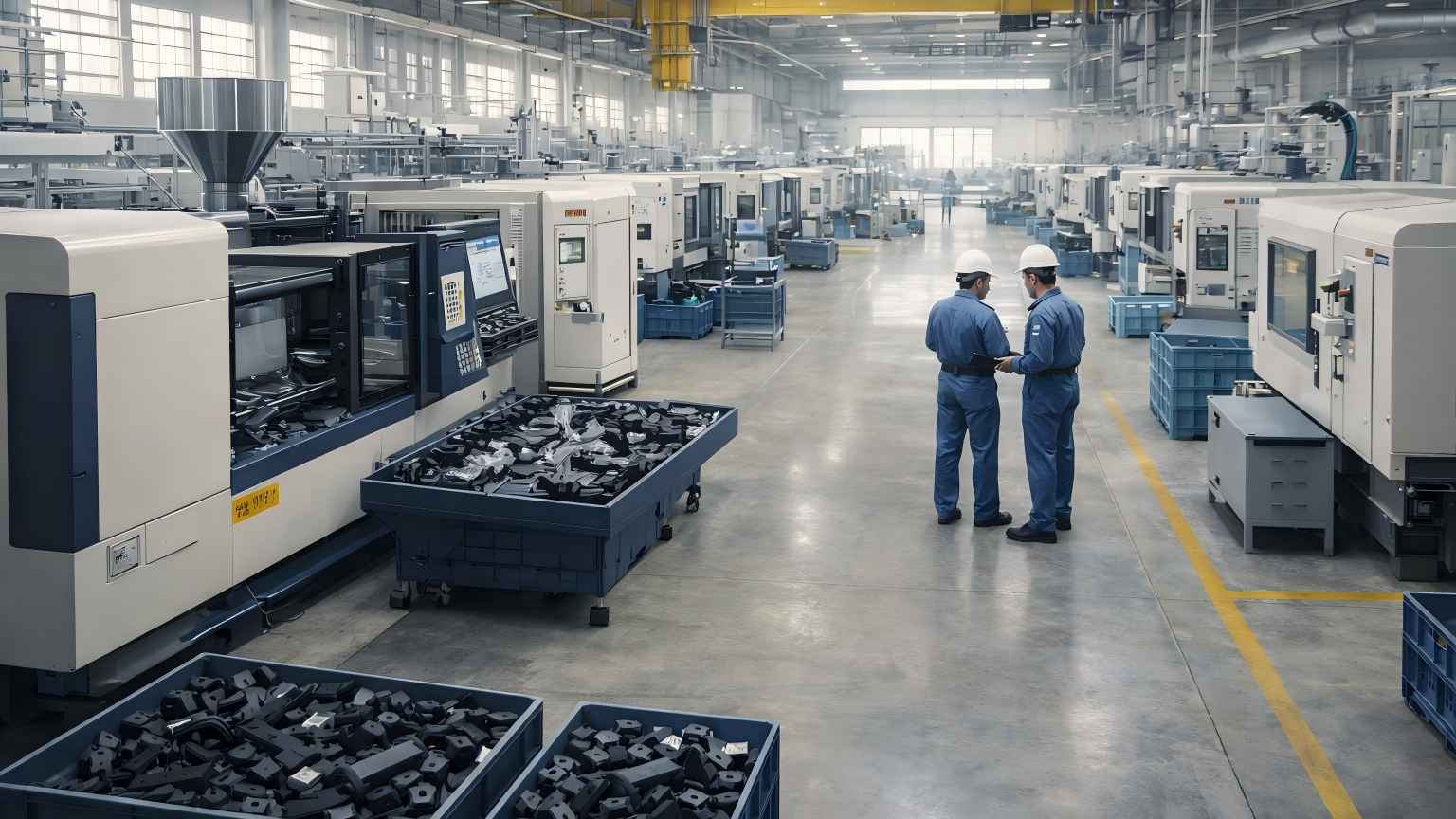
- What is industrial injection molding?
- Industrial Injection Molding Working Principles
- Common Injection Molding Materials
- Industrial-Grade Injection Molding Tolerances and Quality Control
- Balancing Tolerance Control and Design Complexity
- Injection Molding Compared to Other Manufacturing Processes
- In which fields is industrial-grade injection molding used?
- Differentiated Requirements Across Different Industries
- Cost Considerations
- Mold Cost and ROI Analysis
- From Rapid Prototyping to Mass Production
- Injection Molding Solutions for Different Production Scales
- DFM in Industrial Injection Molding
- Mold Lifecycle and Maintenance
- Industrial Injection Molding for Low-Volume and Bridge Production
- Sustainable Development and Environmental Protection
- Common Injection Molding Defects and Solutions
- FAQs
- Industrial Injection Molding in Modern On-Demand Manufacturing
- Conclusion
- Why Choose Horizon as Your Injection Molding Partner
Industrial injection molding is one of the most widely used manufacturing processes in modern industry. From automotive parts and medical devices to air conditioner housings and consumer electronics, injection molding enables the mass production of high-precision plastic parts while maintaining consistent quality and minimizing costs.
For OEMs, product designers, and procurement teams, understanding how industrial injection molding works and when to choose it over CNC machining, sheet metal fabrication, or 3D printing is crucial for making cost-effective decisions.
This guide will systematically introduce industrial injection molding from an engineering perspective, covering process flow, material selection, molds and tooling, tolerance control, cost structure, application scenarios, and its role in modern on-demand manufacturing systems.
What is industrial injection molding?
Industrial-grade injection molding is a manufacturing process used for the mass production of plastic parts. The principle involves injecting molten thermoplastic material into a precisely designed mold. Once the material cools and solidifies, the mold opens and the finished part is ejected.
Unlike prototype or small-batch injection molding, industrial injection molding must meet the following requirements:
- Long-term, large-scale production
- Strict dimensional tolerance control
- Stable and predictable material properties
- Highly automated and repeatable production process
Due to its high reliability, good mechanical strength, and excellent scalability, industrial-grade injection molding is widely used in industries with extremely high demands for quality and consistency, such as automotive manufacturing, medical devices, industrial equipment, and electronic products.

Industrial Injection Molding Working Principles
Mold Design and Tooling
In industrial injection molding, the mold is the core component. Industrial injection molds are typically made of hardened steel or pre-hardened tool steel, capable of withstanding hundreds of thousands, or even millions, of molding cycles.
Common mold steel types include:
- P20 steel: Suitable for medium-volume production
- H13 steel: Suitable for high-temperature environments and ultra-long mold life
- Hardened stainless steel: Commonly used in medical and cleanroom applications
Mold design requires careful consideration of the following factors:
- Part structure and draft angle
- Gate location and runner design
- Cooling channel layout
- Ejection system design
High-quality mold design directly impacts part quality, molding cycle time, and long-term manufacturing costs.
Injection Molding Process Flow
Industrial-grade injection molding typically involves the following controlled steps:
Plastic Melting: Thermoplastic granules are heated to a molten state using heating rods.
Injection Molding: The molten plastic is injected into the mold cavity under high pressure.
Cooling and Solidification: The plastic cools and solidifies in the mold.
Ejection and Demolding: After the product cools, the parts are automatically ejected by ejector pins.
Gate Removal: The runner connecting the product is manually removed, and the gate area is trimmed.
Common Injection Molding Materials
Material selection is a critical factor in industrial-grade injection molding. Commonly used thermoplastic materials include:
- ABS: Good impact resistance and surface quality
- Polycarbonate: High strength and excellent heat resistance
- Nylon: Excellent mechanical strength and wear resistance
- POM: Low coefficient of friction and good dimensional stability
- Polypropylene: Good chemical resistance and flexibility
For demanding applications, high-performance engineering plastics such as PEEK, PPS, and PEI are also used, widely applied in aerospace, medical, and industrial fields.
Injection Molding Material Selection
When selecting injection molding materials, the following factors should be considered:
- Mechanical strength requirements
- Operating temperature environment
- Exposure to chemical media
- Electrical insulation performance
- Regulatory and certification requirements
- Cost
Proper material selection is essential to ensure the long-term performance and reliability of injection-molded parts.

Industrial-Grade Injection Molding Tolerances and Quality Control
Industrial-grade injection molding can achieve high dimensional accuracy, with typical tolerance ranges from ±0.05 mm to ±0.1 mm, depending on the material, part geometry, and mold design.
Quality control methods include:
- First article inspection(FAI)
- In-process monitoring
- Coordinate measuring machine (CMM) dimensional inspection
- Visual and surface quality inspection
In industrial and medical fields, product consistency is often more important than individual dimensional tolerances.
Balancing Tolerance Control and Design Complexity
In industrial-grade injection molding, achieving tight tolerances requires a balance between design complexity, material properties, and mold structure. Different thermoplastic materials have varying shrinkage rates, which must be accurately compensated for during the mold design phase. Complex geometries, significant variations in thickness, or large parts can easily lead to dimensional fluctuations if not designed properly.
In high-precision industrial applications, it is recommended to define tolerances as functional tolerances rather than purely aesthetic targets. Overly strict tolerance requirements increase mold complexity and cost without necessarily improving part performance.
OEMs typically collaborate closely with manufacturers possessing extensive injection molding experience during product development to identify critical dimensions and optimize the structure during the design phase. This ensures that the product meets functional and performance requirements while also improving its manufacturability.
Injection Molding Compared to Other Manufacturing Processes
When choosing the appropriate manufacturing process, engineers and OEMs often need to weigh factors such as cost, production volume, design flexibility, and lead time. Different manufacturing processes have their own advantages in different applications, and there is no single, universally optimal solution.
Understanding the differences between injection molding and other mainstream manufacturing processes helps in making more cost-effective and engineering-sound decisions at different stages of product development. Below, we compare injection molding with CNC machining and 3D printing, highlighting the core differences in mass production capabilities, cost structure, and design flexibility.
Injection Molding vs CNC Machining
|
|
|
|
|---|---|---|
|
|
|
|
|
|
|
|
|
|
High upfront |
|
|
|
|
|
|
|
|
|
|
|
|
|
|
|
High |
|
|
|
|
|
|
|
|
|
|
|
|
|
Injection molding is ideal for large-scale production, while CNC machining is better suited for prototyping and low-volume manufacturing.
Injection Molding vs 3D Printing
|
|
|
|
|---|---|---|
|
|
|
|
|
|
|
|
|
|
|
|
|
|
|
|
|
|
High |
|
|
|
|
|
| Dimensional stability |
|
|
| Surface quality |
|
|
|
|
|
|
|
|
|
|
|
|
|
Prototyping / validation |
3D printing is best suited for rapid prototyping and design validation, while injection molding offers clear advantages in mass production.
In which fields is industrial-grade injection molding used?
Industrial-grade injection molding is widely used in various industries, including:
- Automotive interior and engine compartment components
- Industrial equipment housings and protective covers
- Medical device components
- Electrical connectors and control enclosures
- Consumer electronics housings
Its advantages in complex structures and high consistency make it an indispensable process in modern manufacturing.
Differentiated Requirements Across Different Industries
Different industries have varying technical requirements for injection molded parts:
- Automotive industry: Vibration resistance, temperature resistance, long service life
- Medical industry: Regulatory compliance, traceability, biocompatibility
- Industrial equipment: High mechanical strength, chemical resistance, dimensional stability
Understanding these differences helps us customize materials, processes, and quality systems for different applications.
Cost Considerations
Although injection molding molds have high initial investment costs, injection molding offers significant cost advantages in high-volume production.
Key cost factors include:
- Mold complexity
- Material selection
- Part size and wall thickness
- Annual production volume
- Post-processing steps
Under medium to high production volumes, injection molding typically achieves the lowest per-unit cost.
Mold Cost and ROI Analysis
Mold cost is typically the largest upfront investment in industrial injection molding, encompassing mold design, material selection, machining, heat treatment, testing, and validation.
From an ROI perspective, the unit cost of injection molding decreases rapidly as production volume increases. Many projects achieve cost-effectiveness at production volumes ranging from a few thousand to hundreds of thousands of units.
When evaluating mold investments, OEMs should not only focus on the initial cost but also consider mold lifespan, molding cycle time, maintenance requirements, and annual demand. High-durability molds often offer greater value in the long run.
From Rapid Prototyping to Mass Production
In modern manufacturing, industrial-grade injection molding is no longer the sole manufacturing option. During product development and mass production, engineering teams typically employ a combination of manufacturing processes to balance speed, cost, and risk control.
Common combination strategies include:
- CNC machining or 3D printing: Used for prototype development and design verification
- Bridge tooling: Used for small-batch trial production and process validation
- Industrial-grade injection molding: Used for formal mass production and large-scale delivery
This combined approach not only shortens product delivery cycles but also effectively verifies designs and processes before investing in high-cost mass production molds, significantly reducing upfront investment risks. This phased manufacturing strategy, from prototyping to mass production, has become the mainstream approach for OEMs to control costs and accelerate product time-to-market.
Injection Molding Solutions for Different Production Scales
DFM in Industrial Injection Molding
Key DFM considerations include:
- Wall thickness consistency: Avoids shrinkage, warping, and internal stress, and prevents molding difficulties due to excessively thin sections.
- Draft angle: Typically 1°–3°.
- Undercuts and side cores: Should be used cautiously to control costs.
- Ribs and bosses: Enhance strength while avoiding defects.
Detailed DFM collaboration can reduce revisions, shorten lead times, and improve product yield.
Mold Lifecycle and Maintenance
Mold lifespan reference:
- Aluminum molds: 5,000–50,000 cycles
- P20 steel molds: 100,000–500,000 cycles
- Hardened steel molds: 1,000,000 cycles or more
Regular maintenance can significantly extend mold life and reduce downtime risks.
Industrial Injection Molding for Low-Volume and Bridge Production
Injection molding is no longer limited to mass production. Transitional molds can be used for:
- Validate production-ready designs
- Produce functional parts for market testing
- Reduce risk before committing to high-volume tooling
This approach is especially valuable for startups and product teams transitioning from rapid prototyping to full-scale manufacturing.
Sustainable Development and Environmental Protection
Sustainability is becoming increasingly important in industrial injection molding.
Key initiatives include:
- Use of recyclable thermoplastics
- Regrind and material reuse
- Energy-efficient molding machines
- Lightweight part design to reduce material consumption
Manufacturers that prioritize sustainable practices can help OEMs meet ESG goals without compromising performance.
Common Injection Molding Defects and Solutions
Common injection molding defects are often caused by design issues, improper material flow, or insufficient process control. Understanding these defects helps manufacturers and engineers improve part quality, reduce scrap rates, and optimize process stability.
|
|
|
|
|---|---|---|
|
Sink marks |
|
|
|
|
|
|
|
|
|
|
|
|
|
|
|
|
|
|
|
|
|
|
Proactive design and process optimization significantly reduce defect rates.
FAQs
What production volume justifies industrial injection molding?
Injection molding typically becomes cost-effective at volumes above several thousand units, depending on part complexity and material.
How long does mold development take?
Mold development usually takes 3–8 weeks, depending on complexity and revisions.
Can injection molding handle complex geometries?
Yes. With proper mold design and tooling strategies, injection molding can produce highly complex parts with excellent repeatability.
Is injection molding suitable for tight tolerances?
Yes. Industrial injection molding routinely achieves tolerances of ±0.05–0.1 mm.
Industrial Injection Molding in Modern On-Demand Manufacturing
As manufacturing becomes more flexible and demand-driven, industrial injection molding is increasingly integrated into on-demand manufacturing models, allowing OEMs to move away from long-term contracts and large upfront commitments.
- Order production when needed
- Scale volumes dynamically
- Combine CNC machining, sheet metal fabrication, and injection molding under one supplier
This flexibility reduces risk and accelerates product launches.
Conclusion
Industrial injection molding remains one of the most reliable and efficient manufacturing processes for producing plastic components at scale. When combined with modern on-demand manufacturing services, it enables companies to reduce costs, accelerate time-to-market, and maintain consistent product quality.
Why Choose Horizon as Your Injection Molding Partner
In industrial injection molding projects, selecting the right manufacturing partner impacts not only product cost, but also product quality, delivery reliability, and overall project risk. For OEMs, a partner with strong engineering capabilities and scalable production capacity is especially critical.
Engineering Support:Horizon is supported by an experienced engineering team that provides DFM analysis at the early stages of each project. By helping OEMs optimize part geometry, material selection, and tolerance definitions, understanding injection molding design techniques helps reduce production risks. Engineering support extends throughout the entire process—from prototype validation to mass production.
Engineering Support:Horizon is supported by an experienced engineering team that provides DFM analysis at the early stages of each project. By helping OEMs optimize part geometry, material selection, and tolerance definitions, Horizon reduces tooling complexity and minimizes production risks from the outset. Engineering support extends throughout the entire process—from prototype validation to mass production.
Scalable Production Capacity:Horizon’s manufacturing system supports flexible scaling from low-volume pilot runs to high-volume mass production. As customer demand grows, capacity can be rapidly expanded without compromising quality or lead time, providing OEMs with long-term, stable manufacturing support.
Latest Post
Liquid Silicone Rubber Molding: Process, Benefits, Applications, and Design Considerations
What is a 5-axis machine? The differences from 3-axis machines and their applications.
What Is a Tack Weld? Definition, Purpose, and Applications
How to Remove Burrs from CNC Machined Parts: Common Deburring Methods Explained