
In the field of sheet metal fabrication, when welding structural components, it is essential to ensure assembly accuracy and dimensional stability. Welding engineers often need to fix two components in position. Using fixtures for positioning not only increases cost but is also time-consuming.
As a result, welding engineers commonly use tack welding, a transitional welding method that temporarily fixes workpieces in the correct position before final welding. Tack welding serves as a critical quality control step that connects assembly and final welding. This article introduces the definition, purpose, and applications of tack welding.

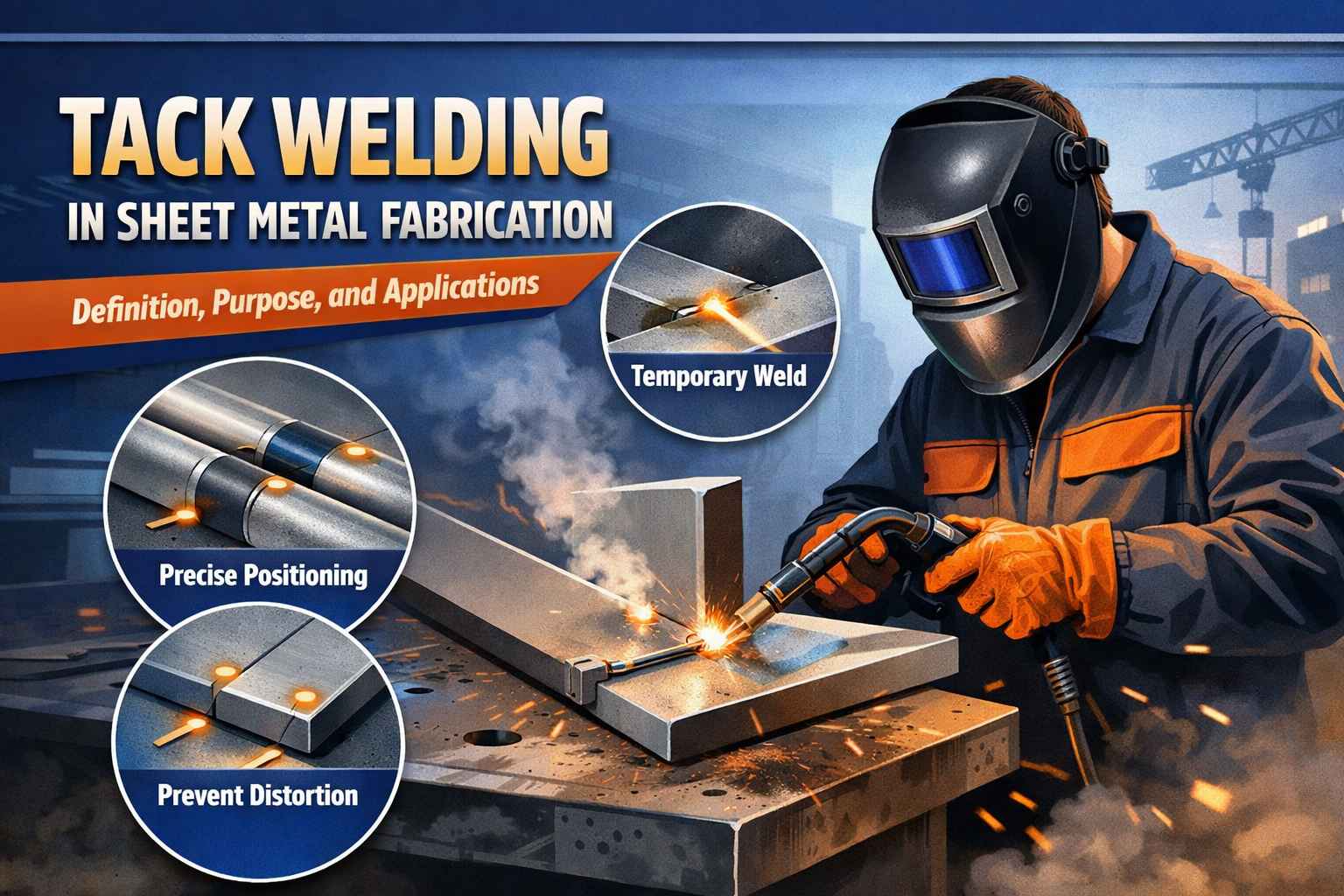
What Is a Tack Weld?
Tack welding (also known as temporary welds) is a welding method in which workpieces are welded at predetermined locations during fabrication or assembly. For example, when welding large enclosures, frames, or other structural components, tack welding is required to hold parts in position. During the welding process, preset positioning marks are used to ensure the accuracy of weld seams and joint locations.
Tack welding allows workpieces to be positioned without the use of fixtures. Typically, tack welds are short weld beads. In any structure, multiple tack welds are applied at specified intervals to hold two components together. The advantage of these temporary welds is that if misalignment is found before final welding, the parts can be easily separated, reassembled, and tack welded again.

Why Is Tack Welding Important?
During the welding process, tack welding is used as an auxiliary method to temporarily secure components. Due to its temporary nature, it may give the false impression that the quality of these auxiliary welds is less important than that of the final welds. In reality, the primary purpose of tack welding is to ensure the quality of the final weld.
Tack welding is real welding. Although tack welds are independent and short in length, they perform the following critical functions:
- Secure assembled components in the correct position and ensure proper alignment.
- Serve as temporary fixtures that can be removed if necessary.
- Control and resist deformation during the welding process.
- Maintain the required root gap between joint surfaces, which is a critical dimension that must be strictly controlled during pre-weld assembly.
- Provide sufficient mechanical strength to support the weight of components during temporary movement or rotation.
Common Applications of Tack Welds
Tack welding is a temporary welding process used before final welding to assemble and fix the position of welded joints. It is widely applied in the manufacturing and installation of various metal structures.
Assembly and positioning: When welding large or complex structures such as pipelines, vessels, frames, ships, and bridges, tack welding is used to precisely align and temporarily secure components according to design requirements. This ensures correct relative positioning and joint gaps during subsequent final welding.
Acting as fixtures: When flexibility is required across different welding scenarios, multiple dedicated fixtures may be needed, resulting in high tooling costs. Tack welding serves as a temporary fixing method that effectively reduces tooling costs while saving time.
Deformation control: Proper placement of tack welds helps prevent overall workpiece deformation caused by shrinkage stress during welding, while maintaining dimensional accuracy.
Maintaining groove gaps: In pipe butt welding, tack welding ensures consistent root gaps, providing a reliable foundation for full penetration and high-quality final welds.
Safety and convenience: During welding operations, when components need to be moved, lifted, or rotated, tack welds create temporary fixed connections between parts. These connections provide sufficient mechanical strength to support the component’s own weight, ensuring operational safety and preventing accidents caused by loosening during lifting or rotation.
Although tack welding is a temporary process, its quality directly affects the performance of the final weld. Therefore, it must be performed by qualified welders in accordance with established welding standards and procedures.
Tack Weld vs Final Weld
In the field of welding, spot welding and final welding are two different concepts.

Spot welding is a welding process in which a high electric current is applied at the contact point when the electrodes clamp together, generating heat that raises the material to its melting point and fuses the two components.

Final welding refers to a welding stage in which two structural components are permanently joined with full-strength welds. It is a welding operation rather than a specific welding method.
|
|
|
|
|---|---|---|
|
|
|
|
|
|
|
|
|
|
|
|
|
|
|
|
|
|
|
|
|
|
|
|
Differences Between Spot Welding and Tack Welding
In common sheet metal fabrication, structural components, and assembly welding processes, spot welding and tack welding differ in welding purpose, process characteristics, and function in the following aspects:
Welding Purpose
- Spot welding is typically used for thin sheet metal. The welds are point-shaped, welding speed is fast, no filler metal is required, and the finished appearance is clean with minimal deformation. Post-weld grinding is generally not required.
- Tack welding is a preparatory operation whose purpose is to temporarily fix workpieces in the correct position before final welding, preventing deformation or misalignment and ensuring welding accuracy.
Welding Nature
- Spot welding is a final welding method that directly joins two components
- Tack welding, unlike spot welding, is a temporary weld performed for positioning and fixation prior to final welding.
Load-Bearing Capacity
- Spot welds are final welds that bear the primary service loads.
- Tack welds serve mainly as bridging or positioning welds and do not carry primary structural loads.
Welding Method
-
Spot welding is a type of resistance welding process.
-
Tack welding is a preparatory step performed before final welding.
Weld Appearance
-
Spot welds form clean, discrete point-shaped welds with an overall neat appearance.
-
Tack welds may form raised beads that are less aesthetically pleasing and often require removal or grinding after welding.
Strength of Spot Welds and Tack Welds
Spot welds are final load-bearing welds. The weld spots themselves are required to withstand external forces over long-term service. When sheet metal parts have a large surface area, multiple spot welds are applied at different locations to ensure the overall stability of the structure.
In contrast, tack welds are temporary or auxiliary welds. Their primary function is to fix the position of components so they can be rotated or handled during assembly. The structural strength is ultimately provided by the final welds. Tack welds are typically covered by subsequent full welds or removed after final welding.
Can Tack Welds Be Removed?
Whether tack welds should be removed depends on several factors, including whether the tack welds are used only for temporary fixation or for preventing deformation and maintaining alignment, the quality of the tack welds themselves, and whether they may affect the formation quality and defect risk of subsequent final welding.
If tack welds are used only for temporary fixation during assembly and the joint will be fully penetrated and properly fused during final welding—so that the final structural strength is mainly provided by the final weld—tack welds can generally be retained. When the final weld fully covers and properly fuses with the tack welds, separate removal is usually not required. However, if tack welds are excessively raised and affect part fit-up, appearance, or may cause local stress concentration, grinding should be performed.
If tack welds are mispositioned and result in difficulty maintaining assembly dimensions, or interfere with torch access, weld continuity, or weld bead formation, the tack welds should be removed and reapplied.
If tack welds serve to prevent deformation and maintain the relative position of components during assembly, removing them may cause misalignment or elastic springback. In such cases, tack welds should not be removed arbitrarily. If removal is necessary, fixtures or other temporary fixing measures should be applied first before removal or adjustment.
For tack welds that exhibit quality issues such as cracks, lack of fusion, slag inclusions, porosity, or severe surface contamination, removal should be prioritized to prevent defects from being introduced into the final weld, which could later lead to cracking. After removing tack welds, care should be taken to avoid excessive grinding that may thin the base material, and required inspections should be conducted in accordance with process requirements.
Applications of Spot Welding and Tack Welding
Spot welding and tack welding play different roles in welding production, and their application focus differs accordingly.
Overall, spot welding emphasizes final joint strength and load-bearing reliability, while tack welding focuses on assembly stability and welding feasibility. In many products, the two are used together to ensure assembly accuracy, welding quality, and overall structural performance.
Conclusion
Spot welding and tack welding serve different but complementary roles in welding production. Spot welding is a final joining method that becomes part of the structure and must provide long-term strength and load-bearing capability. Tack welding is a temporary, auxiliary process used to position parts, prevent deformation, and ensure smooth final welding, with its strength ultimately determined by the final welds. In practice, the two are often used together: tack welding ensures assembly stability and weld feasibility, while spot welding or other final welds deliver the required structural integrity, together ensuring product quality and manufacturing efficiency.
Latest Post
Liquid Silicone Rubber Molding: Process, Benefits, Applications, and Design Considerations
What is a 5-axis machine? The differences from 3-axis machines and their applications.
What Is a Tack Weld? Definition, Purpose, and Applications
How to Remove Burrs from CNC Machined Parts: Common Deburring Methods Explained