
With the rapid advancement of the manufacturing industry, the structures of precision parts are becoming increasingly complex, leading to higher demands for machining accuracy and production efficiency. Relying solely on traditional 3-axis equipment has become challenging for many high-difficulty workpieces and high-efficiency scenarios. Consequently, more companies are adopting high-end machining technologies, among which 5-axis CNC machining is emerging as a critical development trend.
However, for many engineers and technicians, questions remain: How does a 5-axis machine actually work? What does each axis represent? What are the different structural configurations? And compared to the more common 3-axis machines, what are the key differences in terms of capability, cost, and application?
This article will systematically explore these questions, covering the basic concepts, axis definitions, structural forms, pros and cons, and industry applications of 5-axis machining to help you gain a comprehensive understanding of this advanced technology.
What is a 5-Axis Machine?
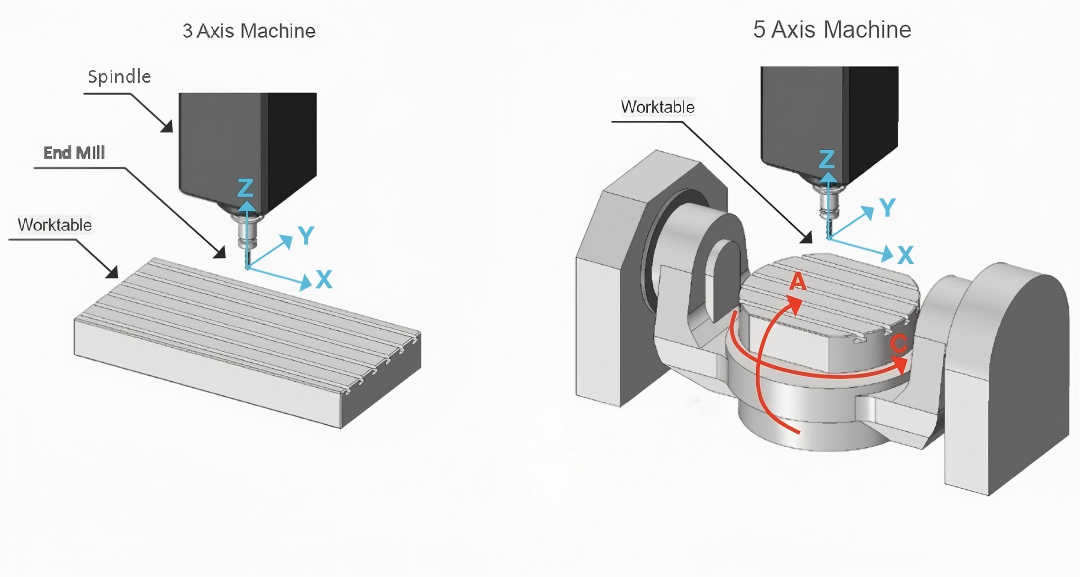
While a 3-axis machine performs cutting by moving along the X, Y, and Z linear axes, a 5-axis machine adds two rotational axes (typically the A, B, or C axes) to this foundation. This allows the cutting tool or the workpiece to tilt and rotate, enabling machining from multiple angles and the creation of highly complex geometric shapes.
Before discussing 5-axis machining in detail, it is essential to clarify a fundamental concept: What exactly is an “axis” in a CNC machine?
CNC (Computer Numerical Control) machining refers to the process where a computer directs the movement and cutting actions of a tool. The “axis” mentioned here can be understood as the controllable direction of movement or the degree of freedom —essentially, the specific directions in which the tool is capable of moving.
5-Axis vs 3-Axis
In the field of CNC machining, 3-axis machines are the most common equipment, while 5-axis machines represent a superior level of processing capability. When selecting equipment, many companies ask: What exactly are the advantages of a 5-axis machine compared to a 3-axis one? The following table provides a clear comparison:
| Comparison Category | 3-Axis Machine | 5-Axis Machine |
|---|---|---|
| Movement Axes | Three linear axes (X, Y, Z) | Three linear axes (X, Y, Z) 、 Two rotational axes (A/B/C) |
| Machinable Structures | Flat surfaces, simple cavities, standard holes, and slots | Complex curved surfaces, angled holes, deep cavities, and multi-sided composite structures |
| Fixturing / Setup | Multiple setups and manual repositioning required | “Single-setup” machining for multiple faces via simultaneous linkage |
| Dimensional & Geometric Accuracy | Prone to cumulative errors due to frequent re-clamping | Highly stable and reliable precision across all faces due to minimal setups |
| Surface Quality | Limited tool angles result in poor surface finish on curves; requires manual polishing | Optimal cutting angles result in significantly higher surface finish and smoothness |
| Machining Efficiency | Multiple processes for complex parts lead to longer lead times | Ability to machine multiple faces in one go significantly shortens cycle times |
| Equipment Investment | Lower initial investment | Higher initial cost, but offers better long-term cost-efficiency for complex parts |
What Are the Different Axes of a 5-Axis Machine?
To truly understand how 5-axis machining works, one must first understand how the tool moves along each “axis.” As previously mentioned, “5-axis” refers to five independent degrees of freedom of tool movement that can be controlled. For ease of description and programming, these directions are typically identified by specific letters.。
An important foundational concept to remember:
- 4-Axis Machine = 3-Axis (X, Y, Z) + 1 additional rotational axis
- 5-Axis Machine = 3-Axis (X, Y, Z) + 2 additional rotational axes (the 4th and 5th axes)
In 5-axis CNC machining, the following axes are generally involved:
- X-axis: Linear movement from left to right.
- Y-axis: Linear movement forward and backward (or up and down, depending on the machine configuration).
- Z-axis: Movement along the spindle direction (approaching or retracting from the workpiece).
- A-axis: Rotation around the X-axis.
- B-axis: Rotation around the Y-axis.
Some machine models are also equipped with a third rotational axis, the C-axis, which rotates around the Z-axis. This is used either in place of or in coordination with the A and B axes.
While traditional 3-axis machining only involves the three linear axes (X, Y, Z), 5-axis machining integrates two additional rotational degrees of freedom. This allows the cutting tool to access the workpiece from many more angles, enabling the machining of complex curved surfaces and integrated multi-sided parts.
Different Types of 5-Axis CNC Machines
A 5-axis CNC machine is not limited to a single structural design. Instead, various typical configurations have been developed based on the position and movement of the rotational axes. Different types are optimized for specific part sizes, levels of complexity, and industrial applications. Below are several common structural configurations of 5-axis machines:
Swivel Head and Rotary Table Configuration
5-axis machines with this configuration are widely used in the production of molds, precision parts, and complex structural components, as they offer an excellent balance between flexibility and machining capacity. This setup is particularly well-suited for machining multi-sided, multi-angle parts, and complex curved surfaces.
Dual Rotary Table Configuration
In certain horizontal machining centers, a dual rotary table configuration is employed. The main table provides one rotational axis, allowing the entire workpiece to rotate. A second rotary table, equipped with tilting or swiveling capabilities, is then mounted onto the main table to provide the second rotational axis.
This structure is particularly ideal for parts requiring multi-sided machining in a single setup. It effectively reduces the number of re-clamping operations, thereby enhancing dimensional consistency and overall production efficiency.
Trunnion-Style Configuration
The Trunnion-style 5-axis machine is also commonly referred to as the rotary table type. In this configuration, both rotational axes are integrated into the trunnion table unit. The workpiece is secured to the table and moves—both rotating and swiveling—along with it. Thanks to its superior rigidity, the trunnion table is ideal for machining small to medium-sized complex parts. This design is considered one of the workhorse models in the world of 5-axis machining.
Dual-Pivot Spindle Head Configuration
The Dual-Pivot Spindle Head configuration is also known as a dual rotary head, articulated head, or Head-Head structure. In this type of machine, both rotational axes are integrated within the spindle head. The worktable typically remains stationary or only moves along linear paths, while the workpiece is firmly secured to the table. This configuration is most commonly found in high-end 5-axis machines designed for large-scale molds, aerospace structural components, and heavy industrial equipment parts.
Advantages of 5-Axis Machine
Compared to traditional 3-axis or 4-axis equipment, 5-axis machining centers offer distinct advantages in structural design, processing capability, and production efficiency, primarily reflected in the following areas:
1. Seamless Handling of Complex Parts and Curved Surfaces
5-axis machines can simultaneously control multiple rotational axes, allowing the tool to approach the workpiece from virtually any angle. For parts with multiple curved or sloped surfaces—such as turbine blades, impellers, complex molds, and orthopedic implants—5-axis systems can often complete all or most operations on a single machine, avoiding the increased lead times and cumulative errors caused by multiple setups.
2. Single-Setup, Multi-Sided Machining
Thanks to additional rotational degrees of freedom, workpieces usually require only one setup to machine multiple faces. This eliminates the need for frequent flipping and re-aligning, which not only shortens auxiliary time but also minimizes setup errors—a critical factor for multi-sided and high-precision components.
3. Enhanced Dimensional Accuracy and Positional Consistency
Traditional multi-setup processes are prone to datum shifts, which affect the relative positional accuracy between different faces. By integrating processes into a single setup, 5-axis machining ensures superior correlation accuracy between holes, surfaces, and features, leading to higher overall precision and stability.
4. Superior Surface Quality and Optimized Cutting Conditions
5-axis machines can adjust tool orientation in real-time, maintaining the most effective entry angle and contact method. This allows for the use of shorter, more rigid tools with uniform force distribution and reduced vibration. Consequently, this achieves better surface finish, more stable quality, and extended tool life.
5. Significant Gains in Production Efficiency and Delivery Capacity
By reducing setups, streamlining process routes, and consolidating operations onto a single machine, 5-axis machining effectively shortens cycle times and the overall manufacturing lead time. For complex and high-value parts, it significantly boosts per-unit efficiency and total line throughput.
6. Reduced Comprehensive Costs for Fixtures and Labor
5-axis machines reduce reliance on specialized workholding; many parts can be completed without complex, multi-faceted custom fixtures. Furthermore, the integration of processes and fewer manual interventions reduce labor intensity and setup frequency, helping to lower long-term labor costs and tooling investment.
Disadvantages of 5-Axis Machine Tools
While 5-axis machines offer clear advantages in complex part machining and high-precision manufacturing, there are certain drawbacks regarding equipment investment and operational requirements that cannot be ignored. These factors must be carefully considered during equipment selection and process planning.
High Equipment Cost
The base price of a 5-axis machine tool is significantly higher than that of a conventional 3-axis machining center. Furthermore, it requires higher-performance CNC systems, servo drives, specialized CAM software, and dedicated post-processors. High-quality cutting tools and fixtures are also essential. This creates substantial upfront financial pressure and represents a major investment, particularly for small and medium-sized enterprises .
Increased Programming and Operational Complexity
Beyond the addition of two rotational axes, 5-axis machining involves much more complex programming and operational logic. Engineers must simultaneously manage toolpaths and tool orientations while accounting for interference checks, collision risks, and rotational axis travel limits. Operators must also be deeply familiar with machine kinematics, coordinate systems, axis directions, and safety protocols. This places high demands on the technical expertise of the staff.
Higher Maintenance Requirements
The structural complexity of 5-axis machines—with more rotational axes and simultaneous movements—results in a high dependency on geometric accuracy and system compensation. The precision, rigidity, and center-of-rotation of the rotational axes require regular inspection and calibration. In the event of a collision or operational error, the difficulty and cost of recovery and recalibration are extensive. This requires companies to have established maintenance capabilities or rely on professional service from the equipment manufacturer.
Applications of 5-Axis Machine
With their powerful capability to machine complex curved surfaces and multi-sided parts, 5-axis machines have become essential equipment in high-end manufacturing. Key application industries include:
Aerospace: Aerospace components are typically characterized by complex structures and stringent precision requirements. 5-axis machines can complete multi-angle and multi-faceted machining in a single setup, which is vital for ensuring dimensional consistency and surface quality. This makes them one of the indispensable, mission-critical assets in aerospace manufacturing.
Automotive: In the automotive sector, 5-axis machines are widely used for complex molds, engine and transmission components, as well as parts for racing cars and prototypes. Through 5-axis simultaneous linkage, manufacturers can consolidate processes and shorten development cycles while meeting the high geometric precision and surface finish requirements of high-performance parts.
Medical: Many medical devices and implants feature intricate 3D curved geometries and are often made from materials like titanium alloys and stainless steel. 5-axis machines are ideal for producing artificial joints, bone plates, dental implants, and surgical instruments. They deliver high precision while accommodating the needs for prototyping, small-batch production, and highly personalized customization.
Military and Defense: In the defense industry, 5-axis machines are utilized to manufacture various weapon components, precision structural parts, and large-scale equipment molds and tooling. By leveraging multi-axis simultaneous machining, high-precision cutting of complex parts can be achieved within short lead times, providing critical technical support for the R&D and production of high-performance defense equipment.

Does Your Business Need a 5-Axis Machine?
After learning about 5-axis machining, many companies face the same question: “Should we actually invest in one?”
If your products generally feature complex structures—including numerous curved surfaces, sloped planes, and high-precision features—and if these 5-axis-dependent parts represent a high and stable percentage of your orders, then it is time to seriously consider adopting 5-axis technology. Building an in-house 5-axis capability helps reduce reliance on outsourcing , minimizes risks associated with scheduling instability and lead-time delays, and lowers communication costs. Furthermore, with appropriate production volume and machine utilization, it offers the opportunity to reduce the total manufacturing cost per unit.
Conversely, if your current workload consists primarily of simple flat parts or conventional turned and milled components, with only a limited number of complex curved parts or unstable demand, it may not be necessary to rush into a 5-axis investment. After all, 5-axis machines require not only a high initial capital expenditure but also highly experienced programmers and operators to run them effectively.
Conclusion
5-axis machine tools are essential equipment in modern manufacturing for handling complex curved surfaces, multi-sided features, and high-precision parts. By enabling multi-sided machining in a single setup, they significantly enhance both efficiency and processing quality. However, they are not necessarily a “standard configuration” for every business. Given the high equipment investment and the steeper learning curve for programming and operation, 5-axis machines are best suited for businesses where complex parts represent a significant portion of production and where there are stringent requirements for lead times and quality.
If your current demand for 5-axis machining is limited or inconsistent, it is often more strategic to collaborate with professional service providers. Partnering with specialized 5-axis CNC machining suppliers, such as HorizRP, allows you to leverage advanced technology without the heavy upfront investment.
HorizRP: Your Trusted Partner
Investing in a 5-axis machine involves significant capital expenditure on equipment, software, and tooling, as well as the long-term training of a specialized programming and operation team—a substantial pressure for many businesses. By choosing HorizRP for your 5-axis machining outsourcing, you gain immediate access to mature multi-axis capabilities and expert engineering experience. This allows you to complete complex prototypes and small-batch production without the need for high-cost equipment procurement. We offer both 3-axis and 5-axis CNC machining services, supporting a wide range of engineering plastics and metals.
If you are unsure whether 3-axis or 5-axis machining is better suited for your current project, feel free to contact HorizRP via WhatsApp or email and send us your CAD files. Our engineers will provide technical advice based on the part’s structure and precision requirements, helping you select the most optimal manufacturing solution.
As a professional CNC machining service provider, HorizRP offers reliable support for your rapid prototyping and low-volume production needs. Simply upload your CAD designs, and HorizRP will handle everything from machining to quality control. You can enjoy the advanced capabilities of 5-axis machining without bearing the heavy burden of equipment investment.
Frequently Asked Questions
1. What is the difference between 3-axis and 5-axis CNC machining?
3-axis CNC machining moves the cutting tool along the X, Y, and Z axes. The workpiece stays fixed, making it suitable for simple to moderately complex parts. It is cost-effective, easy to program, and widely used.
5-axis CNC machining adds two rotational axes, allowing the tool to approach the part from multiple angles in one setup. This makes it ideal for complex geometries, better surface finishes, and higher precision, especially in aerospace and medical applications.
In short: 3-axis is economical and simple; 5-axis is more flexible and better for complex parts.
2. 3+2 axis vs simultaneous 5-axis: pros and cons
3+2 axis machining positions the part at a fixed angle, then machines using three axes.
- Pros: simpler programming, lower risk, good stability
- Cons: limited for complex curved surfaces
Simultaneous 5-axis machining moves all five axes at the same time during cutting.
- Pros: best for complex shapes, smoother surfaces, fewer setups
- Cons: higher cost and programming complexity
In short: 3+2 axis is practical and efficient; simultaneous 5-axis is best for highly complex parts.
Latest Post
Liquid Silicone Rubber Molding: Process, Benefits, Applications, and Design Considerations
What is a 5-axis machine? The differences from 3-axis machines and their applications.
What Is a Tack Weld? Definition, Purpose, and Applications
How to Remove Burrs from CNC Machined Parts: Common Deburring Methods Explained