

With the continuous improvement of machining accuracy and product quality requirements, deburring methods have become increasingly diversified. From traditional manual deburring to mechanical, chemical, and automated deburring techniques, each method has its own advantages and suitable application scenarios. This article provides a brief introduction and analysis of common deburring methods used for CNC machined parts.
What is deburring?

During the CNC machining process, high-speed relative motion occurs between the cutting tool and the workpiece. The tool applies force to the material through its cutting edge, causing shear and plastic deformation, which results in material removal. When the cutting process is observed under high-speed photography, it can be seen that so-called “cutting” is not a purely fracture-based process, but is accompanied by significant compression and material flow.
At tool entry and exit points, as well as at workpiece edges and hole openings, some material is not completely severed. Instead, it remains on the part edges in the form of plastic deformation. This residual excess material is known as burrs.

Why Is Deburring Necessary?
After CNC machining, burrs often form as raised edges on part edges or hole openings. These burrs not only affect the appearance of the part, but may also prevent it from functioning properly. The main reasons for deburring are as follows:
1. Assembly and Functionality:During assembly, the presence of burrs can cause parts to fit improperly or fail to assemble at all, especially at hole locations, precision mating surfaces, and tight-tolerance areas. For components that require sealing or involve movement, burrs may lead to leakage, interference, or restricted motion, ultimately affecting normal operation.
2. Dimensional Accuracy:Although burrs are small in size, they can affect the effective dimensions of a part, particularly at holes, chamfers, and edges. During inspection and measurement, burrs may interfere with accurate readings, resulting in misleading measurement data. As a result, a part may appear to meet specifications while actually being out of tolerance.
3. Surface Finish and Appearance Quality:Unremoved burrs cause irregular and rough edges, negatively impacting the overall appearance of the part. This is especially critical for parts that require secondary processes such as anodizing, electroplating, or painting. Remaining burrs can compromise coating quality and prevent the part from meeting high-quality or premium product standards.
How to Remove Burrs?
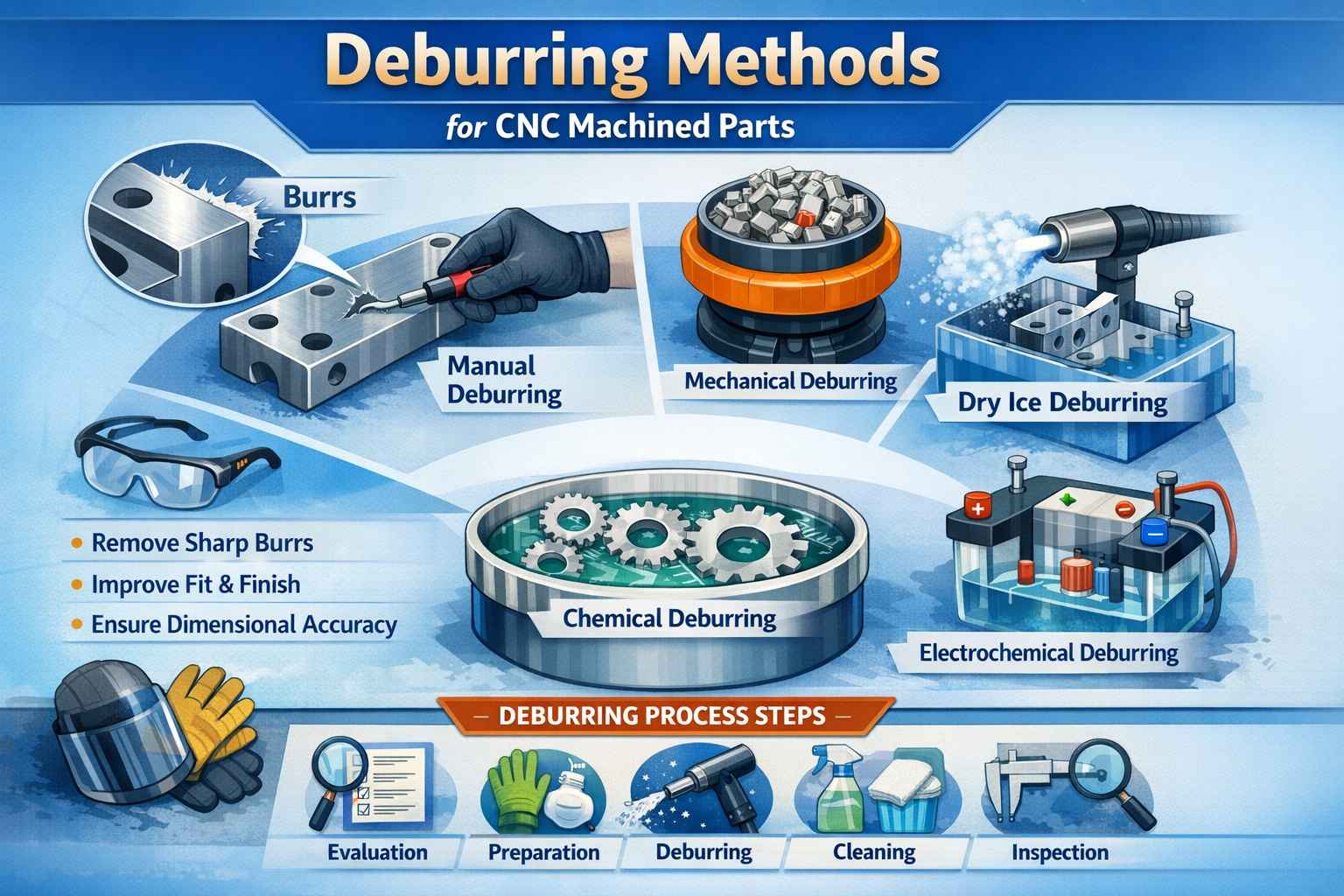
There are many methods for removing burrs, such as manual deburring and mechanical deburring. Each deburring process has its own characteristics and suitable applications. We will analyze each deburring method in detail to help you understand which solution is best suited for your current project.

Manual Deburring
Burrs remaining on metal or plastic parts after machining can be removed manually. Appropriate deburring tools should be selected based on the material. For metal parts, burrs can be manually removed using files or high-hardness scrapers. For plastic parts, sharp blades can be used to trim and clean the burrs.
However, manual deburring is inefficient and is only suitable for prototypes and small-batch production. It is not recommended for high-volume manufacturing. If the part design allows, adding a chamfering operation during the CNC machining process and allowing the CNC machine to remove burrs automatically is the optimal solution.
Mechanical Deburring
Mechanical deburring refers to the use of machines or specialized equipment to remove burrs from part edges and surfaces. Common methods include vibratory finishing and grinding wheel deburring. The principle behind these methods is to use abrasive media to rub against the parts, smoothing and removing edge burrs through friction.
Mechanical deburring offers high efficiency and is well suited for metal parts with simple geometries, large production volumes, and low chamfering requirements. However, it is not ideal for complex structures or precision components. In practical manufacturing, the deburring method should be selected based on the specific part design and application requirements.

Dry Ice Deburring
CO₂ deburring, commonly referred to as liquid or solid carbon dioxide deburring, is a physical deburring method that utilizes low temperature and impact to remove burrs. The basic principle involves spraying pressurized carbon dioxide onto the surface of the workpiece. Once released, the CO₂ rapidly expands and transforms into dry ice particles. Under high-speed impact and instantaneous low-temperature conditions, burrs become brittle and break off, while the base material of the part remains largely unaffected.
Chemical Deburring
Chemical deburring is a deburring method that uses chemical reactions to selectively dissolve burrs. Typically, parts are immersed in a specific chemical solution, allowing burr areas to corrode or dissolve preferentially, thereby achieving burr removal. Because burrs are small in size, have a relatively large surface area, and react faster than the main body of the part, they are more easily removed by the chemical medium under the same conditions. As a result, deburring can be achieved without significantly altering the overall dimensions of the part.
Chemical deburring is well suited for parts with complex geometries, small holes, cross-holes, and precision features. It allows for the simultaneous processing of a large number of parts and provides uniform deburring regardless of part shape. However, this method requires strict process control. The composition of the solution, temperature, and reaction time must be carefully managed to prevent over-etching or loss of dimensional accuracy. In addition, chemical deburring involves the use of chemical agents and waste liquid disposal, which places higher demands on environmental protection and safety management. Proper protective measures and treatment systems are typically required.

Electrochemical Deburring
Electrochemical deburring is a precision deburring method based on the principle of electrochemical anodic dissolution. In a specific electrolyte, the workpiece is used as the anode while a specially designed tool serves as the cathode. A direct current is applied between the two. Because burrs are sharp, have a small radius of curvature, and experience higher current density, they undergo preferential electrochemical dissolution once power is applied, allowing them to be removed rapidly while the main body of the part is minimally affected.
Electrochemical deburring is especially suitable for cross-holes, small-diameter holes, internal cavities, and hard-to-reach areas in metal parts. It offers high deburring efficiency, excellent process controllability, and no mechanical stress on the workpiece. As a result, it is widely used in aerospace, automotive, and precision machinery industries. However, this process involves relatively high equipment and tooling costs and requires strict control over electrode design, electrolyte composition, and process parameters. In addition, thorough cleaning and corrosion protection are usually required after deburring to prevent residual electrolyte from affecting the part.
How to Deburr Different Materials?
Different materials produce burrs with varying shapes, hardness, and adhesion characteristics after machining. Therefore, deburring methods should be selected based on material properties to ensure high efficiency while avoiding damage to the base material. Common deburring approaches for different materials are outlined below.
How to Deburr Metal Parts?
Steel:Due to its high hardness and strong burr adhesion, manual deburring of steel parts is time-consuming. Mechanical deburring methods such as vibratory finishing, belt sanding, grinding wheels, and tumbling are commonly used. For parts with high surface quality requirements or complex geometries, electrochemical deburring can be an effective solution.
Aluminum:Compared with steel, aluminum alloys have lower hardness and burrs are easier to remove. For parts with high surface finish requirements, adding a chamfering operation during CNC machining is an efficient and effective option. CNC chamfering provides consistent results with high productivity.If a textured or matte surface is desired, burrs can also be removed during the sandblasting process. Alternatively, magnetic polishing can be used, which not only achieves a sandblasted-like surface finish but also effectively removes burrs.
Copper:Copper burrs are relatively soft compared to steel. Manual deburring or chemical deburring methods can be used, but care must be taken to control the applied force to prevent deformation of the part.
How to Deburr Plastic Parts?
Burrs generated during plastic machining are typically soft. Manual deburring using sharp blades or trimming knives is commonly applied and is suitable for prototype parts or small-batch production.
For plastic parts with good structural strength and uniform wall thickness, CO₂ deburring (dry ice deburring) can also be used. Under low-temperature impact, burrs become brittle and break off without damaging the base material.
Basic Deburring Process Steps
The basic deburring process generally follows the principle of evaluation first, processing second, and inspection last. Whether manual, mechanical, or automated methods are used, the overall workflow is largely consistent and typically includes the following steps:
1. Burr Evaluation and Process Selection:Before deburring, the part should be inspected to identify the location, size, and type of burrs. Based on the material, structural complexity, tolerance requirements, and production volume, an appropriate deburring method and tools should be selected. Deburring standards, such as allowable chamfer size or edge condition, should also be clearly defined.
2. Preparation and Protection:Clean the part to remove chips, oil, and contaminants. Surfaces that must not be processed or that require protection should be masked or shielded to prevent damage or over-processing during deburring.
3. Deburring Operation: Perform deburring according to the selected process, such as manual scraping, mechanical brushing, CNC chamfering, or electrochemical deburring. During operation, parameters such as force, time, and process settings must be carefully controlled to ensure burr removal without affecting part dimensions, geometric tolerances, or surface quality.
4. Cleaning: After deburring, clean the part to remove residual debris, abrasives, or chemical residues. If necessary, apply light chamfering, polishing, or anti-corrosion treatment to further improve edge quality.
5. Inspection and Verification: Conduct visual and dimensional inspections of the deburred part, with particular attention to edges, hole entrances, and functional areas. Confirm that burrs have been completely removed and that the part meets drawing and specification requirements. If any issues are found, rework or process adjustments should be carried out promptly.
Safety
Safety is a critical consideration in deburring operations. Since deburring often involves sharp edges, high-speed rotating tools, and chemical agents, inadequate protection can easily lead to personal injury or equipment accidents. Common safety considerations include ensuring that operators wear appropriate personal protective equipment (PPE), such as cut-resistant gloves and safety goggles, to prevent injuries from burrs or flying debris. When using grinding wheels, brushing tools, electric, or pneumatic equipment, the equipment must be kept in good condition to prevent workpieces from being ejected or tools from losing control.
For chemical or electrochemical deburring processes, strict adherence to process specifications is required, along with proper ventilation and protective measures against corrosion, high temperatures, and explosion risks. In addition, residual chips and debris should be promptly cleaned up after deburring to maintain a tidy work environment and reduce the risk of secondary injuries. Standardized operating procedures and strong safety awareness are essential to ensuring smooth and safe deburring operations.
Conclusion
Deburring is a critical step in improving part quality in CNC machining. By selecting the appropriate deburring process, assembly performance and operational reliability can be enhanced, while overall product quality and consistency are significantly improved.
With extensive CNC machining experience, Horizon provides customers with one-stop solutions ranging from machining to surface finishing, helping you efficiently achieve high-quality custom part manufacturing.
Latest Post
Liquid Silicone Rubber Molding: Process, Benefits, Applications, and Design Considerations
What is a 5-axis machine? The differences from 3-axis machines and their applications.
What Is a Tack Weld? Definition, Purpose, and Applications
How to Remove Burrs from CNC Machined Parts: Common Deburring Methods Explained