
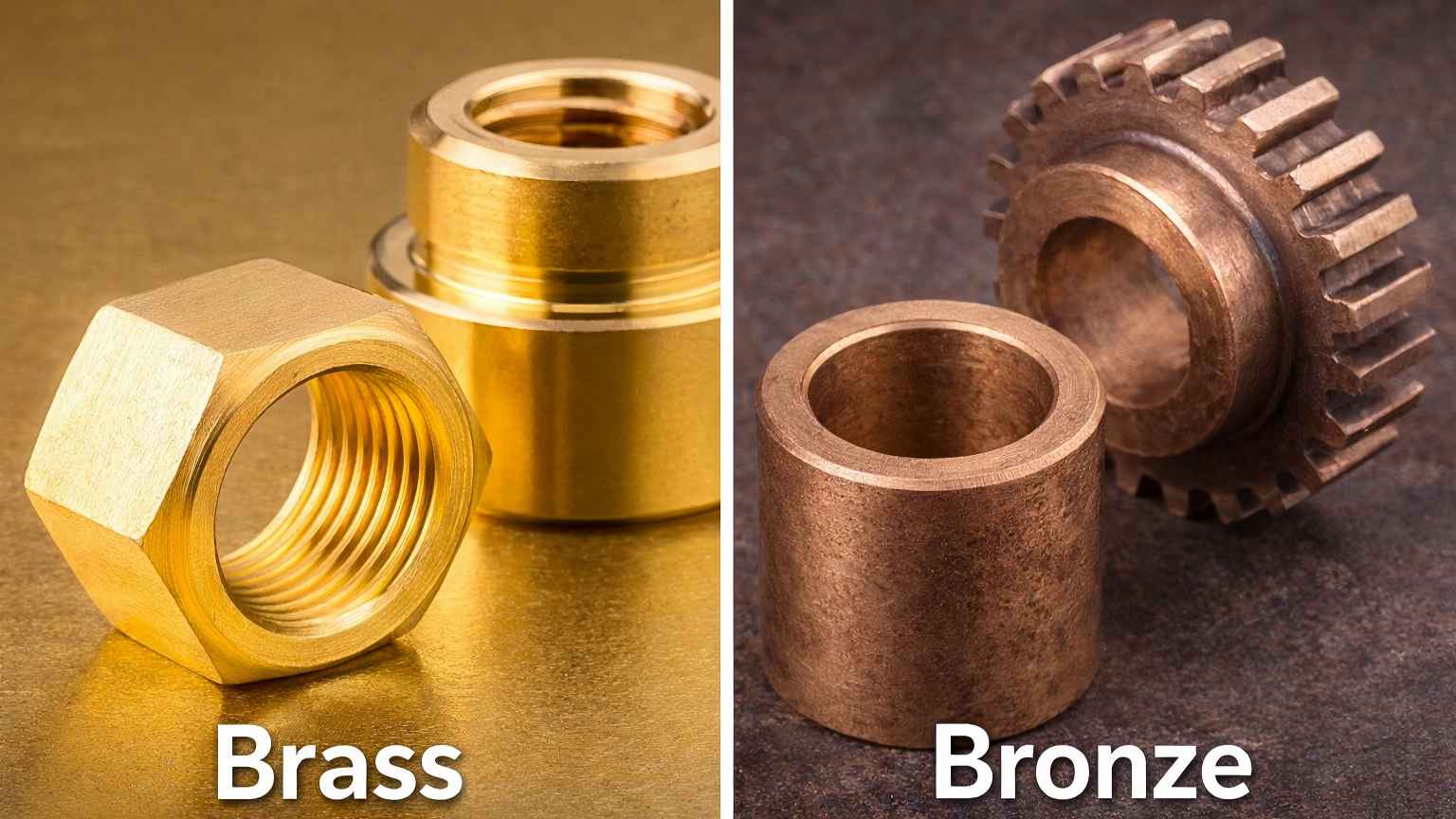
In industrial manufacturing and mechanical parts machining, the differences between brass and bronze are a key consideration during material selection. As two commonly used copper alloys, both brass and bronze are widely applied across various industries. Due to differences in their alloy compositions, they exhibit significant variations in mechanical properties, wear resistance, corrosion resistance, and machinability.
So which is the better choice—brass or bronze? Under different conditions, material selection not only affects the service life of a part but also has a direct impact on manufacturing costs and operational stability. This article provides a detailed analysis from the perspectives of performance comparison, application scenarios, and material selection recommendations, helping you quickly determine which copper alloy is best suited for your specific part requirements.

What Is Brass?
Brass is a copper-based alloy formed by adding zinc, and it is widely used in industrial manufacturing. Thanks to the flexibility of its alloy system, brass can be tailored to exhibit a wide range of strength, formability, and environmental adaptability, allowing it to meet the requirements of different applications.
In some cases, small amounts of other alloying elements—such as silicon, tin, or lead—are added to improve machinability or enhance the material’s stability in specific operating environments.
Compared with bronze,What are the key brass material properties?
Brass is a common copper–zinc alloy known for its well-balanced overall performance. Its main characteristics can be summarized as follows:
Excellent Machinability
Brass offers good plasticity and cutting performance, making it easy to machine through turning, milling, stamping, and forging. It is particularly well suited for parts that require high machining efficiency and tight dimensional accuracy.
Balanced Strength and Ductility
By adjusting the copper-to-zinc ratio, brass can achieve an effective balance between strength and ductility. It can meet the load-bearing requirements of general structural components while remaining resistant to brittle fracture.
Good Corrosion Resistance
Brass exhibits good corrosion resistance in air, water, and many mildly corrosive media, performing significantly better than ordinary steel. This makes it suitable for humid environments and general industrial applications.
Good Thermal and Electrical Conductivity
With its relatively high copper content, brass provides adequate thermal and electrical conductivity. It is commonly used in electrical connectors, heat-dissipating components, and other applications that require efficient heat transfer or electrical conduction.
Attractive Appearance and Decorative Appeal
Brass has a natural golden-yellow luster, giving it strong aesthetic appeal. This makes it advantageous for hardware fittings, decorative components, and architectural applications.
Common Applications of Brass
Thanks to its excellent strength, corrosion resistance, and electrical conductivity, brass is widely used in:
- Precision CNC-machined parts
- Valves, fittings, and connectors
- Electrical and electronic components
- Decorative and architectural hardware

What Is Bronze?
Bronze is not a single material but a broad category of copper alloys formed by adding elements such as tin, aluminum, silicon, or phosphorus to copper. Compared with brass, bronze is more commonly used in applications that require higher strength, better wear resistance, and greater durability.
Compared with brass,What are the key bronze material properties?
Thanks to its unique alloy composition, bronze demonstrates excellent overall performance in a wide range of demanding environments. This is mainly reflected in the following aspects:
Higher Mechanical Strength
Bronze generally offers higher mechanical strength and load-bearing capacity than brass, allowing it to maintain structural stability under heavy loads or impact conditions. This makes bronze well suited for load-bearing components, structural parts, and applications subjected to long-term mechanical stress, such as bushings, gears, and support components.
Excellent Wear Resistance
Bronze performs exceptionally well under friction and wear conditions, particularly in sliding contact or repetitive motion applications. It effectively reduces wear and extends service life, which is why bronze is commonly used for bearings, bushings, and sliding components—especially in low-speed, high-load, or poorly lubricated environments.
Outstanding Corrosion Resistance for Harsh Environments
Bronze exhibits excellent resistance to corrosion from seawater, humid environments, and various chemical media. It resists rust and performance degradation over long-term use, making it ideal for marine engineering, chemical equipment, pump and valve systems, and outdoor or high-humidity applications.
Relatively Higher Machining Difficulty
Compared with brass, bronze typically has higher hardness and toughness, which leads to increased tool wear during machining. As a result, bronze is more challenging and costly to machine, often requiring higher-performance cutting tools, optimized machining parameters, and stricter process control. However, its superior in-service performance often justifies the higher manufacturing cost.
Common Applications of Bronze
In long-term operation, high-load, or high-friction conditions, bronze is generally more reliable than brass. It is commonly used in:
- Bearings and bushings
- Gears and transmission components
- Marine and offshore equipment parts
- Heavy-duty industrial machinery components
Brass vs Bronze: Performance Comparison
Brass and bronze differ in several key performance aspects, as shown below:
|
Comparison Item |
Brass |
Bronze |
|---|---|---|
|
Main Composition |
Copper + Zinc |
Copper + Tin +Aluminum +Silicon |
|
Strength |
Medium |
High |
|
Wear Resistance |
Average |
Excellent |
|
Corrosion Resistance |
Medium |
Excellent |
|
CNC Machinability |
Excellent |
Moderate |
|
Appearance |
Golden yellow |
Reddish-brown |
|
Cost |
Lower |
Higher |
For most applications, this table allows you to make a preliminary material selection decision quickly.
Which Material Is Better Suited for Your Project?
When choosing between these two materials, the following factors should be considered:
When to Choose Brass?
Brass is usually the better choice under the following conditions:
- High-precision CNC machining is required
- High production efficiency and cost control are important
- Good surface quality and appearance are needed
- The part is subject to low to moderate mechanical loads
Typical applications include electronic connectors, pipe fittings, housings, and general mechanical components.
When to Choose Bronze?
Bronze is often more suitable if your part has the following characteristics:
- Long-term exposure to friction or wear
- High requirements for strength and durability
- Operation in humid, highly corrosive, or outdoor environments
- Service life is prioritized over machining efficiency
Common applications include bearings, gears, marine components, and heavy-duty equipment parts.
Differences in CNC Machining: Brass vs Bronze
From a manufacturing perspective, brass and bronze show clear differences in CNC machining performance.
CNC Brass
- Smooth cutting with stable machining processes
- Minimal tool wear
- Easy to achieve high-quality surface finishes
- High machining efficiency, well suited for mass production
Brass is considered one of the easiest metals to machine using CNC processes.
CNC Bronze
-
Higher cutting resistance
-
Greater demands on tooling and process control
-
Relatively slower machining speeds
-
More focused on functionality than appearance
Although more difficult to machine, bronze offers clear performance advantages in high-demand applications.
Cost Considerations: More Than Just Material Price
When selecting a material, it’s important not to focus solely on raw material cost but to make a well-informed choice based on actual operating conditions.
In general:
Brass offers lower material and machining costs
Bronze has a higher initial cost but provides better durability
In high-wear or highly corrosive environments, the longer service life of bronze can result in a lower overall cost of ownership.
What Surface Treatments Are Suitable for Brass and Bronze?
In high-wear or highly corrosive environments, the longer service life of bronze can result in a lower overall cost of ownership.
Surface Treatments Suitable for Brass
Brass offers excellent machinability and an attractive appearance. Many surface treatment options not only enhance protective performance but also improve decorative appeal.
Electroplating:Brass can be electroplated with nickel, chromium, tin, or gold, significantly improving corrosion resistance and wear resistance while achieving a bright, uniform surface finish. Among these, tin and gold plating are widely used for electronic and electrical connectors due to their excellent conductivity and oxidation resistance. These treatments are commonly applied to electronic components, decorative parts, and exposed hardware, balancing functionality and aesthetics.
Polishing:Polishing brass can achieve a high-gloss (mirror-like) surface finish, greatly enhancing its decorative quality. It is often combined with electroplating to further improve appearance and durability, making it ideal for parts with high aesthetic requirements.
Coating / Spray Finishing:Spray coating effectively prevents oxidation and discoloration while preserving the natural golden-yellow appearance of brass. It enhances surface protection without compromising visual appeal and is commonly used for decorative components and architectural hardware.
Passivation:Passivation treatment can slow down surface oxidation and improve corrosion resistance stability. With its low cost and simple process, it is suitable for applications that require basic protection while emphasizing cost efficiency.
Surface Treatments Suitable for Bronze
In bronze applications, greater emphasis is placed on functionality and durability, and surface finishing is mainly intended to enhance performance and extend service life, rather than to improve appearance.
Chemical Passivation:This treatment significantly improves corrosion resistance and enhances surface stability. It is commonly used for industrial and mechanical components that require high reliability.
Common Industry Applications
In practical applications, different industries place varying emphasis on material performance. As a result, the choice between brass and bronze should be based on a comprehensive evaluation of the operating environment, load conditions, machining requirements, and cost considerations. By clearly defining the functional role of the component and its service conditions, it becomes easier to identify the most suitable material solution and achieve an optimal balance between performance, service life, and cost.
-
Electronics and Electrical Industry: Brass is commonly selected due to its good electrical conductivity, excellent machinability, and suitability for electroplating. It is widely used for connectors and contact components.
-
Mechanical Transmission and Bearing Systems: Bronze is generally preferred, as its superior wear resistance and load-bearing capacity meet the demands of long-term operation and high-load conditions.
-
Automotive Components: Material selection depends on the specific function. Brass may be used for precision-machined or decorative parts, while bronze is chosen for high-strength or wear-resistant components.
-
Marine and Outdoor Equipment: Bronze is typically the first choice to withstand humid and highly corrosive environments, ensuring longer service life and higher reliability.
FAQ
Is bronze harder than brass?
Yes. Bronze is generally harder than brass, especially in terms of wear resistance and load-bearing capacity.
Which material is more suitable for outdoor use?
Bronze is usually more suitable for outdoor applications due to its superior corrosion resistance.
Is bronze always more expensive than brass?
Yes. In most cases, bronze is typically more expensive than brass.
How should high-precision brass parts be packaged?
High-precision brass parts are usually vacuum-packed to prevent surface oxidation during transportation. The parts are then protected with high-density pearl cotton (EPE foam) to ensure they are delivered to the customer in perfect condition, free from damage.
Conclusion: How to Make the Right Material Choice
There is no absolute “better” option between brass and bronze—only the material that is better suited to your specific application.
Focus on machining efficiency and cost control → Choose brass
Prioritize wear resistance and long-term reliability → Choose bronze
If you’re unsure, it’s recommended to consult with an experienced manufacturing partner like HorizonRP during the design stage to receive more practical material selection advice.
Choosing the right material early in the project, combined with HorizonRP’s expertise in CNC machining and material applications, can help improve part performance, reduce overall costs, and create long-term value throughout the entire product lifecycle.
Latest Post
Liquid Silicone Rubber Molding: Process, Benefits, Applications, and Design Considerations
What is a 5-axis machine? The differences from 3-axis machines and their applications.
What Is a Tack Weld? Definition, Purpose, and Applications
How to Remove Burrs from CNC Machined Parts: Common Deburring Methods Explained